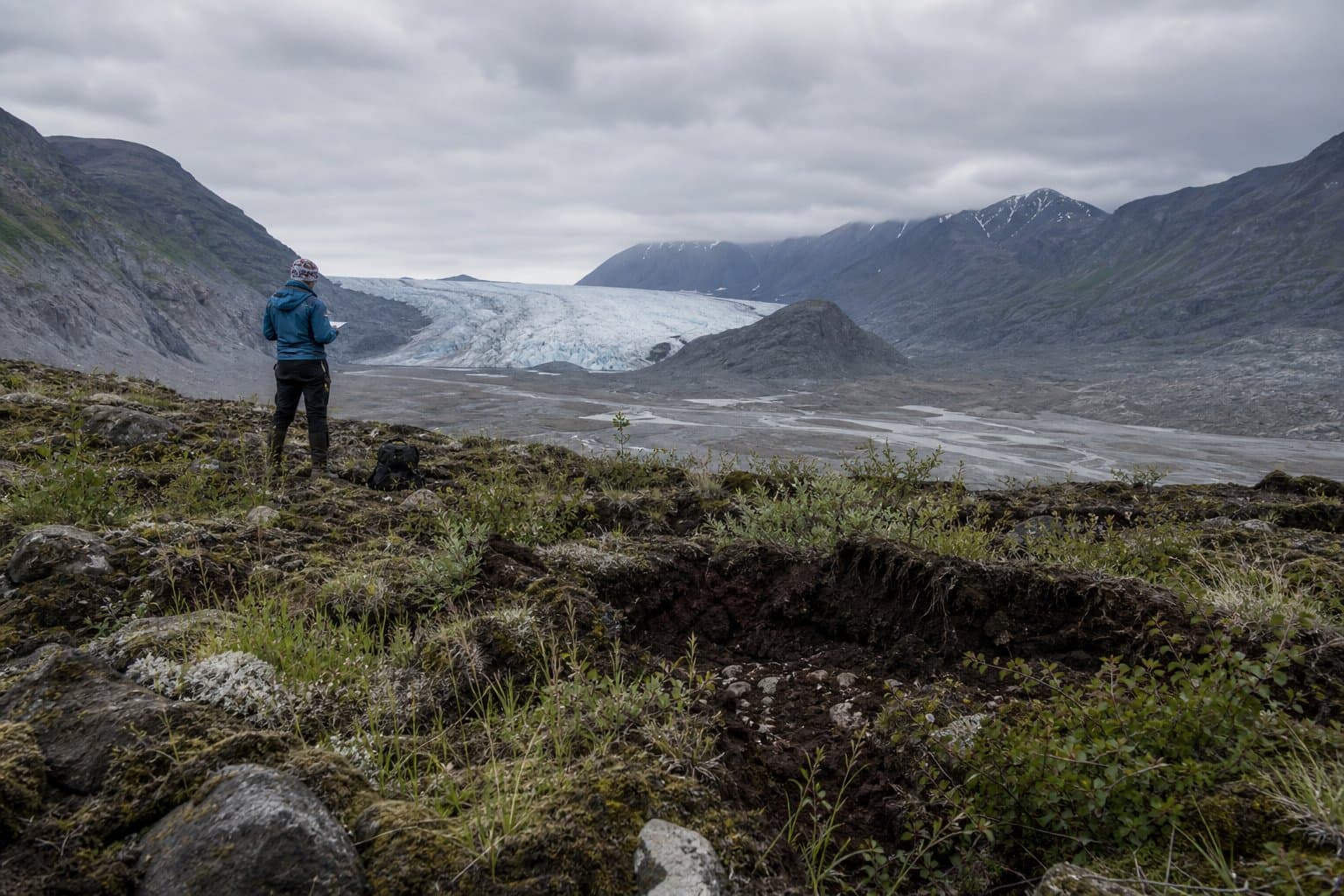
NSF awards UAF $94,000 to study peatlands forming on newly ice-free ground
New peatlands forming on ground newly exposed by Alaska's retreating glaciers will be mapped and studied under a $94,000 National Science Foundation award to the University of Alaska Fairbanks, recorded Aug. 3. Alaska's peatlands store carbon and remain vulnerable as permafrost thaws beneath them; the project will assess how these new peat deposits form and persist while producing planning tools for land managers and communities facing landscape change.
The grant funds UAF's share of InsPIRE (Investigating Peatland Initiation in Retreating Glacier Environments), which will run from Aug. 15, 2026, through July 31, 2029. Principal investigator Louise M. Farquharson, a research assistant professor at the UAF Geophysical Institute, will examine how permafrost aggradation, the refreezing of ground, stabilizes and preserves newly formed peat.
The work combines two lines of evidence. High-resolution remote sensing data from the Arctic Digital Elevation Model will be used to update paleo-glacier extents from the Last Glacial Maximum and the Little Ice Age and to build a statewide chronosequence of peat initiation; laboratory analyses of peat cores will reconstruct how the deposits developed. Those observations will then be integrated with the Open Global Glacier Model and the process-based DigiBog model to simulate how Alaskan peatlands respond to environmental change.
Jenna Sutherland, a senior lecturer in physical geography and environmental science at Leeds Beckett University, leads the broader three-year, £900,000 InsPIRE collaboration with Royal Holloway, the University of Leeds, UAF and the U.S. Geological Survey, funded jointly by NERC and NSF. Alaska was chosen, Sutherland wrote, because "that is the world region where glacier recession is largest and occurring the fastest." Deliverables include statewide peatland inventories, a briefing report and interactive maps for planners, along with co-produced vulnerability maps and outreach through stakeholder workshops and 3D visualizations.
AI-assisted, reviewed by editors. Spot an error?
Related Coverage
NSF awards UAF $877,501 for mass spectrometer to support fisheries and minerals research
Alaska News · 2w ago · 82% match
UAF scientist gets $300K to unlock permafrost's carbon time bomb
Alaska News · 2mo ago · 82% match
NSF awards UAF $1.77 million to build AI geohazard forecasting tools
Alaska News · 3w ago · 82% match
A $1.6 million grant to help Alaska burn on purpose, before wildfire does
Alaska News · 3d ago · 78% match
UAF scientist leads $36K Antarctic sea ice study amid record lows
Alaska News · 2mo ago · 77% match
Comments
Sign in to leave a comment.
No comments yet. Be the first to share your thoughts.