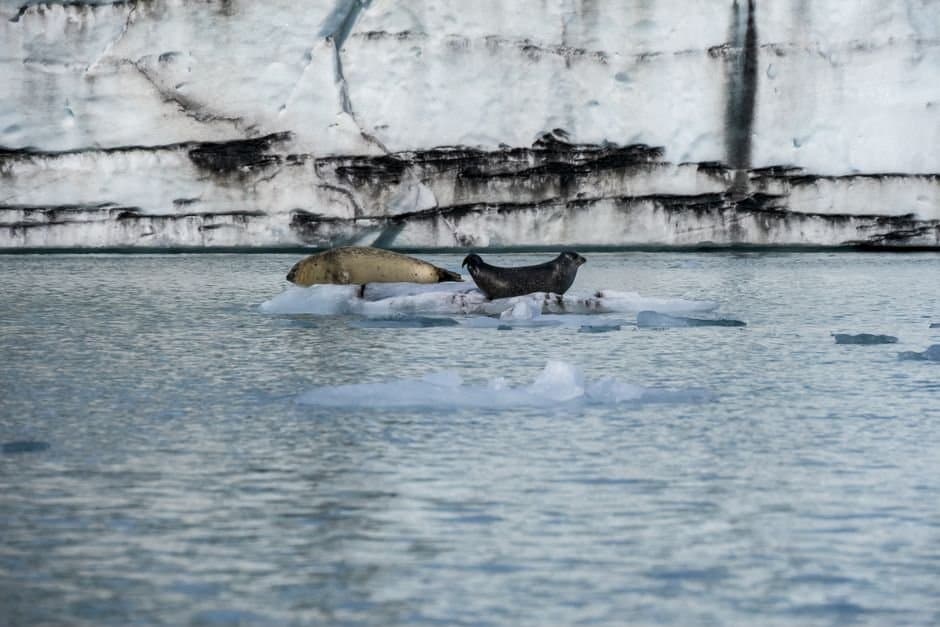
Photo by Rino Adamo on Pexels · Source
NSF awards $812,016 to study shrinking seal ice habitat at Johns Hopkins Glacier
The iceberg habitat that up to 2,000 harbor seals use for pupping and molting in Glacier Bay's Johns Hopkins Inlet will be the subject of three years of federally funded fieldwork under two National Science Foundation grants totaling $812,016, awarded Thursday.
The agency awarded $512,016 to the University of Alaska Southeast Juneau Campus, with Nicole L. Abib as principal investigator, and $300,000 to the University of Alaska Fairbanks, with Kristin M. Timm as principal investigator, for the same collaborative project. Both grants are standard grants issued through the Arctic System Science program in NSF's Directorate for Geosciences, with Colleen Strawhacker as program officer, and both run from Sept. 1, 2026, through Aug. 31, 2029.
The research is framed around a mechanism rather than a species count: tidewater glaciers calve icebergs, and the icebergs are the platforms seals need. Prior work published in the Annals of Glaciology found that Johns Hopkins Glacier slowed roughly 45 percent between 2013 and 2021 as a submarine end moraine grew and first surfaced at low tide in July 2019, reducing calving and the fraction of ice in the fjord. The same study measured about 230 meters of advance and 30 meters of thickening from 2007 to 2021. Seals require icebergs of at least 1.6 square meters.
Jason M. Amundson, a co-principal investigator at UAS, co-wrote that 2023 study, as did Jamie N. Womble, a National Park Service scientist whose earlier work documented harbor seal declines in Glacier Bay from 1992 through 2008. Aerial surveys of Johns Hopkins Inlet have run annually since 2007.
Parts of the inlet are already closed to protect the seals. Under 36 CFR 13.1178, cruise ships may not operate south of a line running west from Jaw Point from May 1 through Aug. 31. All vessels and seaplanes are barred from those waters May 1 through June 30, and from July through August must stay a quarter nautical mile from any seal hauled out on ice.
The abstracts say findings will support science communication for park managers, educators, and the roughly one million annual visitors to Glacier Bay National Park and Preserve.
AI-assisted, reviewed by editors. Spot an error?
Stay informed. Support what matters.
Free, permanent access to local news you can verify. Subscribe to support Melinda Communities.News and go ad-free.
Related Coverage
NOAA pays $1.57 million for samples from subsistence-harvested seals
Alaska News · 5d ago · 79% match
UAF scientist leads $36K Antarctic sea ice study amid record lows
Alaska News · 3mo ago · 78% match
As Alaska's glaciers retreat, new carbon-storing bogs are forming behind them
Alaska News · 3w ago · 78% match
A federal minerals program is funding science on the seafloor mining wants to dig
Alaska News · 1mo ago · 77% match
NSF awards UAF $877,501 for mass spectrometer to support fisheries and minerals research
Alaska News · 1mo ago · 77% match
Comments
Sign in to leave a comment.
No comments yet. Be the first to share your thoughts.