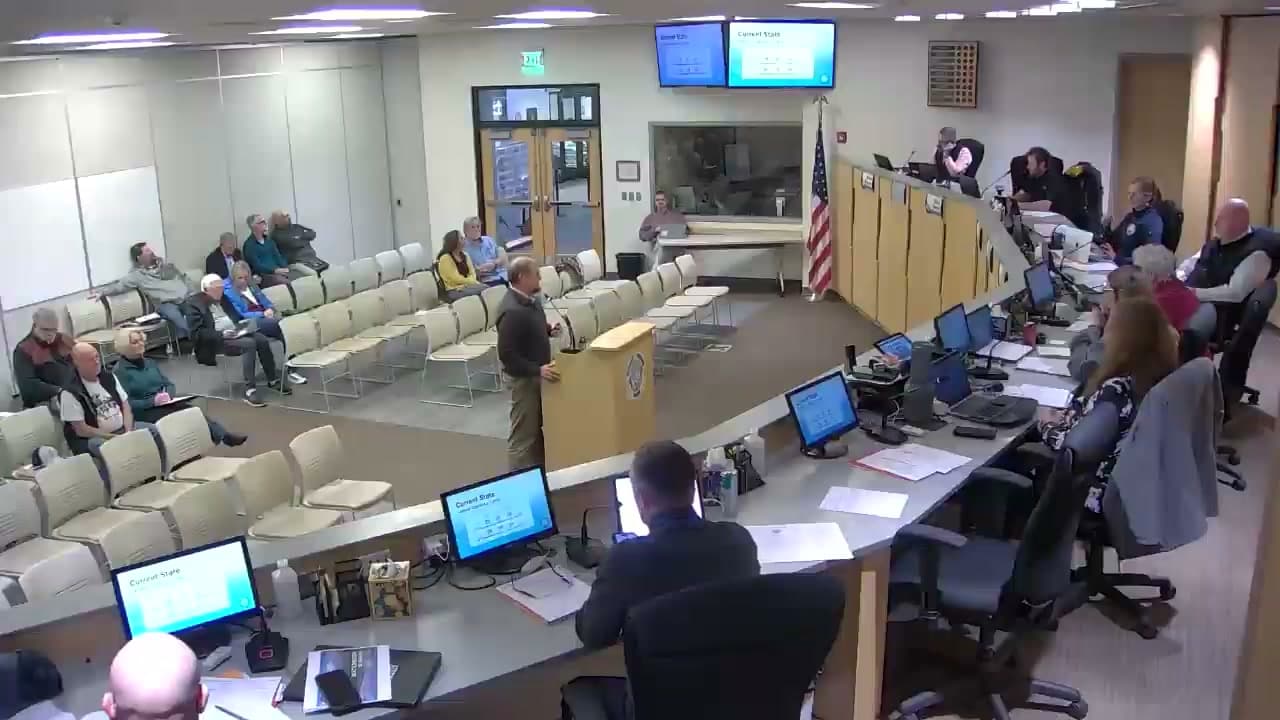
Frame from "Mat-Su Borough: Assembly Special Meeting - October 20, 2026" · Photo source
Mat-Su counts at least 763 buildings likely too close to lakes as Assembly weighs a fix
The Matanuska-Susitna Borough has at least 763 buildings likely standing illegally close to its lakes, Planning Director Alex Strawn told the Assembly on Tuesday, as members took up a one-page proposal that would give their owners a year to apply for legal status.
Assembly member Bill Gamble brought the proposal to a special meeting on lake and river setbacks, called for discussion only. It would grant legal nonconforming status to existing structures within 75 feet of a water body whose owners apply within a year of a code change. Gamble said a few constituents, whom he described as friends, wrote it after he asked for ideas. The page was not attached to the agenda, and Strawn said he received it that day.
"The borough's been dealing with this issue for over 50 years now, and it keeps getting kicked down the road, and we can't do it anymore," Gamble said. He called the recommendations of an earlier citizen advisory board, which the Assembly did not adopt, "too onerous and too costly for people to comply with."
The borough adopted water body setbacks in 1973, Strawn said. The Assembly cut the setback to 45 feet in 1986, and voters restored 75 feet six months later. Whether a building is grandfathered, legal or illegal now depends on how close it is and when it went up.
The 763 count covers buildings larger than 480 square feet, within 75 feet of a lake and built after 1987. It leaves out rivers and streams, and the mapping data behind it doesn't cover the whole borough. The real number of violations "is probably at least double this amount," Strawn said.
An attorney advising the Assembly said he had not fully reviewed the page but that it "looks like it would be achievable." As he read it, the 75-foot rule would stay in force, and owners who did not register an existing building within the year would be subject to it no matter when they built.
Assembly member Stephanie Nowers said she liked "a lot in here," but did not want to "spit in the eye of people who have legally complied." She said the plan needs a way to warn buyers and builders before they buy or build, and water-quality testing, especially on Big Lake, which she called important salmon habitat. "The goal is to keep the water clean," she said.
Assembly member Maxwell Sumner said the setback is also about views and fairness between neighbors. He said the borough requires no land use permit to build near a lake, so enforcement would lack "any teeth" without one.
The page would also bar pavement within 25 feet of the water. Members asked whether that would outlaw paved boat ramps. Sumner said he had helped install ramps permitted by the Army Corps of Engineers and state agencies with pavement down to the lake, and Strawn recommended allowing some pavement for ramps. Gamble said he read the provision as aimed at asphalt runoff. He said he was "willing to bend a little" for existing buildings that could meet new rules, with strict code enforcement from then on.
Two people testified on setbacks. Rod Hanson of the North Lakes Community Council urged a new six-month task force that would leave the code-writing to borough planners. Patty Fisher of Meadow Lakes said owners in violation need a way to correct it but doubted another task force would help. "I have been involved in two task forces, and they've basically gone nowhere," she said.
The meeting transcript is available.
This article is based on a public meeting of Matanuska-Susitna Borough — Mat-Su Borough: Assembly Special Meeting - October 20, 2026.
Made by our human newsroom with AI. Reviewed by Cale Green. How humans and AI work here · Grow with our newsroom Transcript byWalter AlaskaNews
Watch key moments from the source meeting. Click to expand.
Stay informed. Support what matters.
Free, permanent access to local news you can verify. Subscribe to support Walter AlaskaNews and go ad-free.
Related Coverage
Mat-Su Assembly to revisit lake and river setback rules in a special meeting
Alaska News · 1w ago
Anchorage planners ask commission to triple setback threshold director can approve alone
Alaska News · 1mo ago
Anchorage planners count 21 stalled projects as Assembly weighs housing overlay
Alaska News · 3mo ago
Anchorage weighs a variance for a 1998 setback encroachment
Alaska News · 1mo ago
Anchorage moves to clarify its wetlands permitting, though some say it doesn't go far enough
Alaska News · 1mo ago
Comments
Sign in to leave a comment.
No comments yet. Be the first to share your thoughts.