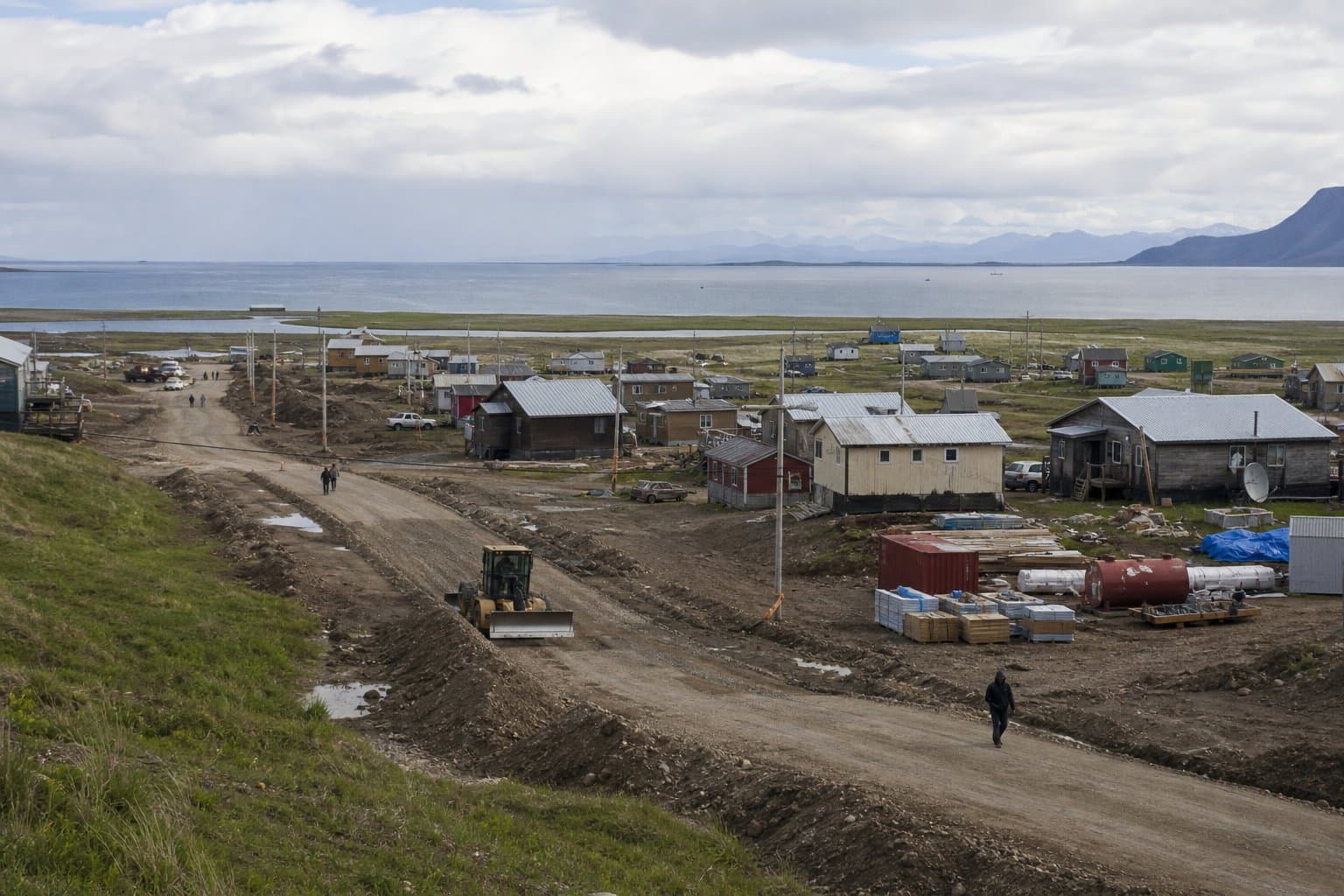
AI image
Nearly four years on, Alaska has been paid 15 percent of Merbok's $90.9 million
Nearly four years after Typhoon Merbok tore through western Alaska, only about 15% of the FEMA money for the rebuild has actually been paid out — $13.6 million of the $90.9 million obligated. That figure tracks how much has moved through the federal system to the state agency that administers the grant and reimburses village, city and school-district applicants; it is not a village-by-village count of who has been paid. And the clock is running out. The window for doing the work ends Sept. 30, 2026, about seven weeks away.
FEMA has said it and the state "approved $108.8 million to help Alaska communities rebuild." But approved is not the same as paid. About 87% of what has been obligated is for permanent repairs to the 2022 storm, though the federal spending record still describes the award as reimbursement for pandemic-era emergency work.
The money is meant for concrete things — $38 million across 29 roads and bridges, $17.9 million in utilities, $11.1 million in parks and $10.1 million in water-control projects, shared among 30 applicants. The City of Hooper Bay holds the largest stake, $22.1 million across 15 projects, followed by Nome at $10.7 million, Teller at $9.7 million, Stebbins at $8.4 million and Elim at $8.1 million. The single biggest project is a $9 million road in Teller. Yet of the grant's 145 projects, just 14 have been closed out — together worth about one-third of one percent of the money.
Federal rules give the state only so long to finish permanent work, and for Merbok that authority runs out in late September. Past it, any extension must come from FEMA's regional administrator — and if one is denied and a project is unfinished, no federal money is provided for it.
The newer disasters are further behind. A declaration for the 2025 storms and the remnants of Typhoon Halong has $5.6 million obligated but just $74,249 paid — 1.3% — and nearly nine-tenths of the obligated total is booked to the state itself, for emergency operations and sheltering, rather than to local projects. Seven local applicants share the rest. The largest is Napakiak's $460,983 for two still-pending debris-removal projects, alongside smaller sums for a generator repair, replacement snow machines for a school district, a glycol line in Bethel, and $3,443 in carpenter's tools for the Native Village of Umkumiut. Ten months in, none of Halong's 13 projects has closed. That declaration also did not activate the program that funds protection against the next disaster — and neither did the two Alaska declarations after it, breaking a run of 14 straight that had.
The state's explanation is that the work itself is slow — large, remote projects take time. Katherine Keith of the Department of Transportation and Public Facilities told a state Senate committee in February that inspectors were rotating through villages out of Bethel, and that contractors have to document everything for FEMA. No applicant community speaks in the record reviewed, which carries only the state's account and the federal numbers.
All told, five Alaska disaster grants are open at once, going back to the 2018 earthquake — $302 million obligated against $68.1 million paid, all ending Sept. 30, with the federal government covering at most 75% of eligible costs.
Source: The $90.9 million Alaska is drawing from FEMA is for Typhoon Merbok, and the storm was four years ago. Fifteen percent of it has actually been paid. The same villages have $5.6 million for Typhoon Halong, and one percent of that has been paid..
AI-assisted. How we use AI
Stay informed. Support what matters.
Free, permanent access to local news you can verify. Subscribe to support Lucas Brown and go ad-free.
Related Coverage
Alaska has spent a fifth of its open federal disaster money, with six weeks on the clock
Alaska News · 1mo ago
Four years after Merbok, Alaska is hiring a contractor to start rebuilding homes
Alaska News · 4d ago
Alaska declines to move Kuskokwim villages into its larger Merbok tier
Alaska News · 1w ago
None of Ketchikan's $1.65 million in landslide aid has been paid out
Alaska News · 3w ago
Three Merbok-damaged stretches of the Nome-Council Highway are finally getting permanent repairs
Alaska News · 1mo ago
Comments
Sign in to leave a comment.
No comments yet. Be the first to share your thoughts.