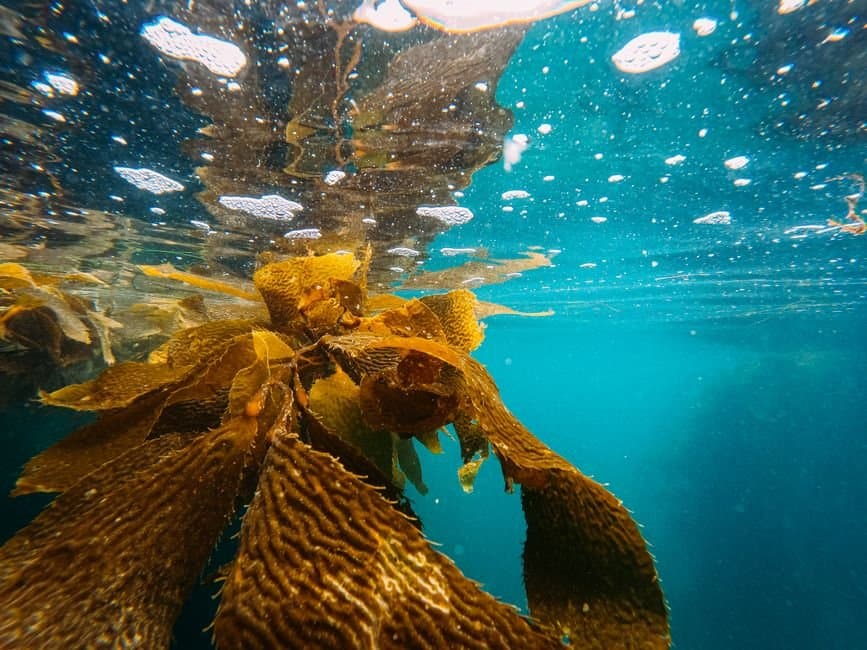
Photo by Kindel Media on Pexels · Source
Juneau kelp farm study suggests minimal influence on fish and invertebrates
A one-year study at two kelp farms near Juneau suggests they had minimal influence on the fish and invertebrates around them, though a missed sampling trip left researchers unable to test whether that effect was statistically significant.
The Alaska Fisheries Science Center's peer-reviewed study, published July 18 in Annals of Botany, compared farm leases about 10 miles west of Juneau with nearby locations without farms. The farms, run by Sea Quester, grow bull, split and sugar kelp on 10- and 25-acre sites.
Divers ran visual surveys, and researchers also collected environmental DNA, the traces animals shed into the water. They measured nutrients, temperature and salinity before the farms were installed, at peak kelp growth and after harvest. The study found minimal influence on the animal communities and water conditions, and no species groupings unique to the farm sites.
"Our findings show that at these sites, kelp farms did not change what species we observed in each location," Jordan Hollarsmith, the science center's aquaculture research lead and the paper's first author, said in a NOAA feature story.
A review of Alaska kelp farming linked to NOAA recommends keeping farms out of known Essential Fish Habitat, which federal law protects. It also documents a possible negative interaction with Pacific herring spawning at a Southeast Alaska farm, and its authors say siting decisions should weigh habitat and commercially important fish.
The findings arrive as NOAA works to identify Aquaculture Opportunity Areas in Alaska, places that could suit seaweed and shellfish farms. Being identified doesn't pre-approve any farm at any location. NOAA received 20 written and spoken comments during a scoping period that closed May 28. A separate atlas identified 77 potential opportunity-area options in the Gulf of Alaska covering more than 13,000 acres. A draft environmental impact statement is expected in spring 2027.
Based on a press release.
Drafted with AI. Edited by Cale Green (1 revision). No full editor review is on record. Who is accountable.
Stay informed. Support what matters.
Free, permanent access to local news you can verify. Subscribe to support Bill AlaskaNews and go ad-free.
Related Coverage
NOAA weighs 77 Gulf of Alaska sites for future kelp and shellfish farms
Alaska News · 9h ago
NOAA scouts new fish-farm zones as Gulf of Alaska planning proceeds
Alaska News · 1mo ago
A NOAA study finds Pacific capelin may spawn more than once
Alaska News · 1mo ago
DNR extends geoduck farm lease near Ketchikan; comment period open
Alaska News · 2mo ago
Hatchery groups cite NOAA Chinook decision as validation
Alaska News · 3mo ago
Comments
Sign in to leave a comment.
No comments yet. Be the first to share your thoughts.