
Photo: Emma Forsberg via Wikimedia Commons · Photo source · CC BY 2.0
Judge dismisses school funding suit from districts with very different local shares
Anchorage Superior Court Judge William A. Taylor on Nov. 10 dismissed a lawsuit in which two school districts argued that Alaska underfunds its public schools.
The districts had tried "to get the court to determine what level of education funding is appropriate," the Alaska Department of Law said after the ruling. Those questions "lie with the legislature and the executive branch, as the court today recognized."
The two districts that sued, Fairbanks North Star Borough and Kuspuk, agreed the state isn't paying enough. But they sit on opposite sides of Alaska's split over who pays for schools.
Who pays to run the schools
In Fairbanks, local taxpayers chip in. Under state law, every borough and city that runs a school district must put in at least the equivalent of a 2.65-mill property tax, or $2.65 for every $1,000 of taxable property, with that requirement capped at 45% of the district's basic need, according to the Alaska Supreme Court.
That is a floor. Local governments can add more, up to the greater of 2 mills or 23% of the district's basic need, according to an Anchorage Assembly briefing. Anchorage set a 6.32-mill school levy for 2026, about $277 million.
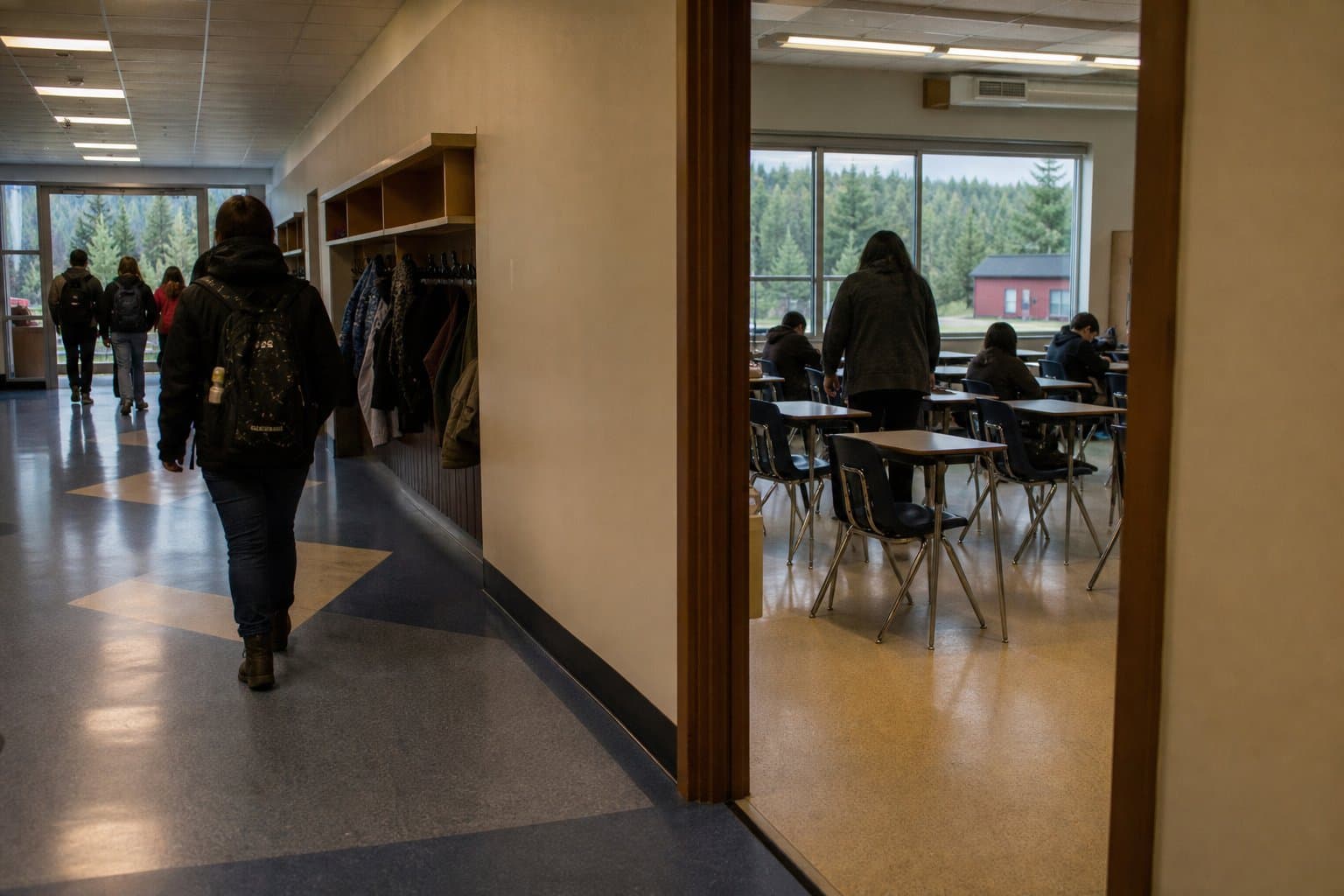
Kuspuk has no such requirement. Its schools serve Aniak, Sleetmute, Stony River and other villages along the Kuskokwim River, across more than 12,000 square miles; its villages are reached only by air and river, according to the district. It is one of 19 regional educational attendance areas, school districts in the part of Alaska with no borough government, known as the unorganized borough.
Attendance areas have no power to tax. Only cities and boroughs can raise local money for schools, so attendance areas pay no required local share, according to the state Department of Education and Early Development.
Statewide, cities and boroughs were projected to put about $351.6 million in required local money toward schools this school year, according to the department's budget summary.
Separately, the state's formula sends more money per student to small, remote schools. It counts a school of 14 students as if it had nearly 40, and multiplies each district's count by a cost factor that, as of 2018, ranged from 1 to about 2.1, according to a department funding overview.
Who pays for buildings
Each year the department ranks districts' requests to build, replace or renovate schools. On the list for this budget year, the second-ranked project is replacing the K-12 school in Deering, a Northwest Arctic Borough village on Kotzebue Sound, at about $59.9 million. As a borough district, it is down to cover 30% of the eligible cost, about $17.8 million.
The third-ranked project is in Kuspuk: replacing the Jack Egnaty Sr. School in Sleetmute, at about $40.2 million. Kuspuk's share is 2%, as is that of the other attendance areas near the top of the list. Anchorage and Kenai Peninsula projects carry 35%.
Over the 16 years the department tracks, state grants for school construction and maintenance averaged about $72 million a year, and payments on cities' and boroughs' school bonds added about $42.5 million a year. Together, that covered "only 30.5 percent of the need," according to the department's annual report to the Legislature. Districts now report $2.5 billion in needs over the next six years.
Earlier court fights
In 1997, rural parents and six attendance areas sued the state over school construction. In 1999, a Superior Court judge ruled that the state's record of funding rural school buildings violated the Alaska Constitution's education and equal protection clauses, as well as the federal Civil Rights Act, according to legislative records. The case, known as Kasayulie, settled in 2011, with neither side admitting wrongdoing. The state agreed to fund five rural schools, including Kivalina's, and the settlement said the state's school construction funding system addresses the constitutional concerns.
Part of that system is a separate fund for building schools in attendance areas and small districts. Lawmakers had put about $486.6 million into it by the end of 2025. Its yearly amount is set by a formula tied to the school bond debt the state helps cities and boroughs repay.
Ketchikan Gateway Borough paid its required contribution under protest and sued, arguing it violated the constitution's ban on dedicated funds. The Alaska Supreme Court sided with the state in 2016.
Two justices wrote separately that the parties never argued whether the required contribution squares with the constitution's public schools clause. One, Justice Daniel Winfree, wrote that he did not rule out that it is unconstitutional.
Federal money
Federal Impact Aid goes to districts that "have lost property tax revenue" because of tax-exempt federal property, or that educate children tied to federal land, including military bases and Indian lands, according to the U.S. Department of Education.
Alaska counts much of that federal money against what it would otherwise pay those districts. The state projected that would come to about $70.8 million this year, according to its budget summary.
The Legislature's Task Force on Education Funding calls Alaska the only state that may do that, and says the issues around Impact Aid, local contribution requirements "and the equity of this approach are complex," in draft recommendations released Nov. 9. It called for more study.
What comes next
The task force's broader recommendations include having the Legislature define an adequate education, studying whether the funding formula reflects current costs, adjusting the base student allocation for inflation, and funding building upkeep separately. It cites a $535 million backlog in school maintenance requests. It held statewide public hearings on the draft Nov. 12, and its final report is due in January. A new governor takes office in December, and a new Legislature convenes in January.
The lawsuit
Fairbanks and Kuspuk sued the state, the education department, Gov. Mike Dunleavy and Education Commissioner Deena Bishop in January, according to Department of Law reports to the State Board of Education. They argued the state had violated the constitution's education and due process clauses by "failing to fund education at a level sufficient to provide each Alaska student with a sound basic education," and asked the court to order a fix, including a court-supervised review of school finance adequacy.
The state argued that how much Alaska spends on schools is a political question that the constitution leaves to the Legislature. The constitution's education clause says the Legislature "shall by general law establish and maintain a system of public schools open to all children of the State."
Neither district nor their lawyers have said whether they will appeal.
What did you make of this story? (no account needed)
Made by our human newsroom with AI. Reviewed by Cale Green. How humans and AI work here · Grow with our newsroom ·
Get Alaska News in your inbox
Create your free account and get the day’s top stories around 6 each morning, in a few minutes’ read.
Top stories, around 6 each morning.
Stories on what you follow, on Sundays.
Source: Anchorage judge dismisses Fairbanks and Kuspuk school districts' lawsuit claiming Alaska underfunds its schools.







Comments
Sign in to leave a comment.
No comments yet. Be the first to share your thoughts.