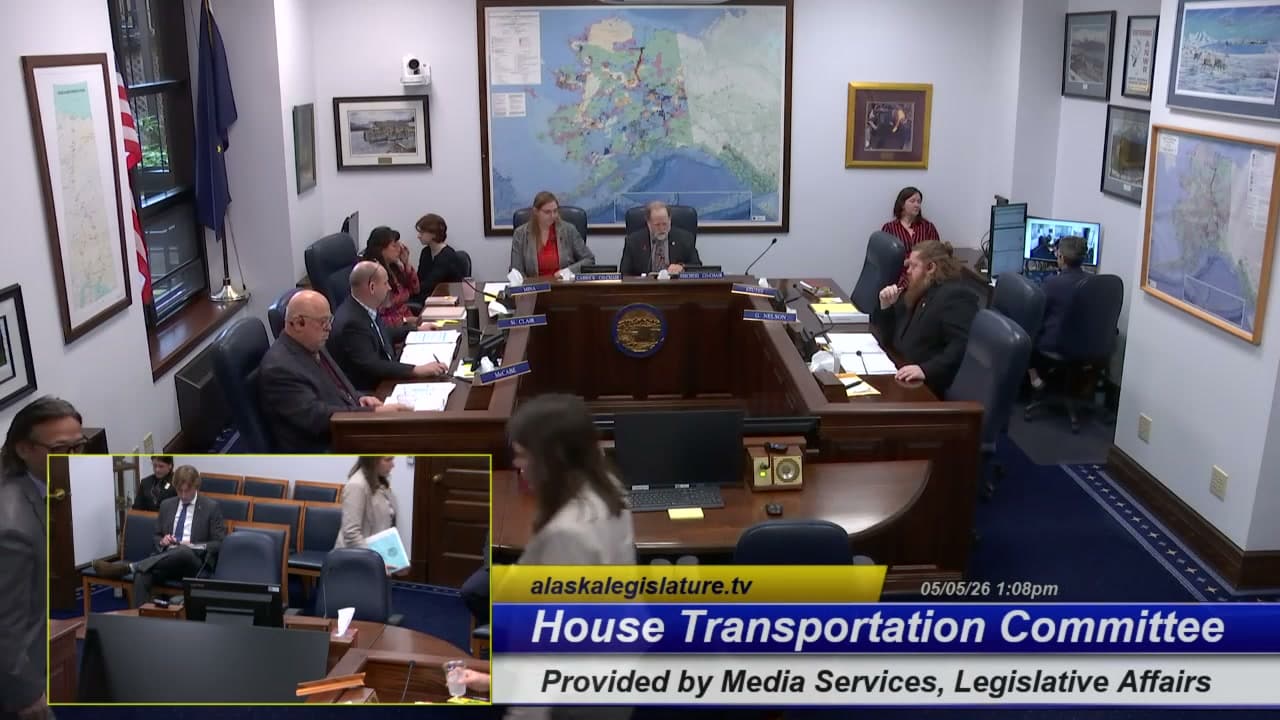
House panel holds wildfire evacuation bill over cost, scope concerns
The House Transportation Committee held legislation Tuesday that would require the state to prioritize maintenance of roads and airports in wildfire-prone areas to ensure evacuation routes remain functional. Lawmakers raised concerns about potentially massive implementation costs and unclear scope.
House Bill 317, sponsored by Representative Ky Holland, would direct the Department of Transportation and Public Facilities to develop a long-term plan for maintaining facilities in areas at risk of wildfire. The committee substitute adopted Tuesday expanded the bill beyond the original wildland urban interface definition to include all areas designated for critical or full wildfire response by the Division of Forestry. It added airports as evacuation facilities alongside roads.
The planning phase alone would cost $73,000 according to DOT's fiscal note. Full implementation could exceed $100 million statewide. Andy Mills, legislative liaison for DOT, told the committee that a recent project on the Old Glen Highway cost $1 million to clear vegetation along just a few miles of road.
Representative Kevin McCabe questioned whether the Department of Natural Resources, rather than DOT, should handle wildfire mitigation work. "I continue to believe that this is a DNR responsibility, not a DOT responsibility," McCabe said. He asked whether federal grants might be available for forest fire mitigation that could help fund the work.
The bill would apply to state-owned facilities, including 237 state-owned airports and approximately 5,600 center lane miles of roads. Mills explained that DOT would overlay its geographic information systems with DNR datasets to identify where roads and airports intersect with wildfire risk areas.
Mills noted that DOT already maintains clear zones around airports under Federal Aviation Administration requirements. The department works with DNR in a support capacity during active wildfire events by managing communications, restricting access, and rerouting traffic. The bill would impose new obligations by requiring DOT to develop a long-term maintenance plan specifically prioritizing wildfire-prone areas and to establish a framework for ongoing vegetation management along evacuation routes, rather than responding only during active fire events.
Holland explained that the bill emerged from difficulties his community group encountered trying to clear vegetation along state roads. "What we ran into was the DOT in their right-of-way requires that if you are going to do work in that area, you have got to get a permit from them. And that permit process takes time and money to do that," Holland said.
The bill would require DOT to consult with tribal entities and other organizations as it develops its prioritization framework. No representatives from these groups testified at Tuesday's hearing. The bill would also direct the department to prioritize facilities that support communities with only one means of egress.
Holland referenced wildfire evacuation failures in other western states. "What we have seen in the rest of the western U.S. is many of these areas that who do not have this work done end up getting into a gridlock during a wildfire because you have got emergency apparatus with big wide rigs trying to come in, trying to set up, and then you have got folks with all their vehicles trying to come out, and at some point a bottleneck happens, a vehicle breaks down, and all of a sudden everyone is stuck, and that is the Paradise Campfire situation," Holland said.
Mills said the committee substitute would likely require a higher fiscal note than the original bill because it expands the areas under consideration and adds language about developing long-term plans to address environmental changes and preserve functionality during natural disasters. The fiscal note covers only the planning phase. The legislature would need to allocate additional funds for DOT to implement the maintenance work in the priority order the department recommends.
"I understand the interest and I think there has been a lot of great ideas generated and I hope that is helpful to the bill sponsor. At this point, this bill will be held," Co-Chair Ted Eischeid said, closing discussion on the measure.
This article is based on a public meeting — HTRA-260505-1300 ().
AI-assisted. How we use AI Transcript byLucas Brown
Stay informed. Support what matters.
Free, permanent access to local news you can verify. Subscribe to support Alaska News and go ad-free.
Related Coverage
Alaska moves to standardize wildfire evacuation alerts statewide
Alaska News · 5mo ago
Senate Resources advances three bills on agriculture, evacuations, invasive species
Alaska News · 5mo ago
Legislature advances $347M fire station grant program
Alaska News · 4mo ago
House panel advances statewide evacuation alert system
Alaska News · 5mo ago
Alaska House debates school transportation funding amid rural-urban divide
Alaska News · 5mo ago
Comments
Sign in to leave a comment.
No comments yet. Be the first to share your thoughts.