Senate Resources advances three bills on agriculture, evacuations, invasive species
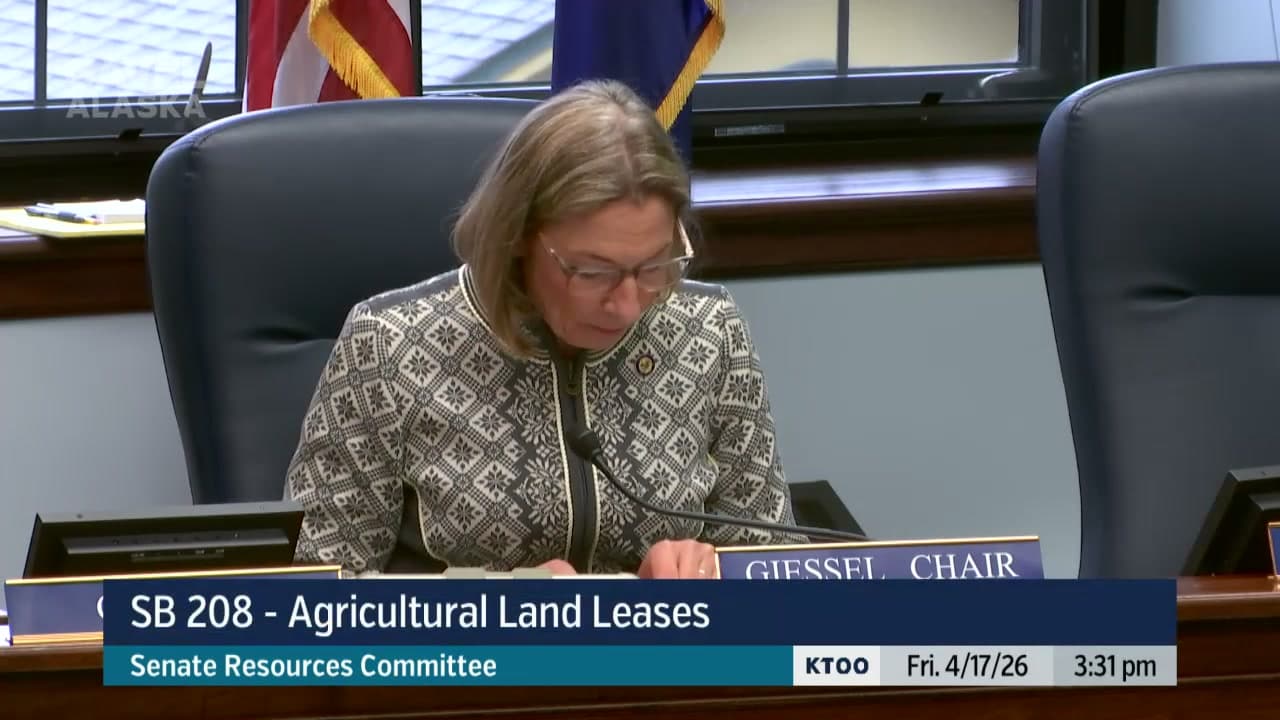
The Senate Resources Committee advanced three bills Friday covering agricultural land development, emergency evacuation protocols, and invasive species management.
Background
The legislation represents part of a broader effort by Alaska lawmakers to address environmental and agricultural challenges facing the state. Alaska has grappled with invasive species management and agricultural development issues for years, with previous legislative sessions considering similar coordination and land-use measures. The current package aims to streamline state responses to these interconnected challenges through improved agency coordination and clearer public safety protocols.
Agricultural land leasing
The committee moved Senate Bill 208, which creates a new state program to lease agricultural land more quickly and at lower cost to farmers. The bill also gives the Department of Natural Resources civil penalty authority for agricultural covenant violations, providing an alternative to immediate foreclosure proceedings.
Laura Asche, staff to Senator Jesse Bjorkman, said the leases would be based on agricultural plans that farmers submit and that would be scored to ensure leases serve the state's interests. The bill also adds an optional merit-based test before the state sells agricultural land.
Evacuation color-coding
The committee also advanced Senate Bill 192, which establishes uniform color-coding for evacuation warnings statewide. The bill designates green as "pay attention," yellow as "be prepared," and red as "go."
Asche said emergency managers requested the legislation to resolve confusion in jurisdictions where red means "stay in place" rather than evacuate. Senator Kawasaki said he initially found the red-means-go convention counterintuitive but accepted the emergency managers' recommendation.
Invasive species council
The third bill, Senate Bill 174, creates an invasive species management council to coordinate federal, state, and non-governmental efforts to control invasive species. Hunter Lotzfeld, staff to Senator Dunbar, said the council would focus on prevention as more cost-effective than later intervention.
Senator Dunbar said Alaska faces significant problems with invasive species including elodea, northern pike, and green crab. He noted the bill emerged from a scientific community meeting at the BP Energy Center where researchers requested better coordination between agencies.
Senator Dunbar cited European bird cherry trees as an example of poor agency coordination. The state Department of Transportation once planted the trees for erosion control, but they became invasive and now form monocultures in parts of Anchorage's Chester Creek Greenbelt. The Anchorage Assembly later banned sale of the species, though removal remains difficult because roots must be extracted, not just cut.
Committee action
All three bills passed without objection. Senate Bill 208 and Senate Bill 192 carry zero fiscal notes. Senate Bill 174 includes a fiscal note and will move to the Finance Committee.
The committee's next meeting is scheduled for Monday at 9 a.m., with hearings on House Bill 117 regarding commercial fishing set gillnet cooperatives and Senate Bill 255 on municipal grant land transfer to the Matanuska-Susitna Borough.
This article is based on a public meeting — Alaska Legislature: Senate Resources, 4/17/26, 5:30pm ().
AI-assisted. How we use AI Transcript byLucas Brown
Stay informed. Support what matters.
Free, permanent access to local news you can verify. Subscribe to support Alaska News and go ad-free.
Related Coverage
House Resources passes agricultural land lease bill unanimously
Alaska News · 4mo ago
House panel advances statewide evacuation alert system
Alaska News · 5mo ago
Alaska moves to standardize wildfire evacuation alerts statewide
Alaska News · 5mo ago
Alaska Senate passes wildfire evacuation color-code system
Alaska News · 5mo ago
Senate Finance Advances Agricultural Leasing Reform After Farmer Cites $9,000 Annual Fee
Alaska News · 5mo ago
Comments
Sign in to leave a comment.
No comments yet. Be the first to share your thoughts.