House panel hears confirmation for physician assistant to State Medical Board
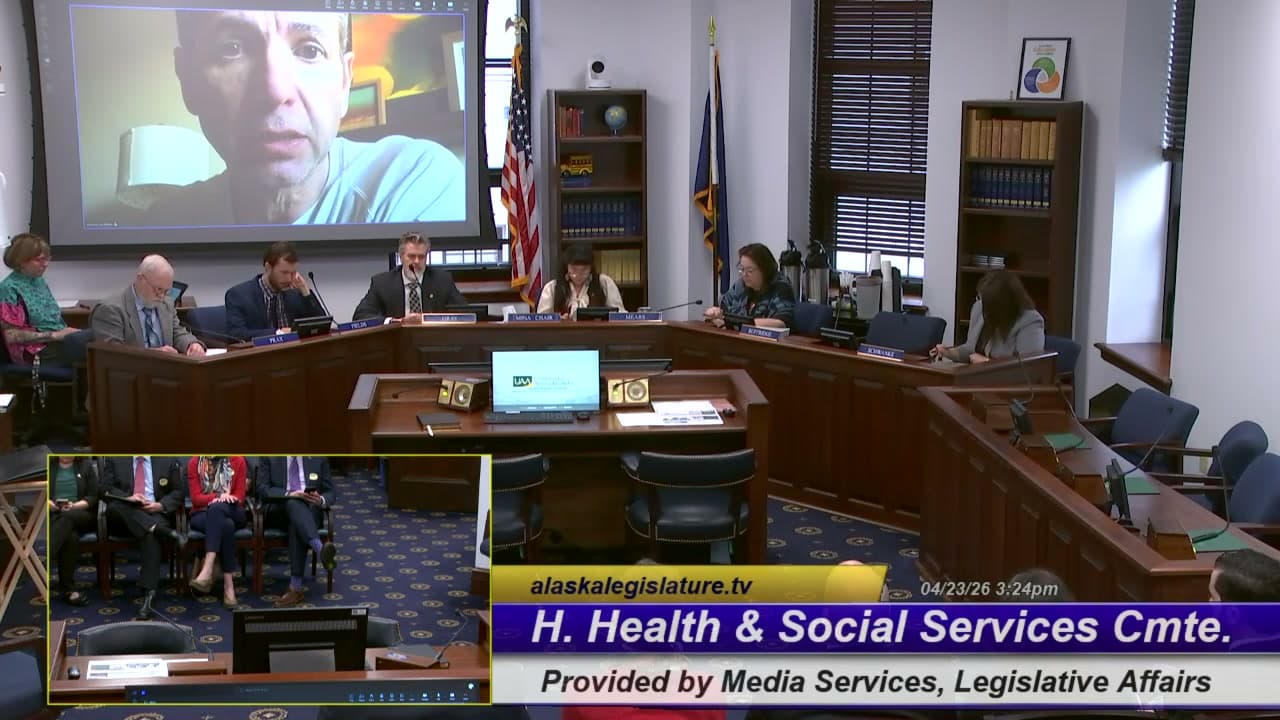
The House Health and Social Services Committee held a confirmation hearing Thursday for Norman Walker, a physician assistant appointed to the State Medical Board, and received a presentation from the University of Alaska Anchorage College of Health on workforce development programs.
Walker has practiced as a physician assistant for 27 years across multiple states, including four years in Alaska. He told the committee he brings experience in neurosurgery, cardiothoracic surgery, emergency medicine and family practice. He said he has no political agenda but supports regulatory changes that would give physician assistants more practice independence, similar to nurse practitioners.
"I do not have any political affiliations or significant encumberments that would prevent me from having an unbiased opinion," Walker said. "I wanted to be able to serve other physician assistants and help them to work their way through the process."
Walker's most recent Alaska position ended in January with Southeast Alaska Regional Health Consortium. He said the contract ended by mutual agreement. He is currently working a temporary position in Delaware while seeking permanent employment in Alaska. His supervising physician in Alaska was Victor Sonoy Harrison.
Representative Gray asked about Walker's experience with different state licensing systems. Walker said he has seen physician assistants pushed out of rural markets in states like Montana because hospitals found it easier to hire nurse practitioners who do not require physician supervision agreements.
"The fact that it is easier for organizations to license or not have to supervise nurse practitioners, they were kind of pushing physicians into only urban areas where you had a lot of physicians in order to do the direct supervision," Walker said.
Walker has attended two or three State Medical Board meetings since his appointment several months ago. He said the board's biggest challenge is inadequate staffing, with several positions unfilled. The board primarily reviews license applications and investigates complaints against healthcare providers.
When asked about the board's role in approving collaborative practice agreements between physician assistants and supervising physicians, Walker said agreements must meet minimum requirements for chart review and supervision based on the provider's experience level. He said he has not yet been asked to review any supervision agreements in his new role.
Committee Chair Representative Mina asked about recent controversies involving State Medical Board resolutions. Walker said he was not aware of specifics about any controversy.
The committee took no action on Walker's confirmation. Under Alaska law, a signature on the committee's report does not reflect an intent to vote for or against confirmation during any future session.
The committee then heard a presentation from UAA Chancellor Cheryl Seamers and College of Health officials on healthcare workforce programs. The presentation covered nursing, allied health, social work, public health and behavioral health programs that graduate hundreds of students annually. Most remain in Alaska.
Associate Dean for Clinical Sciences Carrie Moore said the School of Nursing aims to provide education across the state through various delivery models and clinical placements at designated campuses. Graduate programs offer options for advanced practice nurses, nurse educators and nurse leaders.
Representative Fields asked whether hospital employers have analyzed the cost of traveling nurses versus directly funding expanded training programs. Moore said Providence and other healthcare systems offer scholarships with service agreements but did not have specific cost comparison data available.
Moore identified faculty recruitment and clinical placements as the biggest barriers to expanding nursing programs. She explained that clinical placements require healthcare workers willing to supervise students, which adds unpaid work to their duties. Supervisors must approve student placements on their units.
Representative Gray suggested the licensing board could provide continuing education credits or other incentives for healthcare providers who supervise students.
Associate Dean André Rosay presented on behavioral health programs including social work, public health, justice and human services, and psychology. He said the Master of Social Work program has graduated more than 700 students since 1997 but still does not meet statewide demand. The program is expanding from 35 to 85 students with startup funding from Recover Alaska and other organizations.
Rosay said the biggest challenge in behavioral health workforce development is recruiting students interested in mental health careers. The college works with high schools through programs like Mental Health First Aid and dual credit courses. Few high school students express interest in behavioral health professions, he said.
The college also presented a proposal for an academic medical center that would partner a university with healthcare entities to provide clinical care, education and research. The proposal requests $30 million over five years from the Rural Health Transformation Project, with $2 million in the first year to hire a consulting firm. The need for expanded residencies is driven by the WWAMI program, Alaska's only in-state medical education pathway, which enrolled a record 30 students in 2025 and will graduate 30 students annually starting in 2029.
The academic medical center would focus on expanding residency programs to match the 30 medical students who will graduate annually from the WWAMI program starting in 2029. Alaska currently has 12 to 14 residency positions. The proposal includes a feasibility study for a value-based care model and would require all residents to complete training rotations in rural sites.
Representative Ruffridge asked about the sustainability plan after the five-year funding period ends. Moore said academic medical centers generate significant revenue through resident billing to Medicare and insurance providers, making the project self-sustaining after the initial investment.
The committee's next meeting is scheduled for Tuesday at 3:15 p.m.
This article is based on a public meeting — Alaska Legislature: House Health & Social Services, 4/23/26, 3:15pm ().
AI-assisted. How we use AI Transcript byLucas Brown
Stay informed. Support what matters.
Free, permanent access to local news you can verify. Subscribe to support Alaska News and go ad-free.
Related Coverage
Senate panel advances 10 health board nominees to full Legislature
Alaska News · 5mo ago
Senate Panel Advances Nine Board Nominees After Confirmation Hearings
Alaska News · 5mo ago
Recent High School Graduate Appointed to Alaska State Medical Board
Alaska News · 4mo ago
19-year-old homeschool graduate appointed to State Medical Board
Alaska News · 4mo ago
Senate panel adopts changes to health care compact bill
Alaska News · 5mo ago
Comments
Sign in to leave a comment.
No comments yet. Be the first to share your thoughts.