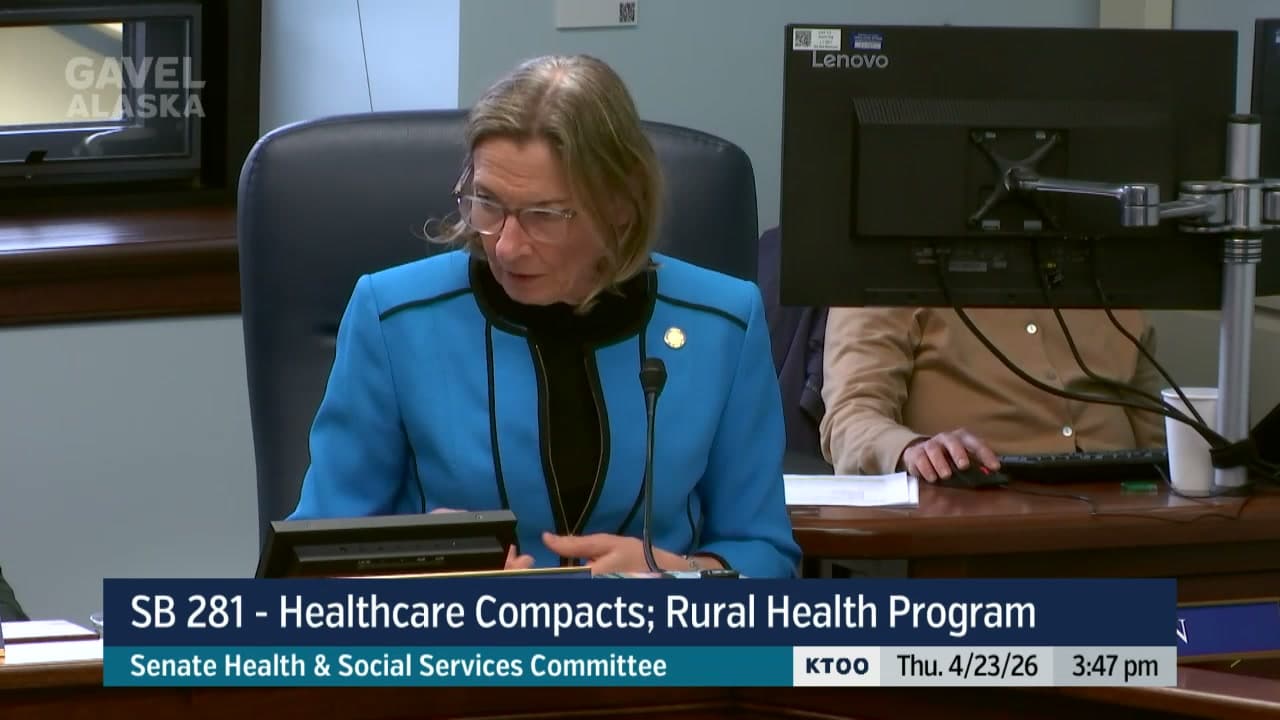
The Senate Health and Social Services Committee adopted a committee substitute Thursday for legislation that would bring Alaska into four interstate medical licensing compacts and establish a rural health advisory council in statute.
The committee substitute for Senate Bill 281 removes language that would have expanded the scope of practice for physician assistants. Chair Forrest Dunbar, an Anchorage Democrat who sponsors the bill, said another PA scope bill is moving through the Legislature and this was not the right vehicle for that change.
The revised bill adds background check requirements for physicians, osteopaths, podiatrists, physician assistants, psychologists and emergency medical personnel. The Department of Public Safety requested the changes to comply with federal law governing criminal history record checks for licensing purposes. Alaska's Background Check Program already requires fingerprint-based criminal history checks for healthcare workers in licensed facilities through the Department of Health, but the new requirements would extend to individual professional licensure.
"Without clarifying statutory language, the Department of Public Safety would be unable to process background checks required under these healthcare compacts," committee aide Ariel Harbison said.
Lisa Parenton, director of statewide services for the Department of Public Safety, said the changes ensure compliance with Public Law 92-544, which governs access to criminal justice information for non-criminal justice purposes. The law requires that background check information only be shared with government entities and used solely for licensing decisions.
The Division of Corporations, Business and Professional Licensing requested expanding background check requirements to all license types under the State Medical Board, not just those seeking licensure under the compacts. Director Sylvan Robb said most Alaskans assume background checks are already required for medical licensure.
Senator Liz Snyder, a Wasilla Republican who serves as vice chair, raised concerns about the fingerprinting process, calling it "ponderously slow" and noting Alaska may be the only state still using paper fingerprint cards. Parenton said the department recently converted to a modern platform and is exploring electronic submission options with licensing agencies.
The committee substitute also revises the proposed Rural Health Transformation Program Advisory Council to align with the existing council the Department of Health already convenes. Changes include allowing members to represent organizations rather than requiring them to work directly for specific entities, and adding the Department of Health deputy commissioner as a non-voting chair.
Senator Jesse Bjorkman, a Nikiski Republican, questioned whether the changes ensure geographic diversity and representation from underserved communities. Courtney Enright, special assistant to the health commissioner, said the seated organizations represent a wide range across the state, including the Alaska Hospital and Healthcare Association, which represents hospitals statewide.
The committee removed language that would have required the department to distribute Rural Health Transformation Program grants equally across judicial districts and organization sizes. Enright said those requirements could conflict with federal Centers for Medicare and Medicaid Services rules governing how Alaska must spend the grant money.
Senator Elvi Gray-Jackson, a Nome Democrat, expressed concern that future administrations could change the council's composition in ways that reduce rural representation. Dunbar said she could propose an amendment adding geographic diversity language before the Wednesday deadline he set for amendments.
The bill would bring Alaska into the Interstate Medical Licensure Compact, the Physician Assistant Licensure Compact, the Psychology Interjurisdictional Compact, and the EMS Personnel Licensure Interstate Compact. Supporters say the compacts will help recruit and retain health care providers, particularly for telehealth services in rural areas.
Sam Garcia, testifying on behalf of the Alaska Mental Health Board, said the compacts would help address long wait times for behavioral health services. He described helping someone experiencing homelessness who needed substance use treatment but faced a six-month wait just for an assessment.
"For somebody that finally finds that motivation to take that step in the recovery, being told that you're just to get that assessment, which gives you the level of care you need for treatment, that's not even a treatment bed, that leaves people feeling crushed, unheard, and quite often will slip into further crisis," Garcia said.
The committee closed public testimony on the bill. Dunbar set an amendment deadline of 5 p.m. Wednesday, April 29, before the committee's next meeting Thursday.
The committee also set a Monday, April 27 amendment deadline for Senate Bill 261, which addresses identification and birth certificates for unhoused young adults.
This article is based on a public meeting — Alaska Legislature: Senate Health & Social Services, 4/23/26, 3:30pm ().
AI-assisted. How we use AI Transcript byLucas Brown
Stay informed. Support what matters.
Free, permanent access to local news you can verify. Subscribe to support Alaska News and go ad-free.
Related Coverage
Alaska expands background checks to all medical professionals
Alaska News · 5mo ago
Senate panel advances health care compacts bill despite sovereignty concerns
Alaska News · 5mo ago
Senate Committee Advances Healthcare Licensing Compact Bill
Alaska News · 4mo ago
Alaska House passes five healthcare licensure compacts in single bill
Alaska News · 4mo ago
House Finance approves pharmacist prescription bill after rejecting nurse compact
Alaska News · 4mo ago
Comments
Sign in to leave a comment.
No comments yet. Be the first to share your thoughts.