House Labor Committee Advances Travel Insurance Bill, Hears Disaster Pet Plan
House Labor Committee Advances Travel Insurance Bill, Hears Disaster Pet Plan
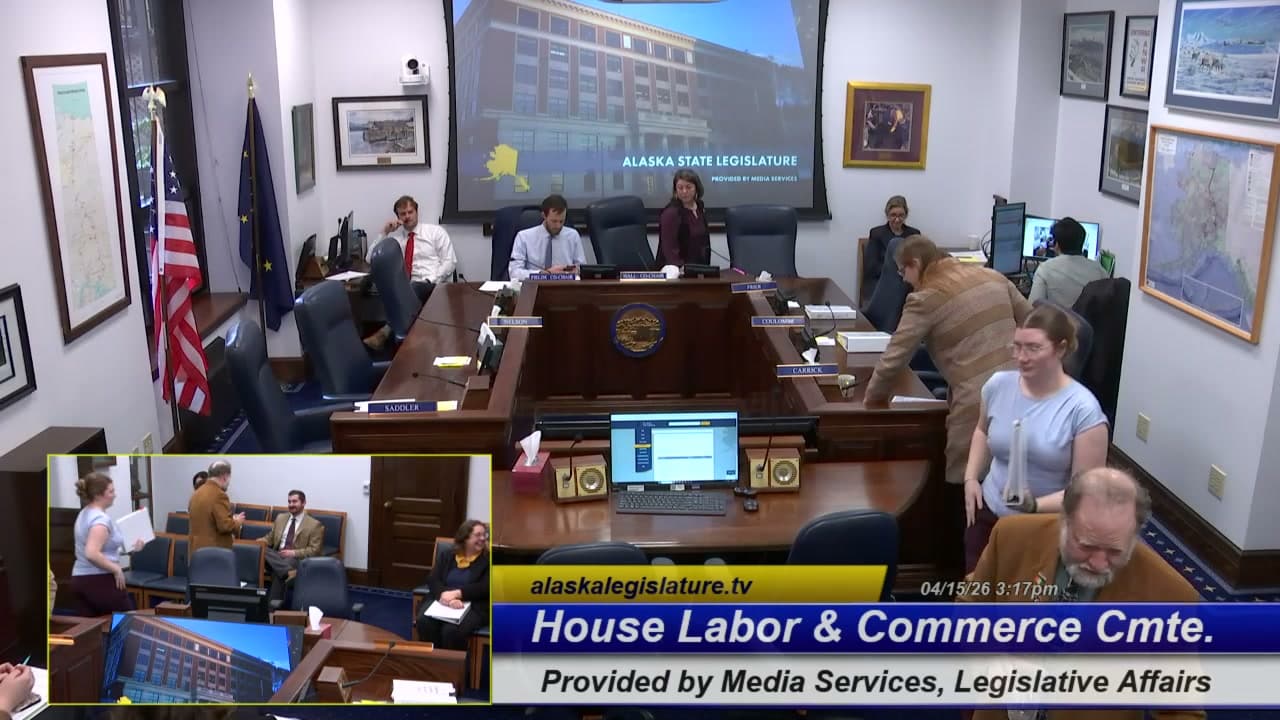
The House Labor and Commerce Committee moved travel insurance legislation forward Tuesday while hearing proposals to strengthen emergency planning for pets and clarify state authority over natural gas contracts.
The committee voted to advance HB 302, which updates Alaska's travel insurance regulations, after adopting technical amendments. The bill now moves to the House floor.
Travel Insurance Bill Moves Forward
The committee adopted an amendment to HB 302 that corrects the insurance classification for travel insurance and delays the effective date to January 1, 2027. The change addresses a drafting error that incorrectly referenced "wet marine and transportation lines" instead of "inland marine line," where travel insurance has historically been filed.
"Wet marine line is typically reserved for high seas, air, and cargo," said Keith Bruce, staff to the bill's sponsor. The amendment also gives the Division of Insurance additional time to prepare for filing changes under the bill.
Heather Carpenter, director of the Division of Insurance, explained that inland marine is "a little bit of a catch-all" that covers items like expensive artwork, jewelry, and travel insurance, despite the maritime terminology.
The committee voted unanimously to report the bill out with individual recommendations.
Pet Emergency Planning Proposal Heard
Representative Ted Eischeid presented HB 335, which would require the state to develop comprehensive disaster plans for pets and service animals. The bill responds to coordination challenges that emerged during the October 2026 typhoon that struck western Alaska communities.
"We know that sometimes folks will actually stay behind in emergencies because they're worried about their pets and what will happen to them if they leave," Eischeid said.
The legislation would direct the Division of Homeland Security and Emergency Management to establish evacuation procedures, identify pet-friendly shelters, and create an identification system to reunite animals with owners. It would also add an animal welfare professional to the Alaska State Emergency Response Commission.
Kelly Donnelly, executive director of the Alaska SPCA, testified that her organization helped coordinate animal care during the typhoon response but found Alaska lacks a fully coordinated system for managing pets during disasters.
"Those breakdowns don't just affect the animals. They slow evacuations. They increase risk to first responders, and they make already difficult situations harder for families," Donnelly said.
The bill would also allow out-of-state veterinarians and veterinary technicians to provide assistance during declared disasters without obtaining Alaska licensure.
Committee members raised questions about the scope of the proposal. Representative Carrick asked whether working animals like sled dogs and horses used by tourism operations would be covered. Staff confirmed the current definition of "pets" in state law does not include working animals.
Representative Sadler questioned the breadth of language requiring an identification system with "all information necessary" to reunite pets with owners. He asked whether the bill provides adequate authority for collecting and maintaining such data.
Dr. Sarah Coburn, the state veterinarian, testified that Alaska currently has no standardized pet identification system. Microchipping requirements vary by municipality, and rural communities may lack access to microchipping services.
The committee set an amendment deadline of April 21 at 5 p.m. and held the bill for future consideration.
Natural Gas Regulatory Authority Clarified
The committee heard SB 180, which would repeal a provision added to state law in 2024 that has created confusion about the Regulatory Commission of Alaska's authority over liquefied natural gas import facilities. A parallel bill, HB 208, sponsored by Representative Donna Mears, seeks the same repeal and has advanced through the House Resources Committee following hearings in May 2025 and April 2026.
The 2024 language, inserted into an unrelated carbon storage bill, stated that LNG import facilities under federal jurisdiction are exempt from RCA regulation. That provision has been cited in legal challenges to RCA's authority to review gas supply contracts and terminal use agreements. The RCA opened docket I-26-001 in February 2026 to gather information on LNG import plans for Cook Inlet amid the ongoing regulatory confusion.
"It was placed in a CS for House Bill 50 in Senate Finance Committee, and there was no discussion or debate in the legislative record about why Section 49 was added to this bill," said Paige Brown, staff to the Senate Resources Committee.
The Federal Energy Regulatory Commission has exclusive authority over siting, construction, and operation of LNG terminals. However, RCA maintains jurisdiction over rate-making decisions for utilities that purchase gas from those facilities.
John Espendola, chair of the Regulatory Commission of Alaska, confirmed that repealing the provision would preserve RCA's authority to review terminal use and gas supply agreements. "With the repeal of this provision, we believe we have the authority to review the terminal use and gas supply agreements," he said.
Commissioner Steve DeVries explained that while RCA issued an order last year affirming its jurisdiction, the 2024 provision continues to be raised by litigants attempting to challenge that authority. "I should emphasize that we, the Commission, do not believe that that provision deprived us of our jurisdiction to review those gas supply agreements or terminal use agreements, but that would be an argument that could theoretically be raised," DeVries said. "And the reason that Senator Giesel has expressed as the justification for passage of this bill is to remove that uncertainty. It does not change the jurisdictional status quo as we understand it."
The committee set an amendment deadline of April 25 at 5 p.m.
Other Business
The committee also heard HB 316, which would adjust damage limits for personal injury and wrongful death cases to account for inflation since the caps were set in 1997. The bill would create an ongoing inflation adjustment mechanism.
Kerry Silverman, counsel to the American Tort Reform Association, testified in opposition, warning the bill would "substantially and suddenly increase the maximum award for non-economic damages" and could raise insurance costs.
The committee also considered a committee substitute for HB 350, which would impose a 9.4 percent income tax on partnerships, LLCs, sole proprietorships, and S corporations with taxable income above $25 million annually. The substitute removes retroactivity and delays implementation to allow the Department of Revenue to collect baseline data before the tax takes effect.
Both bills were held for future consideration with amendment deadlines set for April 21 at 5 p.m.
The committee adjourned at 4:48 p.m. and will meet next on Friday, April 17, at 3:15 p.m.
This article is based on a public meeting — Alaska Legislature: House Labor & Commerce, 4/15/26, 3:15pm ().
AI-assisted. How we use AI Transcript byLucas Brown
Stay informed. Support what matters.
Free, permanent access to local news you can verify. Subscribe to support Alaska News and go ad-free.
Related Coverage
House panel advances travel insurance consumer protection bill
Alaska News · 5mo ago
Senate panel advances travel insurance modernization bill
Alaska News · 4mo ago
Alaska House Committee Advances Five Bills in Single Session
Alaska News · 4mo ago
Alaska House panel advances dental insurance transparency bill
Alaska News · 5mo ago
House Panel Considers Bills to Ease Alaska's Liquor Liability Insurance Crisis
Alaska News · 6mo ago
Comments
Sign in to leave a comment.
No comments yet. Be the first to share your thoughts.