Alaska House panel advances dental insurance transparency bill
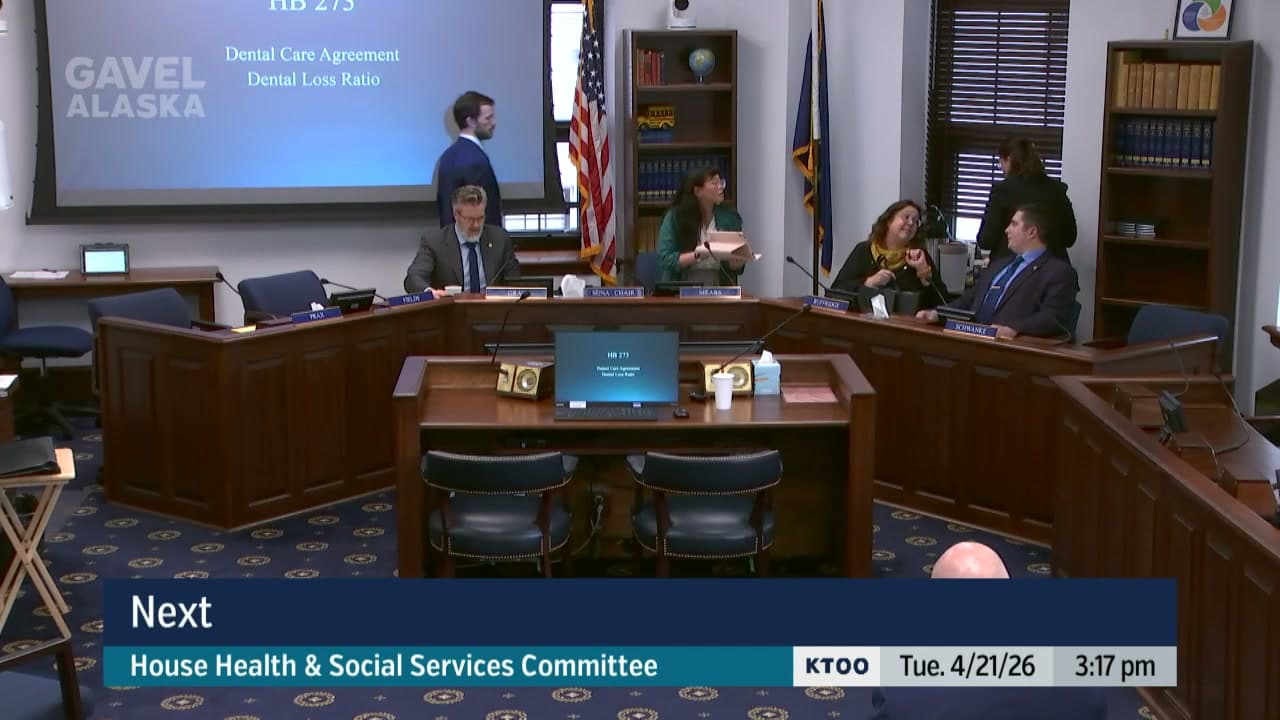
The Alaska House Health and Social Services Committee advanced a bill Tuesday that would require dental insurers to disclose how much of customers' premium dollars actually pay for dental care.
House Bill 273, sponsored by Representative Justin Ruffridge, would establish a dental loss ratio reporting framework in Alaska. The measure would require the state's 48 dental insurance companies to report what percentage of premiums they spend on actual dental services versus administrative costs and profits. The committee heard the bill and set it aside for a future hearing.
Background
House Bill 273 was introduced in the 34th Alaska Legislature by Ruffridge on January 23, 2026. The bill was referred to the House Health and Social Services and Labor and Commerce committees. The committee held its initial hearing on the bill Tuesday, April 7, 2026.
The bill also expands Alaska's existing direct health care agreement statute to include dental services, allowing patients to contract directly with dentists for set monthly fees. That framework was established in 2024 for medical services under Senate Bill 45.
Ruffridge said the bill addresses what he called an opaque industry. "You do not really know the answer to the question of the 48 offerings," he said. "You do not know really what that metric is coming in at."
The bill does not set a specific loss ratio percentage that insurers must meet. Instead, it directs the Division of Insurance to collect data, calculate averages, and make the information public so consumers can compare plans.
"A consumer who was looking to purchase a dental insurance plan could then say, listen, this plan offers, you know, a 90 percent or an 80 percent, or, you know, you potentially would not want to be investing in a plan that is a 20 percent because you would have less, you know, bang for the buck," Ruffridge said.
Heather Carpenter, director of the Division of Insurance, told the committee her agency would need to stand up an entirely new regulatory structure to implement the dental loss ratio reporting. The division currently collects medical loss ratio data for health insurance but sends it to the federal Centers for Medicare and Medicaid Services for analysis. CMS does not collect dental loss ratio information.
Carpenter said the division would need at least one new position to handle the work. She expressed doubt that regulations could be ready by the bill's proposed January 2027 effective date. "Regulations are taking a long time, so I do not have a high amount of confidence that regulations would be in place by January 1, 2027," she said.
Of Alaska's 48 dental insurance companies, only three cover more than 10,000 individuals, and 13 cover at least 1,000 people. Representative Zack Fields asked whether the reporting requirement would be administratively burdensome for small plans.
Carpenter said it could be. "It gets administratively burdensome for small plans. It gets administratively burdensome for the division," she said. She suggested lawmakers might consider setting a threshold based on the number of covered lives or premium volume, noting that $1 million in premiums is a common cutoff in other states.
Fields also raised concerns about whether the direct care agreements could lead to fewer Alaskans carrying dental insurance. "I would be concerned that people would basically make a choice and we would have less insurance coverage and potentially risk higher uncompensated care," he said.
Paul O'Connor, senior legislative liaison with the American Dental Association, said roughly 32 states have enacted some version of direct dental care agreements over the past decade. He said he had not seen evidence of negative impacts on insurance participation in those states, though he acknowledged data is limited.
Dr. Heather Willis, governmental affairs chair of the Alaska Dental Society, testified in support of the bill. She said dental insurance often operates more like a gift card than true insurance, with annual coverage limits that leave patients responsible for major expenses. "Once you use that up, that is the end of the payments from the insurers," she said.
The Alaska Dental Society submitted a letter of support for the bill on January 29, 2026.
Representative Genevieve Mina, committee chair, set the bill aside for a future hearing. "I am setting House Bill 273 aside for a future hearing," she said.
The committee's next meeting is scheduled for Tuesday, April 14, 2026, in Davis 106.
This article is based on a public meeting — Alaska Legislature: House Health & Social Services, 4/21/26, 3:15pm ().
AI-assisted. How we use AI Transcript byLucas Brown
Stay informed. Support what matters.
Free, permanent access to local news you can verify. Subscribe to support Alaska News and go ad-free.
Related Coverage
House panel advances travel insurance consumer protection bill
Alaska News · 5mo ago
Senate panel advances travel insurance modernization bill
Alaska News · 4mo ago
House panel advances telehealth pay parity bill with wage protections
Alaska News · 4mo ago
House Labor Committee Advances Travel Insurance Bill, Hears Disaster Pet Plan
Alaska News · 5mo ago
Senate Panel Advances Nine Board Nominees After Confirmation Hearings
Alaska News · 5mo ago
Comments
Sign in to leave a comment.
No comments yet. Be the first to share your thoughts.