Galena School District Shows Early Learning Drives Math, Reading Gains
The Galena City School District is showing how early childhood investment can drive academic gains, with students in early grades performing above national norms in math and reading assessments.
The district serves just over 300 students at Sydney Huntington School in Galena and operates a state-licensed child care center inside the elementary school. The center serves children from 8 months to 3 years old, using the same curriculum as the district's 3-year-old and 4-year-old preschool programs. The approach extends beyond the typical Head Start model, which has served children since 1965, and Early Head Start, established in 1995 for infants and toddlers. Galena's integration of early learning directly into the school district allows for continuity from infancy through elementary grades.
"The premise behind this was to help us not only with child care for employability for the entire community, but also to support the Alaska Reads Act in our ages 0 to 3, which that doesn't touch, to build capacity for our students beyond that into K-3," Assistant Superintendent Lisa Shelby said.
The district extended its school day by 45 minutes and added two daily intervention blocks without extending teacher contracts. The change moved support from voluntary after-school programs to mandatory in-school interventions.
"We had a kind of a voluntary after-school program a few years ago after school, and what we found is the kids who needed the support most were not coming to school to access those interventions," Shelby said. "So we pulled that into the school day."
Representative Jubilee Underwood asked how the district worked the intervention blocks into the schedule. Shelby said the district has about 35 minutes twice a day for interventions and uses multiple curriculums depending on student needs. The district also picked up high-density tutoring through a grant for reading.
On the mCLASS math assessment, which is used by about 230,000 students nationwide, Galena's early-grade students are showing strong performance. The assessment uses color bands to indicate proficiency levels, with green representing on-grade-level performance and blue representing above-grade-level performance. Galena's data shows significant blue and green across kindergarten through second grade.
In reading, the district is using mCLASS, the same assessment picked up by the Alaska Reads Act. That product is used by 4 million students nationwide. Galena's students are performing slightly above national norms, with particularly strong results in kindergarten through second grade.
All of the district's programs serving more than 300 students are grant-funded through tribal partnerships and state and federal grants. The district has a grants writer who also handles federal programs, and Shelby manages grant reporting and implementation.
Representative Rebecca Himschoot asked about the grant writer position and how the district sustains it with small enrollment. Shelby explained that the position wears multiple hats, including federal programs, and is funded district-wide across all schools.
Shelby emphasized that the district's 100 percent free and reduced lunch population makes the early childhood investment crucial for meeting Alaska Reads Act expectations and reducing achievement gaps.
"I think the power is the earlier we can get students into school and getting those experiences, the more gains we're going to see, especially that will impact the Alaska Reads Act and their later successes," Shelby said.
The district also partners with the Louden Tribe, the Tanana Chiefs Conference, and the City of Galena. For secondary students, the district offers dual credit and STEM opportunities through partnerships with the University of Alaska Anchorage and the University of Alaska Fairbanks.
Shelby noted that many of the district's successes depend on grants that are not sustainable long-term. The early education programs, interventions, summer school, winter break activities, and after-school programs are all built on grant funding.
Representative Jubilee Underwood asked about accommodating the wide age range in the pre-kindergarten programs. Shelby said the daycare program is separate, and this year the 3-year-old and 4-year-old programs are combined in one classroom. The district relies on rotating volunteers to help meet staff-to-child ratios.
Shelby also addressed how the district encourages pre-kindergarten enrollment in its IDEA homeschool support program. The district enrolls pre-kindergarten siblings without funding to support those families and help children begin early learning.
"We just really know and understand how important early learning is," Shelby said.
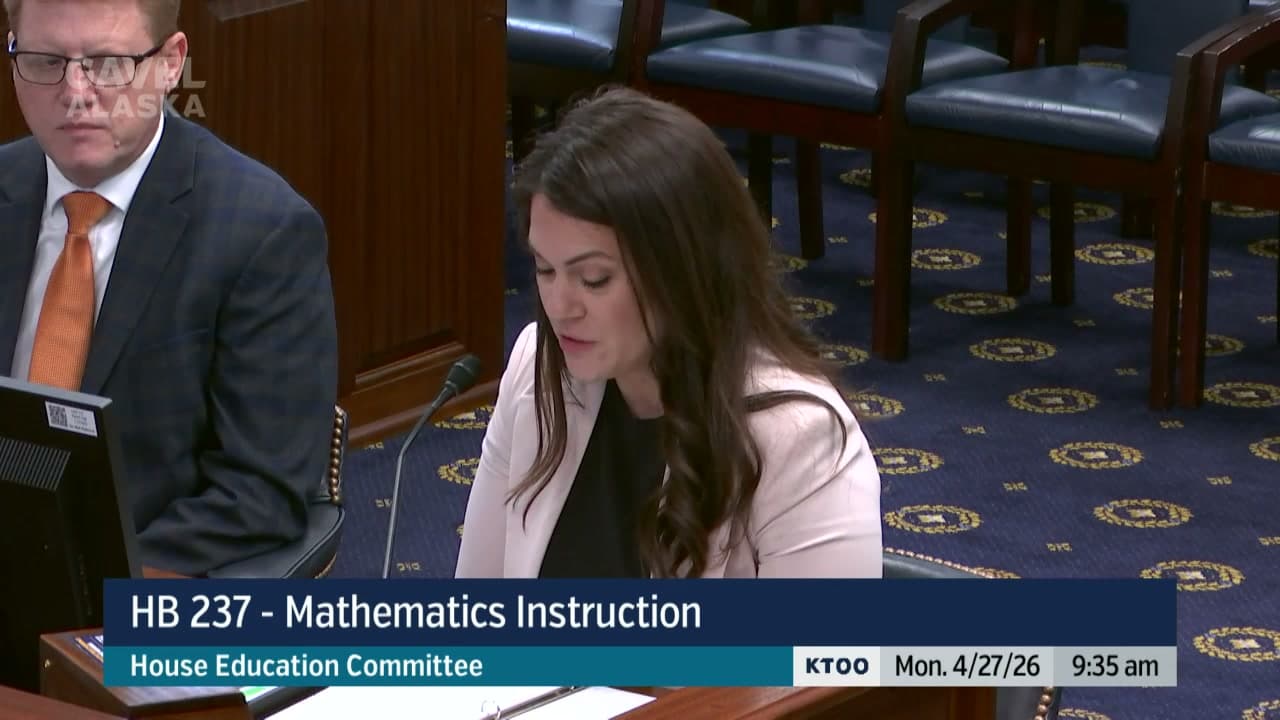
This article is based on a public meeting — Alaska Legislature: House Education, 4/27/26, 8am ().
AI-assisted. How we use AI Transcript byLucas Brown
Stay informed. Support what matters.
Free, permanent access to local news you can verify. Subscribe to support Alaska News and go ad-free.
Related Coverage
Senate panel advances full funding for pre-K students statewide
Alaska News · 4mo ago
A Fairbanks Head Start for Alaska Native families gets five more years of federal money
Alaska News · 1mo ago
House panel considers expanding early intervention for Alaska children
Alaska News · 5mo ago
Alaska House committee advances bill to expand early intervention eligibility
Alaska News · 5mo ago
Alaska school tests show early gains and a one-in-five participation gap
Alaska News · 1w ago
Comments
Sign in to leave a comment.
No comments yet. Be the first to share your thoughts.