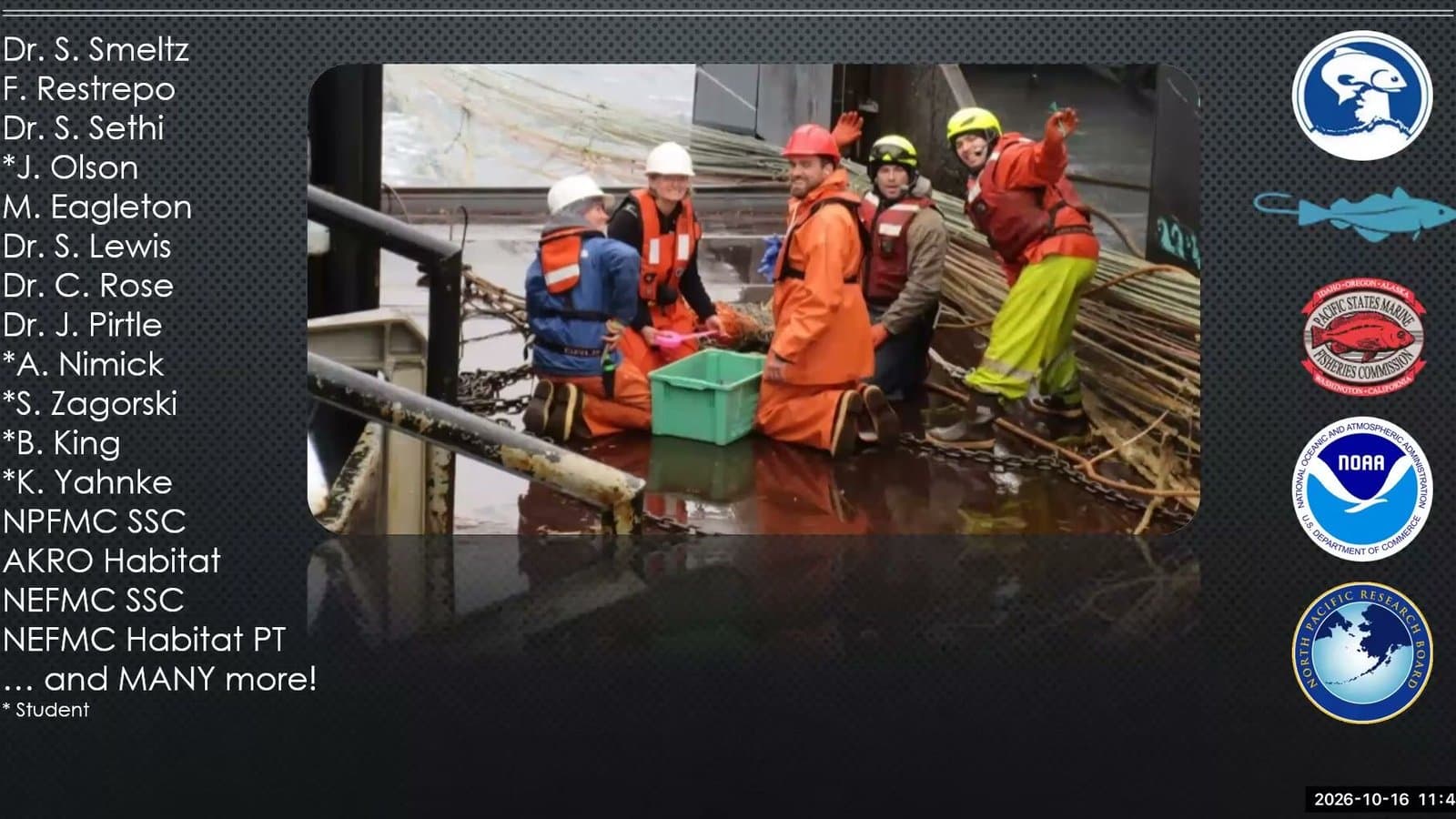
Frame from "NPFMC: Joint Protocol Meeting Presentations" · Photo source
Federal trawl habitat model lacks data on some state fisheries, board members told
State Board of Fisheries members heard Friday that the federal model used to judge trawling's effects on fish habitat includes fishing in some state waters but has no data on state-managed fisheries such as Prince William Sound pollock.
The briefing came at a joint committee session of the Alaska Board of Fisheries and the North Pacific Fishery Management Council in Anchorage. It was meant to inform board members who will decide future proposals to restrict trawling in state waters. The committee cannot act on any of it.
Board Vice Chair Tom Carpenter of Cordova, who chairs the board's side of the committee, said he asked for the session after trawl proposals reached the board in March. Reviewing them, he said, it was clear "the board may not be as informed as it should be in regards to some of the nuances surrounding trawl fisheries." Council staffer Sarah Marrinan said three of those proposals dealt with pelagic trawl gear in state waters, and a fourth would have closed the Aleutians west of 170 degrees west longitude to all trawl gear. As Alaska News reported Sept. 24, the board took 51 seconds on three trawl proposals in March.
Marrinan said 33 catcher vessels fished Gulf parallel state waters in 2025, with state waters supplying an average of 10% of active vessels' gross revenue. Marrinan said the council has stated the most recent habitat review concluded fishing effects on essential fish habitat are no more than minimal or temporary.
Board members focused on whether federal tools apply to state-managed fisheries.
Brad Harris, whose lab runs the federal Fishing Effects Model, said its grid already crosses state waters and includes any fishery captured through federal catch accounting, including parallel fisheries. "What we don't have is state waters fishing information," Harris said. Council member Nicole Kimball noted the Prince William Sound pollock fishery falls outside the model for that reason.
Board Chair Marit Carlson-Van Dort said the federal material "certainly builds confidence in the federal fishery," but her question was whether it applies to state waters. She urged state-waters stakeholders to start advocating to the state Department of Fish and Game to get information state fisheries managers "don't have right now."
A progress update on the federal fishing effects model goes to the council's Scientific and Statistical Committee in February 2027.
This article is based on a public meeting of North Pacific Fishery Management Council — NPFMC: Joint Protocol Meeting Presentations ().
Made by our human newsroom with AI. How humans and AI work here · Grow with our newsroom Transcript byLucas Brown
Stay informed. Support what matters.
Free, permanent access to local news you can verify. Subscribe to support Bill AlaskaNews and go ad-free.
Related Coverage
Fishery managers will meet on trawl seafloor contact, with no power to recommend
Alaska News · 3w ago
Trawl meeting in Anchorage Oct. 16 will take no remote testimony
Alaska News · 3w ago
Board of Fish Defers Trawl Gear Restrictions, Opts for Federal Coordination
Alaska News · 7mo ago
Board considers trawl gear restrictions in Aleutian Islands state waters
Alaska News · 7mo ago
Pollock fleet builds empirical database of trawl seafloor contact as Congress weighs gear restrictions
Alaska News · 4mo ago
Comments
Sign in to leave a comment.
No comments yet. Be the first to share your thoughts.