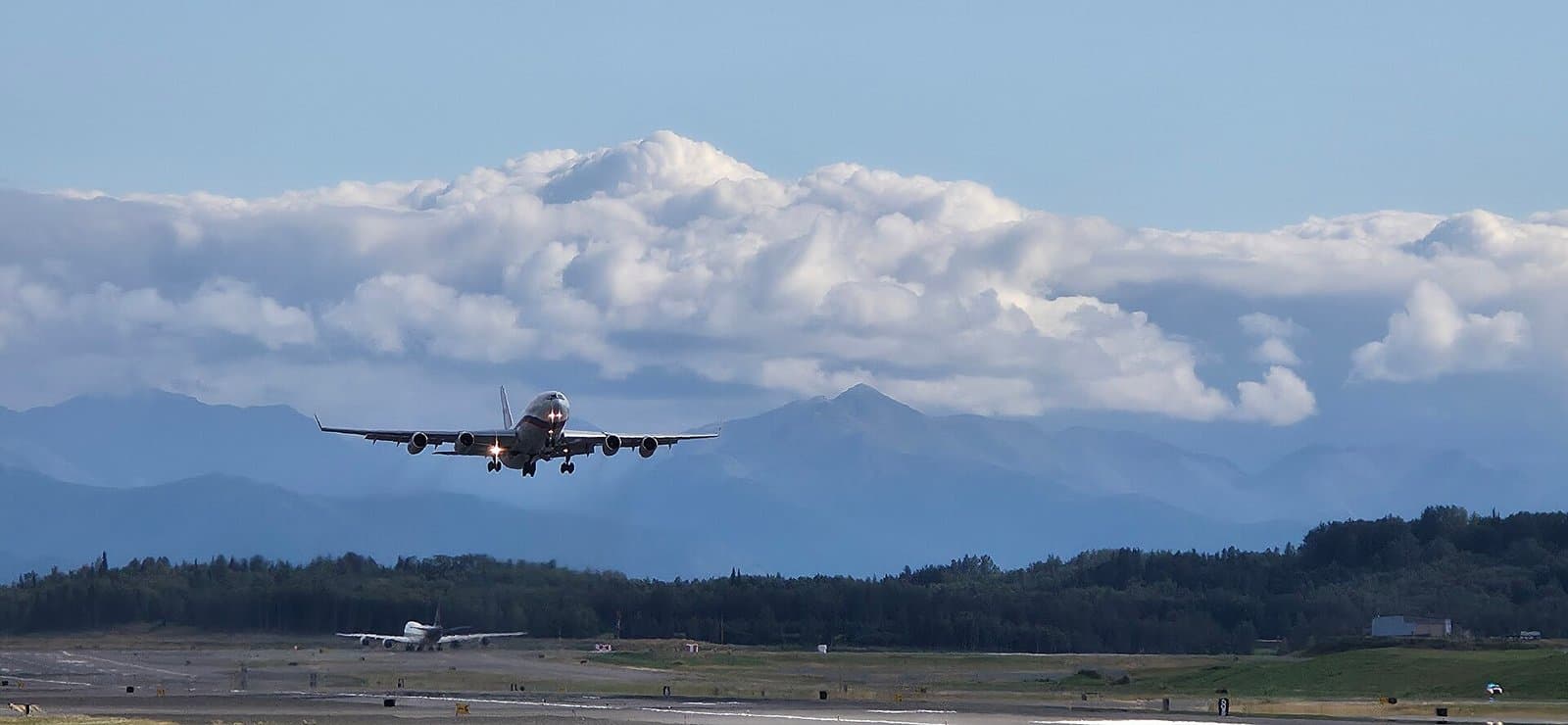
Photo: Cheese007 via Wikimedia Commons · Photo source · CC0
FAA lifts nationwide ground stop as Duffy blames old, overloaded equipment
This story was updated Friday evening after the FAA lifted the ground stop and Alaska Airlines said its flights within Alaska weren't affected.
The Federal Aviation Administration lifted its nationwide ground stop Friday, more than four hours after it halted departing flights at U.S. airports because of a communications problem at the centers that guide planes between airports.
Alaska Airlines said its flights within Alaska weren't affected, according to the AP. Grant Aviation's office in Kenai said Friday afternoon that the airline was still flying, too.
The FAA said it "thoroughly tested" its systems to make sure they were stable before letting departures resume, the AP reported.
Transportation Secretary Sean Duffy blamed old equipment. He said "old switches, old routers" and "1980s little copper lines" became overloaded with data. He called it "an emergency" and asked Congress for emergency money, according to the AP.
Homeland Security Secretary Markwayne Mullin said there was no indication of an attack. "It's just a telecommunications outage," he said. He said adding new technology to an old system had overwhelmed it.
The FAA had expanded a new artificial intelligence planning tool, called SMART, to all 22 of its regional centers on Tuesday. The company that built it, Air Space Intelligence, said the ground stop wasn't a result of the system, and the communications problems don't appear to be linked to it, the AP reported.
The FAA ordered the stop at 11:54 am AKST, telling airports to keep departing traffic on the ground "until further notice" because of "extraordinary circumstances" and "for reasons of safety." Planes already in the air were allowed to keep flying and land. About 3,500 planes were in the air when the stop began, Duffy said.
Air route traffic control centers track and direct planes on the long stretches between airports. Alaska's center is in Anchorage. It's responsible for more than 2 million square miles of airspace, according to the FAA, and is one of three U.S. centers that handle flights over the ocean. Radar covers only 55% to 60% of that airspace, the agency says.
About 82% of Alaska communities aren't connected to the road system, according to the state transportation department, which runs 235 airports. Most Alaska airports have no control tower. The FAA counts 13 towers in the state: four in the Anchorage area, three in the Fairbanks area and six elsewhere.
Anchorage's airport is a global cargo hub, handling more than 180 widebody cargo operations a day. Nearly 2.66 million passengers passed through it in the first half of this year.
Friday's order was the first nationwide ground stop since January 2023, according to the AP. That one followed the failure of the FAA system that sends safety notices to pilots, and it lasted less than two hours. Before that, the last nationwide stop followed the Sept. 11, 2001, attacks.
What did you make of this story? (no account needed)
Get Alaska News in your inbox
Create your free account and get the day’s top stories around 6 each morning, in a few minutes’ read.
Top stories, around 6 each morning.
Stories on what you follow, on Sundays.















Comments
Sign in to leave a comment.
No comments yet. Be the first to share your thoughts.