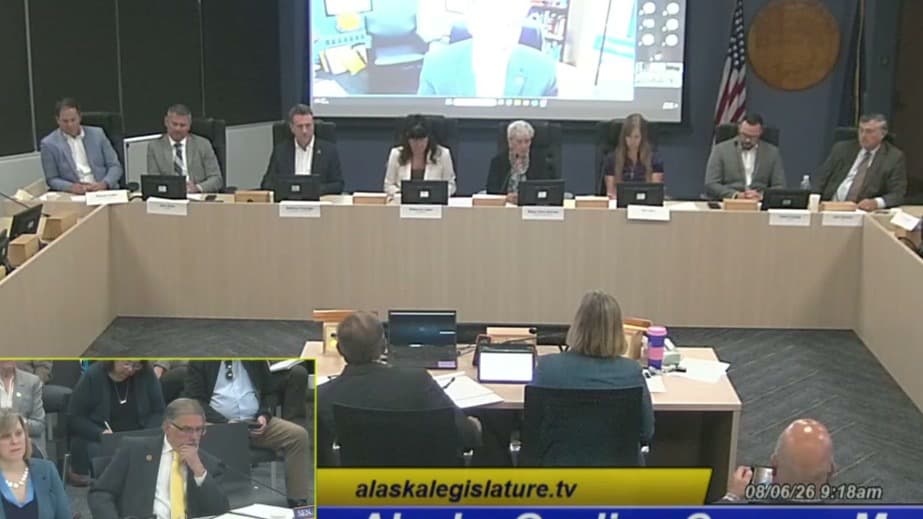
Enstar tells Alaska Gas Line Caucus it could be 18 days short of gas this winter
Enstar could fall about 3 billion cubic feet short of gas this winter — enough to leave the utility unable to serve any customer for 18 days in midwinter — president John Sims told the Alaska Gas Line Caucus on Thursday.
The session was a pitch for a property tax bill meant to advance the Alaska LNG project, the pipeline now in its third special session before the Legislature. Most of the panelists — utility and gas-producer executives who stand to benefit — urged lawmakers to pass it. A few pushed back.
Sims said the size of the shortfall depends on deliveries: 3 BCF short if Cook Inlet supply holds at the current rate, or about 1 BCF — six days of gas — if expected deliveries arrive under normal weather. Enstar's own public materials say most of its gas needs are contracted through 2033, though that figure measures overall supply, not whether current deliveries can meet peak winter demand; the session did not spell out how much of that peak is under firm contract. Enstar's tariff also says it does not guarantee uninterrupted service and may ration gas during a shortage.
Sims said Joint Base Elmendorf-Richardson, planning a building tied to $6.9 billion in expansion, has been told to plan for dual fuel.
Matanuska Electric Association CEO Tony Izzo, whose cooperative serves about 150,000 Alaskans, said the shortfall Sims described equals half of MEA's annual supply, and that his gas is under contract for just two years and seven months. He said MEA's price climbs from $9 — to $10.25 by April 2027 and $11.75 the year after — though that first jump is about 14%, not the 5% he stated, and he did not specify the unit. Interruptible gas in the inlet, he said, runs $16 to $17. (Alaska Energy, an energy commentary publication, has argued household bills may not climb as sharply as feared even with imported gas, though that addresses residential costs rather than the wholesale prices the executives cited.)
Sims and Izzo said Cook Inlet no longer works on its own economics. "It is no longer a viable basin," Sims said, pointing to critical-infrastructure designations, dry-well insurance and subsidies. Hilcorp Alaska's Luke Sargey, from the inlet's largest gas producer, said operators are "getting dangerously close to not having enough gas to go around."
But the producers at the table were still spending. Sargey said Hilcorp puts $400 million to $500 million a year into Cook Inlet gas and will drill 28 wells this year — its busiest season in years — even as he called the basin mature and in long-term decline. HEX owner John Hendricks disagreed outright. "Cook Inlet is the lowest cost, lowest risk natural gas available in Southcentral," he said, and "don't walk away from Cook Inlet." He said HEX doubled production last year, has invested $50 million, is drilling now, and will raise fixed deliveries to Alaskans from 8.1 million to 26 million cubic feet a day next year.
Kenai Peninsula Borough Mayor Peter Micciche urged lawmakers not to overreact. "The gap is tiny," he said, calling for interim fixes like short-term imports at the lowest available cost and continued support for existing producers. "Don't panic," he added. "When we are panicked, and I've seen that happen in Juneau through the years, we make mistakes."
The decline itself is real and steep. Cook Inlet daily production has fallen from 450 million cubic feet in 2010 to roughly 200 million, against winter demand near 320 million, and two Southcentral utilities have warned of steep residential increases starting in 2029.
But the pipeline at the center of the session would not arrive in time to ease the shortage the executives described. "A pipeline or an LNG import, we cannot do it in time to get it here for this winter," Sims said — or next winter, "and probably not even in 2029."
The caucus took no action. It was a listening session, and the co-chairs did not field questions.
This article is based on a public meeting — Alaska Legislature: Alaska Gasline Caucus, 8/6/26, 9am ().
Drafted with AI. Edited by Cale Green (1 revision). No full editor review is on record. Who is accountable. Transcript byLucas Brown
Watch key moments from the source meeting. Click to expand.
Stay informed. Support what matters.
Free, permanent access to local news you can verify. Subscribe to support Walter AlaskaNews and go ad-free.
Related Coverage
Enstar tells legislators it's 18 days short of gas for winter
Alaska News · 4w ago
Southcentral is 3 Bcf short this winter, and producers told lawmakers the gas runs out in 2029
Alaska News · 1w ago
Utility warns of rolling blackouts in Southcentral as soon as this winter
Alaska News · 1mo ago
Enstar faces 2033 supply gap as Hilcorp contract expires, no Cook Inlet producer can match drilling scale
Alaska News · 3mo ago
Southcentral utilities warn of steep rate hikes as Cook Inlet gas dwindles
Alaska News · 3mo ago
Comments
Sign in to leave a comment.
No comments yet. Be the first to share your thoughts.