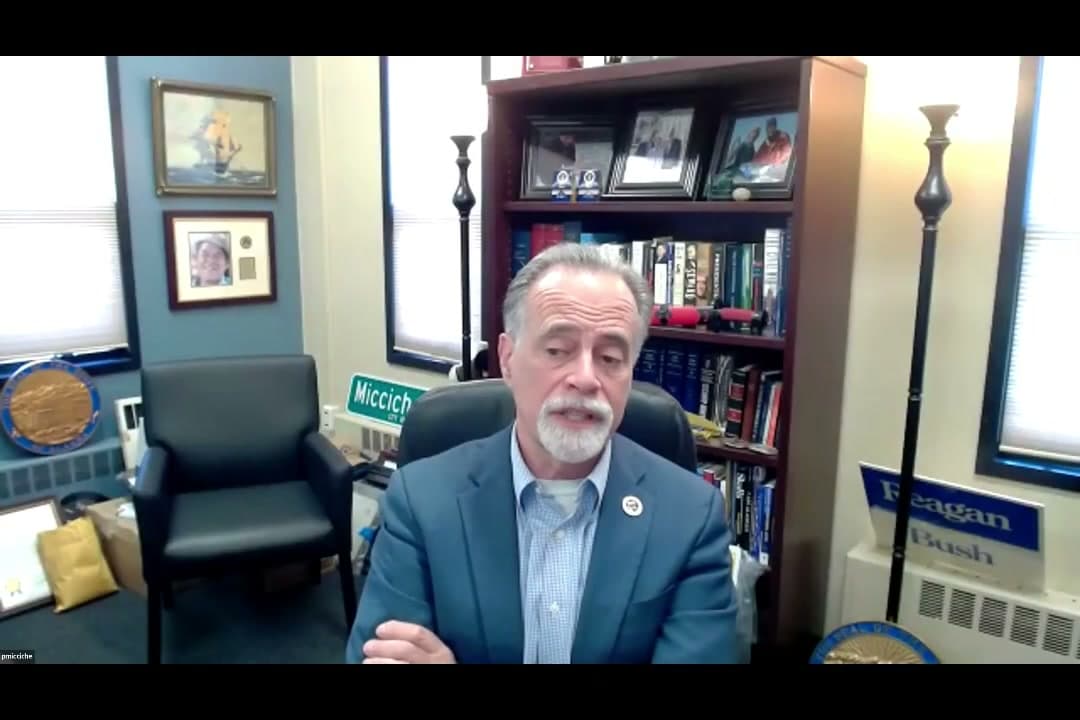
Frame from "Taxes and the Alaska Gas Line: The Fiscal Questions Behind AK's Energy Future" · Photo source
Enstar faces 2033 supply gap as Hilcorp contract expires, no Cook Inlet producer can match drilling scale
Enstar Natural Gas will lose its primary Hilcorp contract in 2033, Enstar president John Sims told a Commonwealth North forum Friday, leaving Southcentral with no Cook Inlet producer currently positioned at Hilcorp's investment scale. Hilcorp has drilled 192 wells and spent more than $1.5 billion in Cook Inlet since 2012. "There's no one else in Cook Inlet that has the balance sheet to be drilling 192 wells over a 10-year period," Sims said.
Cook Inlet daily production has dropped from 350 million cubic feet in 2010 to around 200 million in 2026, while Enstar's winter peak demand reaches 320 million cubic feet daily. BlueCrest, the second-largest producer, doubled output last year to 25 million cubic feet per day. Smaller producers including HEX Cook Inlet (formerly Furie Operating) are also working to expand.
Without a North Slope pipeline, utilities would need to import LNG when Hilcorp contracts end. ISER economist Brett Watson estimated all-in costs at $9 to $21 per thousand cubic feet. The Alaska LNG project's Phase 1 would deliver North Slope gas at a fixed $16 per thousand cubic feet starting in 2029, escalating at 2% annually or inflation. Phase 2, if built, would drop the price to $5 by 2034.
Sims noted that Hilcorp charged Enstar $16 per thousand cubic feet for emergency gas during March's cold spell, twice the current contract rate of $8.36. Watson emphasized that the biggest difference between no project and Phase 1 is the volatility utilities would see on the LNG import market, contrasting the fixed Phase 1 price with fluctuating spot-market LNG costs.
The Alaska State Legislature is weighing SB 280 and HB 381 to replace the project's 20-mill property tax with a volumetric tax of $0.06 per thousand cubic feet. Kenai Peninsula Borough Mayor Peter Micciche said the borough faces $30 million in annual impacts during construction and that the original bill left the borough short. Alaska State Senate Majority Leader Cathy Giessel said the legislature received the bill March 20 and has held 36 hearings in two months, adding that the body can thread both needles of reasonable government revenue and project support.
Watson outlined four potential futures for the project: successful completion of both phases, partial success with only Phase 1, no project, and a limbo scenario in which utilities limp along with short-term, high-cost solutions while waiting indefinitely for Phase 1. He said the limbo case is what he thinks of as the worst-case scenario.
Watson also noted that under the no-project case, Alaska might develop alternative energy infrastructure projects, though most of these projects, as they are proposed today, are relatively small, save for maybe the Susitna-Watana Dam or the TerraCoal Energy Project.
This article is based on a public meeting of Commonwealth North — Taxes and the Alaska Gas Line: The Fiscal Questions Behind AK's Energy Future ().
Made by our human newsroom with AI. How humans and AI work here · Grow with our newsroom Transcript byLucas Brown
Watch key moments from the source meeting. Click to expand.
Stay informed. Support what matters.
Free, permanent access to local news you can verify. Subscribe to support Bill AlaskaNews and go ad-free.
Related Coverage
ENSTAR says Cook Inlet output has fallen to a fifth of its 1990s peak, with its firm contract ending in 2033
Alaska News · 4mo ago
Cook Inlet gas production falls to 61 Bcf in 2025
Alaska News · 4mo ago
Record cold pushed Anchorage's gas demand to an all-time high, just as the supply is running out
Alaska News · 9mo ago
Southcentral is 3 Bcf short this winter, and producers told lawmakers the gas runs out in 2029
Alaska News · 1mo ago
Cook Inlet gas production drops 60% since 2010
Alaska News · 4mo ago
Comments
Sign in to leave a comment.
No comments yet. Be the first to share your thoughts.