Education Fund Amendment Advances With Key Questions Unresolved
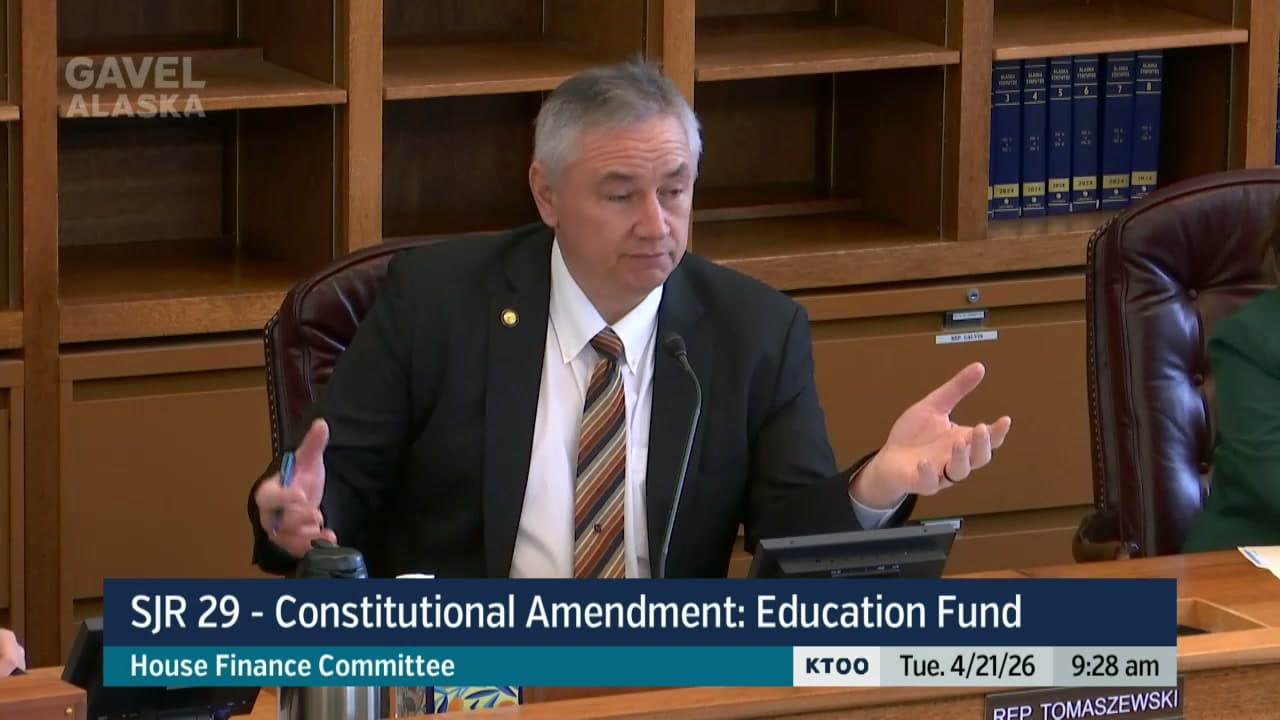
The Alaska House Finance Committee heard testimony Tuesday on a constitutional amendment that would create a dedicated education fund, but lawmakers left the hearing with fundamental questions about how the fund would work and what it would accomplish.
Senate Joint Resolution 29 would add a new section to the Alaska Constitution allowing the legislature to create an education fund in the state treasury. Money in the fund could only be spent on public education. The measure was introduced in the Senate on March 13 and moved through the Senate Finance Committee in three hearings between March 17 and March 24. The resolution passed the full Senate 17-3 on April 1 and was transmitted to the House the same day. A fiscal note prepared by the Governor indicates the measure would have zero fiscal impact.
The resolution now requires a two-thirds vote in both the House and Senate to reach the November ballot, where it would need only a simple majority to pass.
But the resolution leaves critical details undefined. The fund would have no guaranteed revenue source, no required draw rate, and no initial funding. What qualifies as public education, whether that includes pre-kindergarten programs or university education, is not specified. Even the question of whether a future legislature could dissolve the fund remains unclear.
Tim Gruesendorf, staff to the resolution's sponsor Senator Hoffman, described the fund as a constitutional parking space rather than an endowment. The legislature could withdraw all the money if it chose to, he said, as long as it spent the money on education.
"It right now is not an endowment. It is just a fund that you guys, that the legislature can pull money out of for education," Gruesendorf said.
Representative Jeremy Bynum pressed on the constitutional language, which says the legislature "may" create the fund rather than "shall." He asked whether that meant a future legislature could eliminate it with a simple majority vote.
"Is this just giving the legislature the ability to establish a dedicated fund, but it is at our discretion to do so?" Bynum said. "Because I do not see that it is asking the voters to say we shall create a specific fund for this purpose. It is just giving the authority to the legislature to create a dedicated fund."
Legislative Legal Services attorney Megan Wallace said the permissive language implies the legislature could establish or repeal the fund, though she suggested the committee might want to make that explicit in an amendment.
Representative Alyse Galvin asked what the resolution envisions for the scope of public education spending.
"When we say public education, or in this case, is the thought that it would be maintenance and operating for public education? And is it just K-12 or is it pre-K and university?" Galvin said.
Gruesendorf said the original vision was K-12, including both operations and construction, but acknowledged the definition was not settled.
Representative Julie Coulombe described the fund as essentially a parking lot, a constitutional space where money could be placed with the guarantee it would only be used for education, but with no mechanism to put money there or rules for how to spend it.
The main benefit, Gruesendorf and Coulombe agreed, is that once money is placed in the fund, it cannot be swept into the Constitutional Budget Reserve or appropriated for other purposes. Unlike existing education funds created by statute, which the legislature could redirect to public safety or other needs, this fund would be protected by the Constitution.
"Because it is a separate, it is a separate account within the Treasury, that keeps it from being sweepable," Gruesendorf said.
Representative Frank Tomaszewski asked what would seed the fund and how it would be funded in the future.
"Right now there is, first of all, we have to create the fund. So there is no funding included with this," Gruesendorf said. "It would be, I think it would be putting the cart before the horse if we said, oh, here is some money."
Galvin asked whether a future education tax could be dedicated directly to the fund. Wallace said no. The resolution as written protects money once it is in the fund, but does not allow the dedication of a specific revenue stream such as a tax. To dedicate a revenue source, the resolution would need to be amended to explicitly authorize that.
Wallace explained that money could enter the fund through appropriation or land transfer, both requiring only a simple majority vote of the legislature. Once in the fund, the money could only be withdrawn for public education purposes.
The resolution would bypass the administration and go directly to voters if it passes both legislative bodies by a two-thirds majority. If approved in November, it would take effect but would still require future legislative action to fund and implement.
Gruesendorf said the purpose is to signal that education is a priority and to provide a protected space for education funding as the state considers new revenue sources.
"The only discussion on the draw side of it was right now it is a simple majority, and the reason it is written the way it is right now for a simple majority is that we did not want this fund to become a tool for leverage," Gruesendorf said.
The committee held the resolution without taking action. A second hearing is scheduled for later Tuesday at 1:30 p.m., when the committee will take public testimony.
This article is based on a public meeting — Alaska Legislature: House Finance, 4/21/26, 9am ().
AI-assisted. How we use AI Transcript byLucas Brown
Stay informed. Support what matters.
Free, permanent access to local news you can verify. Subscribe to support Alaska News and go ad-free.
Related Coverage
House panel questions education fund proposal with no guaranteed revenue
Alaska News · 5mo ago
House Finance advances education fund amendment, rejects gas pipeline revenue tie
Alaska News · 4mo ago
House Finance Advances Education Funding Bill Despite Fiscal Concerns
Alaska News · 4mo ago
Alaska House Weighs $113M Education Funding Overhaul
Alaska News · 5mo ago
House Finance considers multi-year school funding averaging bill
Alaska News · 5mo ago
Comments
Sign in to leave a comment.
No comments yet. Be the first to share your thoughts.