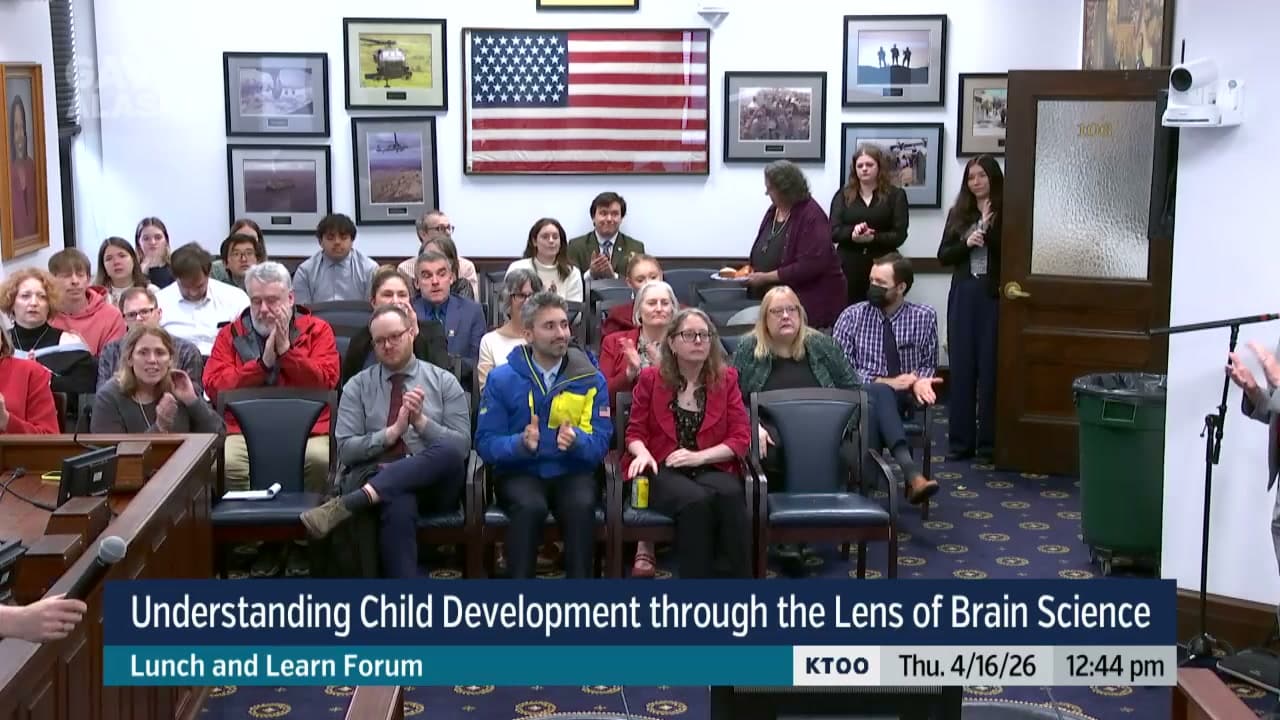
Frame from "Lunch & Learn: Understanding child development through the lens of brain science, 4/16/26, 12pm" · Source
Brain science experts brief legislators on early childhood development
Two officials from the All Alaska Pediatric Partnership walked state legislators through the science of early childhood brain development at a lunch-and-learn session April 16, connecting neural research to Alaska programs that serve young children. The briefing came as lawmakers weighed competing budget priorities, with advocates having recently called on the Senate Finance Committee to restore $5.72 million in funding for the Infant Learning Program.
Tamara Ben-Yosef, executive director of the partnership, and Carmen Wenger, director of programs, presented findings on how experiences in the first years of life physically shape brain architecture. The session took place during the 90th day of the legislative session.
"Every second, a million new connections are being made in a baby's brain," Wenger said, citing research on neural development in children under age 3.
The presentation emphasized that brain growth happens fastest in early childhood. Sixty percent of adult brain size develops by age 3, and 92 percent by age 5. Neural connections that get used strengthen, while unused pathways get pruned away. That process becomes harder to change as children age.
"If we set down that strong foundation, we get the neural pathways the way to set a strong start," Wenger said. "It costs a lot more and it is a lot harder to adjust them later if you are not liking third grade reading scores or your graduation rate is not what you want it to be."
The partnership has operated for 30 years, starting as a collaboration between Alaska hospitals, tribal health organizations, and the Division of Public Health. It became a nonprofit 10 years ago with a mission to transform systems of care and increase access to health services for children.
One of its largest programs, Help Me Grow Alaska, provides resource navigation and care coordination for anyone caring for a child from prenatal to age 26. Family support specialists staff a call center from 8 a.m. to 5 p.m. and help families navigate everything from basic needs to behavioral health referrals.
"We do not provide the service ourselves," Ben-Yosef said. "We do not have medical providers or behavioral health providers, but we will get the family connected."
The presentation highlighted several Alaska programs that support early brain development: the Infant Learning Program for birth-to-3 intervention, Head Start for comprehensive family services, Parents as Teachers for home visiting, and early childhood education programs.
Wenger explained the concept of "serve and return" interactions. When babies coo or gesture and adults respond in meaningful ways, those exchanges form the foundation of brain architecture.
"The way we interact with them, it is how we respond and we show them that we understand them and that they are safe and that we can keep building on their understanding of the world," Wenger said.
The officials also discussed executive function skills: working memory, impulse control, and mental flexibility. Those skills develop between 6 and 12 months and continue maturing into early adulthood. They determine whether children can follow directions, take turns, and adjust to changing situations.
Data from Alaska's Pregnancy Risk Assessment Monitoring Survey shows direct connections between household challenges before birth and in the first year of life and later outcomes including third-grade reading proficiency and school attendance.
One legislator asked about return on investment for early childhood programs. Ben-Yosef cited economist James Heckman's research showing $7 returned for every dollar invested in early childhood, though the exact figure varies by what costs are included. Heckman's research shows a 13 percent return on investment per child per year for high-quality early childhood education for disadvantaged children, exceeding the stock market average of 7 percent.
Representative Alyse Galvin, who organized the session, noted that children who receive services through the Infant Learning Program between ages 1 and 3 are far less likely to need special services in kindergarten through 12th grade. She said the average cost savings is $227,000 per child. Data shows 46 percent of children who receive early intervention through the program do not require special education by kindergarten, representing annual savings up to $34.9 million.
The discussion took place against a backdrop of limited state investment in early childhood. Alaska spends less than 1 percent of its General Fund directly on early childhood, with total federal funding at $173.9 million. In fiscal year 2026, the state added $5.9 million to support licensed child care providers, including a pilot for supplemental payments to infant and toddler care through June 2026.
Another legislator asked about the impact of screen time on young children. Wenger said exposure to screens at young ages takes away the social interactions children need for proper brain development.
"What is needed for that structure and those appropriate neural connections to be created in those really important early years is very much based in the social interactions," Wenger said. "Our brains do not interpret it the same way. We are not learning about social cues. We are not able to see eyes and understand what eyes do."
One legislator noted that vocabulary levels for children entering kindergarten have dropped from about 25,000 words to about 12,000 words, affecting reading proficiency.
Ben-Yosef cautioned against eliminating screen time as an option for parents without providing alternatives. She said sometimes a screen is the difference between a child being completely unsupervised and being in one place safely.
"It is how do we ensure that the families are supported to be able to work with their kids, talk to their kids, read books with their kids, do those things, interact with them, play peekaboo, those things that really build that infrastructure and executive function," Ben-Yosef said.
The partnership also operates an annual pediatric symposium for medical providers and a new program called Growing Minds that offers consultation services for early childhood providers who need help coaching children through behavioral challenges.
Families can contact Help Me Grow Alaska by phone during business hours or submit requests through the partnership's website at any time.
This article is based on a public meeting — Alaska Legislature: Lunch & Learn: Understanding child development through the lens of brain science, 4/16/26, 12pm ().
AI-assisted. How we use AI Transcript byLucas Brown
Stay informed. Support what matters.
Free, permanent access to local news you can verify. Subscribe to support Alaska News and go ad-free.
Related Coverage
House panel considers expanding early intervention for Alaska children
Alaska News · 5mo ago
Alaska Senate passes bill to expand early intervention for delayed children
Alaska News · 4mo ago
Alaska House committee advances bill to expand early intervention eligibility
Alaska News · 5mo ago
Alaska lowers bar for toddlers to get early intervention services
Alaska News · 4mo ago
House panel advances bill to expand early intervention for delayed infants
Alaska News · 4mo ago
Comments
Sign in to leave a comment.
No comments yet. Be the first to share your thoughts.