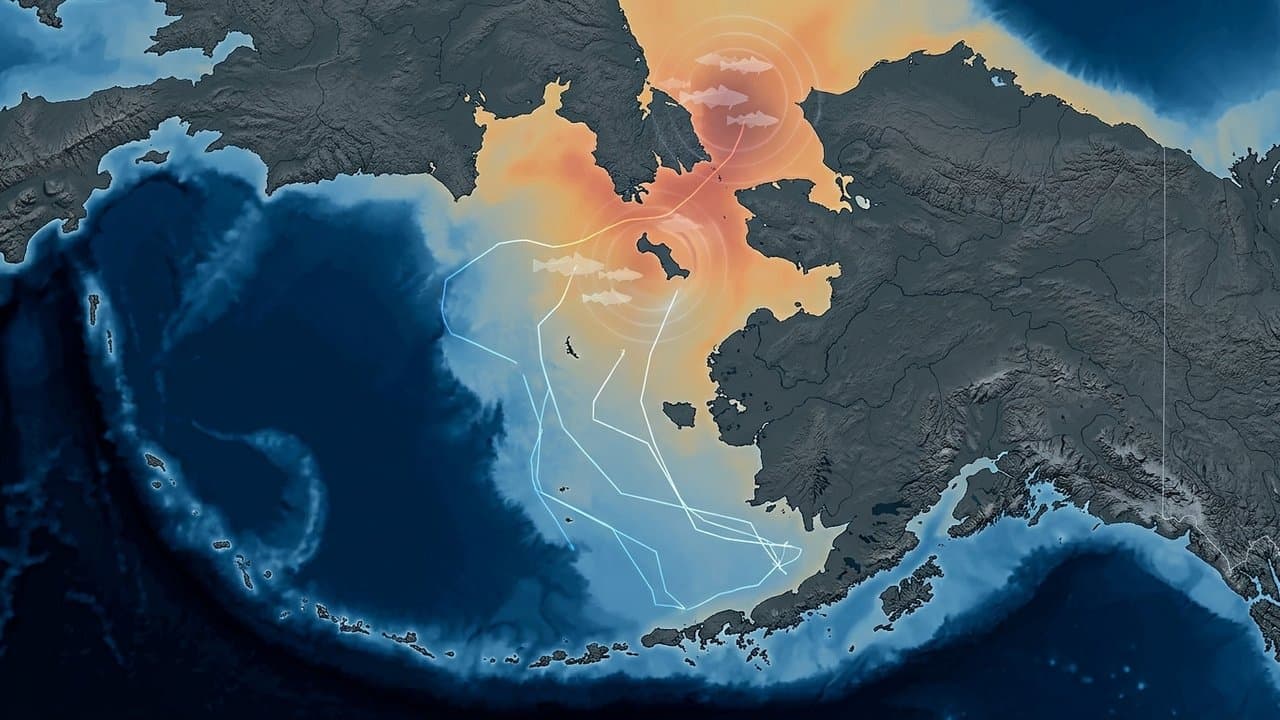
Editorial map (Gemini + Google Maps)
Satellite Tags Track Pacific Cod Shifts in Warming Bering Sea
Pacific cod support Alaska's second-largest groundfish fishery and play a critical role in the Bering Sea ecosystem. From 2017 to 2019, the Bering Sea experienced unusually warm temperatures and minimal sea ice, conditions that appear to have shifted Pacific cod distributions farther north compared to colder years, raising questions about long-term changes in population distribution and demographic structure.
A satellite tagging study launched in 2019 is now generating data to help answer those questions, with direct implications for stock assessments and sustainable management of the fishery.
The tagging study was led by Dr. Susanne McDermott, the Gulf of Alaska bottom trawl survey lead, and included fisheries biologists Julie Nielsen and Kimberly Rand, among others. McDermott described the uncertainty that drove the research: "There was tremendous anxiety over what's going on. Why are these fish in different places? Is this something that's changing on a population level? Is this just the same population moving into different areas?"
The research aims to determine whether recent shifts in cod distribution represent long-term changes or temporary movements, providing data that stock assessments depend on for sustainable management of the groundfish fishery.
Understanding whether the same population is simply moving into different areas, or whether something more fundamental is changing at the population level, is central to the study's purpose. The stakes extend to Bering Sea and Aleutian Islands fishing fleets, processors, coastal communities tied to cod revenue, and northern communities watching ecosystem shifts affect subsistence resources, all of whom depend on accurate distribution and abundance data feeding into management decisions.
Based on a press release.
AI-assisted. No editor review is on record for this article. Who is accountable.
Stay informed. Support what matters.
Free, permanent access to local news you can verify. Subscribe to support Bill AlaskaNews and go ad-free.
Related Coverage
NOAA maps out how new tools enter Alaska's fish surveys
Alaska News · 1w ago
BSAI Pacific cod trawl season ends early for AFA catcher/processors
Alaska News · 1mo ago
A NOAA study finds Pacific capelin may spawn more than once
Alaska News · 1mo ago
NMFS closes Central Gulf cod for hook-and-line vessels 50 feet and up
Alaska News · 2w ago
Pollock fleet builds empirical database of trawl seafloor contact as Congress weighs gear restrictions
Alaska News · 3mo ago
Comments
Sign in to leave a comment.
No comments yet. Be the first to share your thoughts.