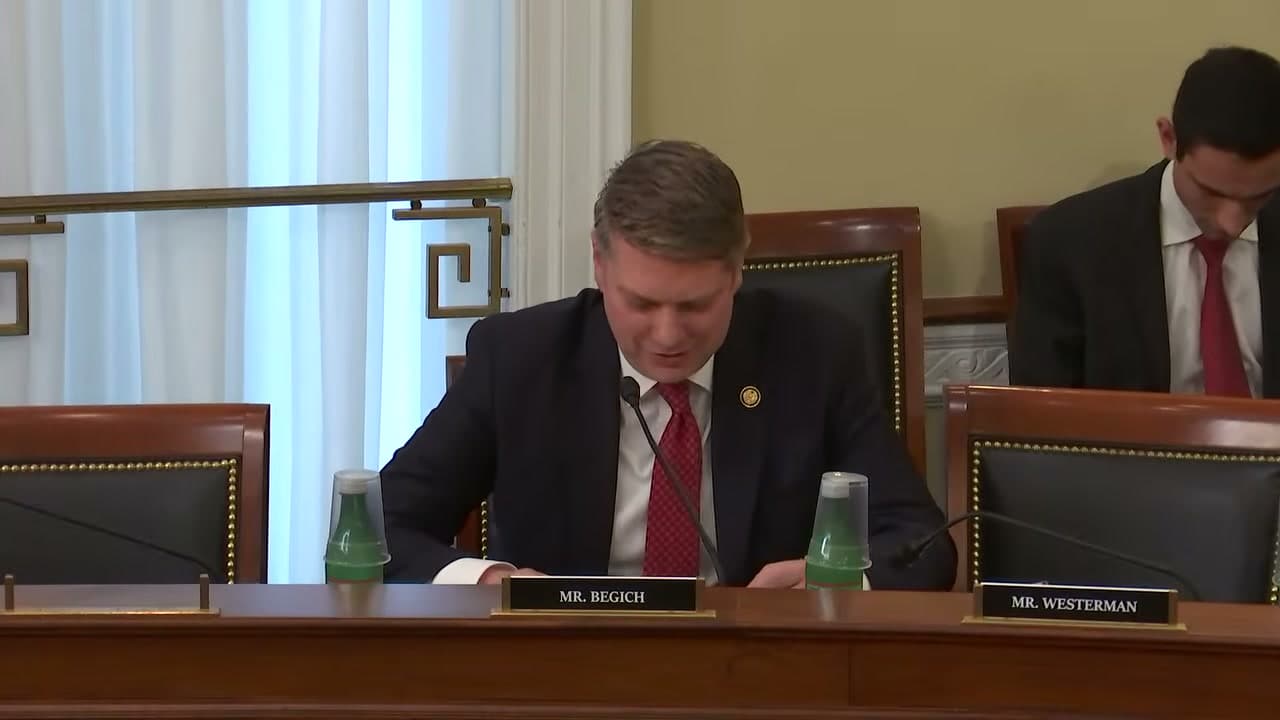
Frame from "House Natural Resources Subcommittee on Indian and Insular Affairs (Begich): Legislative Hearing" · Photo source
Begich bill would let the Indian Health Service fund rabies shots and spay/neuter in rural Alaska
In the Yukon-Kuskokwim Delta, Alaska Native children are hospitalized for dog bites at seven to nine times the national per capita rate. Statewide, the rate is roughly twice the national average. Rabies remains endemic in northern and western Alaska fox populations. And the Indian Health Service — the federal agency responsible for healthcare in Alaska Native communities — does not have statutory authority to fund the veterinary services that would address either problem at the source.
H.R. 8473, introduced by U.S. Rep. Nick Begich in April, would change that. The House Natural Resources Subcommittee on Indian and Insular Affairs heard testimony on the bill Tuesday. Over the past five years, more than 24,000 patients received ambulatory care for dog bites in IHS service areas, with more than 200 hospitalized.
Brian Berube of the Alaska Native Tribal Health Consortium told the panel about a recent incident in Marshall, where 40 of the village's roughly 450 residents required post-exposure treatment after contact with a rabid dog and puppies.
"40 of the roughly 450 residents of Marshall, Alaska, are actually undergoing post-exposure treatment after being exposed by a dog who had come in contact with a rabid fox. And this is not a once-off, this is a fairly common occurrence in our state," Berube said.
H.R. 8473 would give the Department of Health and Human Services explicit authority to provide or fund rabies vaccination, spay and neuter services, and disease prevention through IHS direct care or tribal self-determination contracts. Without that authority today, tribal health organizations in western and northern Alaska can give rabies shots but cannot access spay and neuter services through IHS — meaning dog populations keep growing while individual dogs cycle through boosters.
"Our tribal health organizations in western and northern Alaska, we provide rabies shots, but with no access to especially spay and neuter services, there's no way you can keep up," Berube said.
Funding would come from existing IHS resources, not new appropriations. The bill also directs the Animal and Plant Health Inspection Service Wildlife Services to study oral rabies vaccine delivery to Arctic wildlife — the upstream source of the problem in fox populations that pass rabies to village dogs.
The subcommittee took no action. The ranking member criticized the administration for missing the hearing, noting it was the third tribal hearing in a row without an administration witness. The same hearing also covered H.R. 6917 (Las Vegas Paiute land into trust) and H.R. 8954 (Tribal Regulatory Reform Implementation Act of 2026).
This article is based on a public meeting of House Natural Resources Subcommittee on Indian and Insular Affairs (Begich) — House Natural Resources Subcommittee on Indian and Insular Affairs (Begich): Legislative Hearing ().
Made by our human newsroom with AI. How humans and AI work here · Grow with our newsroom Transcript byLucas Brown
Watch key moments from the source meeting. Click to expand.
Stay informed. Support what matters.
Free, permanent access to local news you can verify. Subscribe to support Alaska News and go ad-free.
Related Coverage
Veterinary care reaches rural Alaska, where dog-bite rates run high
Alaska News · 4mo ago
Rabies is climbing among wildlife across the Yukon-Kuskokwim Delta
Alaska News · 1mo ago
Bethel police warn residents not to shoot suspected rabid animals in the head
Alaska News · 4w ago
Alaska House panel hears testimony on statewide spay-neuter program, no vote taken
Alaska News · 5mo ago
Bethel rewrites its animal code to fight the diseases that actually threaten its dogs
Alaska News · 3mo ago
Comments
Sign in to leave a comment.
No comments yet. Be the first to share your thoughts.