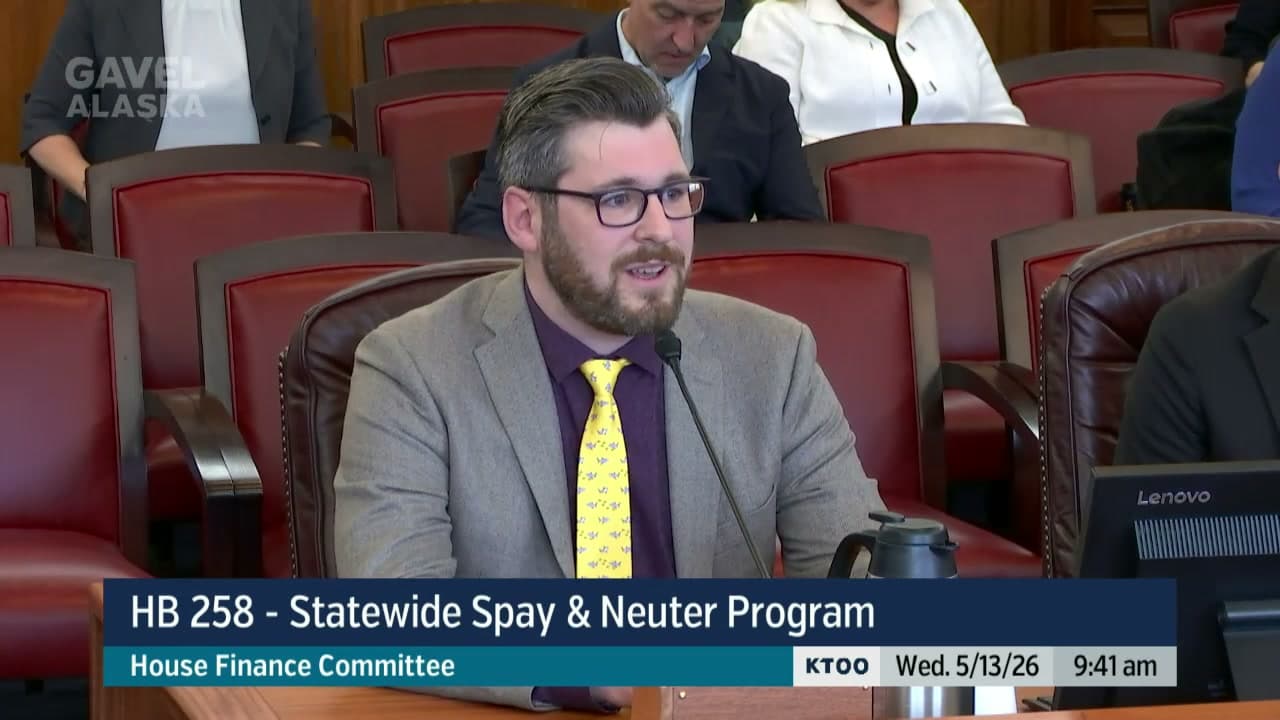
Alaska House panel hears testimony on statewide spay-neuter program, no vote taken
The Alaska House Finance Committee heard testimony Wednesday on legislation to create the state's first statewide spay and neuter assistance program. Supporters described an animal overpopulation crisis in rural communities where veterinary services are scarce or nonexistent.
House Bill 258 would establish a program initially supported with general funds, with potential future revenues from specialty license plates, permanent fund dividend donations, and grants. Representative Elizabeth Rexford said the bill is designed to reduce long-term public costs associated with uncontrolled companion animal populations, including impacts on public safety, animal control, and sheltering.
Background
Alaska News previously reported that the House Resources Committee advanced HB 258 on February 13, 2026, after the bill was introduced January 20 by Representatives Will Stapp, Moore, Dibert, and Costello. The legislation moved to the House Finance Committee, which held its first hearing on the measure Wednesday morning.
Rural communities face veterinary care crisis
Testifiers described severe animal overpopulation problems in communities with no veterinary access. Abby Hall, president of Kenai Peninsula Animal Lovers Rescue, said many villages struggle with large stray dog populations and no access to vaccinations or spay and neuter care.
"Many villages are struggling with large stray dog populations and no access to vaccinations or spay and neuter care," Hall said. "The result is increasing dog bites, often involving children, preventable disease, starvation, freezing, and heartbreaking culling practices."
Linda Lance, president of the Humane Society of Kodiak, told the committee that spay procedures in her community cost around $900 per animal. She said the high cost, combined with Alaska's expensive cost of living, forces pet owners to make difficult choices.
"Locally, the cost of a spay procedure for a female dog is around $900," Lance said. "When faced with the choice between buying food, buying gas for the car, or paying the vet clinic, the latter becomes a low priority and is often forgotten."
A representative from Pawz Nome said her organization is the only nonprofit providing free animal care resources across more than 100,000 square miles in the Bering Straits region. She said the scale of the crisis requires state-level intervention.
Program costs and funding structure
The Department of Environmental Conservation estimates the program would cost $536,200 in the first year and $331,300 annually thereafter. The fiscal note identifies two full-time positions, a program coordinator and an accounting technician. Other costs include an information management system to track applications, eligibility, provider participation, and reimbursements.
Shawndi Perry, Department of Environmental Conservation Environmental Health Division Director, said the fiscal note assumes initial implementation will be supported with general funds and then with potential future offsetting program receipt revenues from donations, license plate fees, grants, and permanent fund dividend contributions.
Representative Galvin asked whether the $30,000 annual public awareness budget would be needed in perpetuity. Perry said the funds would cover mailings to participating veterinarians, newspaper ads, social media campaigns, and general outreach each year, though she would take the committee's concerns into consideration.
Lance emphasized the funding structure would allow Alaskans who care about the issue to support it directly. "By establishing a structure for Alaskans to donate through license plates, Pick Click and Give, and grant opportunities, the statewide spay and neuter assistance program will be funded by Alaskans that care about this problem," she said.
Hall said her organization recently received a Rasmuson Foundation grant and invested in mobile spay and neuter surgical equipment. "Sleepaw recently received a grant from the Rasmuson Foundation and has invested in mobile spay and neuter surgical equipment to launch clinics in communities where no veterinary access is available," she said.
The Permanent Fund Dividend Division submitted an indeterminate fiscal note because of one-time programming costs and an ongoing system overhaul being transitioned to the division in the coming months.
Debate over feral cat programs
Neil Steininger, a Juneau Assembly member testifying in his personal capacity, advocated for including trap-neuter-release programs for feral cats. He described a colony of 20 feral cats in his downtown Juneau neighborhood that creates problems for residents.
Steininger said trap-and-kill policies do not work in dense neighborhoods because they pit neighbors against each other. He said trap-neuter-release offers a more compassionate approach that reduces populations over time.
Representative Hannan asked Steininger whether he would advocate for including feral cats in the bill's coverage. "Through the chair, Representative Hannan, yes, yes, I would," Steininger said.
The bill as currently drafted exempts feral cats from coverage. Hannan asked multiple testifiers about the ratio of dog to cat demand for services. Lance said Kodiak's needs are mostly dogs, while the Pawz Nome representative said 11 of 90 animals her organization provided spay and neuter services for last year were cats.
Lance said her organization treats feral cats brought to the shelter the same as other cats. "If they are not feral enough that we can adopt them, we will take care of them as we would any other pet," she said. "Spay/neuter, vaccines, and find them a home."
The state veterinarian was present for questions but did not testify.
Next steps
Co-Chair Neal Foster set an amendment deadline of Friday, May 15 at 5 p.m. The committee did not take action on the bill Wednesday, scheduling further consideration for a later meeting. Foster said the committee would accept written testimony by email at [email protected].
The committee closed public testimony after hearing from multiple witnesses. No one testified in opposition to the bill.
This article is based on a public meeting — HFIN-260513-0900 ().
AI-assisted. How we use AI Transcript byLucas Brown
Stay informed. Support what matters.
Free, permanent access to local news you can verify. Subscribe to support Alaska News and go ad-free.
Related Coverage
House Finance adds feral cat spay-neuter provisions to invasive species bill
Alaska News · 4mo ago
Alaska House panel considers doubling bulk fuel loan cap amid price crisis
Alaska News · 4mo ago
Senate Finance considers $1M teacher loan repayment pilot program
Alaska News · 4mo ago
House Finance weighs bill to standardize state payment timelines
Alaska News · 6mo ago
Legislature advances $347M fire station grant program
Alaska News · 4mo ago
Comments
Sign in to leave a comment.
No comments yet. Be the first to share your thoughts.