AI image
Anchorage pushes for an emergency boat launch on Turnagain Arm after a drowning
The Girdwood Fire Department entered the water about 25 minutes after arriving at a fatal Turnagain Arm incident. No boat launch exists along that stretch of the Seward Highway, according to a resolution the Anchorage Assembly passed Aug. 4. Assembly member McCormick submitted the resolution, which urges Alaska's congressional delegation — Sens. Lisa Murkowski and Dan Sullivan and Rep. Nick Begich III — to secure federal money to study, design and build an emergency boat access point on the Arm.
The measure builds its case on the death of Joshua Novakovich, 25, of Anchorage, who was swept into the Arm near Mile 92 while paddleboarding the bore tide on June 19, 2026. His body was recovered June 21, 2026, according to Alaska Department of Public Safety records and prior Alaska News coverage. Novakovich remained alive in the water for about three hours, in contact with family and in view of responders, before he died as rescuers tried to reach him, according to the resolution's account.
Girdwood Fire Department arrived with roughly 10 to 12 personnel and multiple apparatus. Crews first requested air rescue, but no aerial asset was available in time. The Alaska State Troopers helicopter carries no hoist and cannot fly at night. The Alaska Air National Guard could not respond from Joint Base Elmendorf-Richardson because of fatigued resources. The Coast Guard helicopter had to launch from Air Station Kodiak, more than 240 miles away.
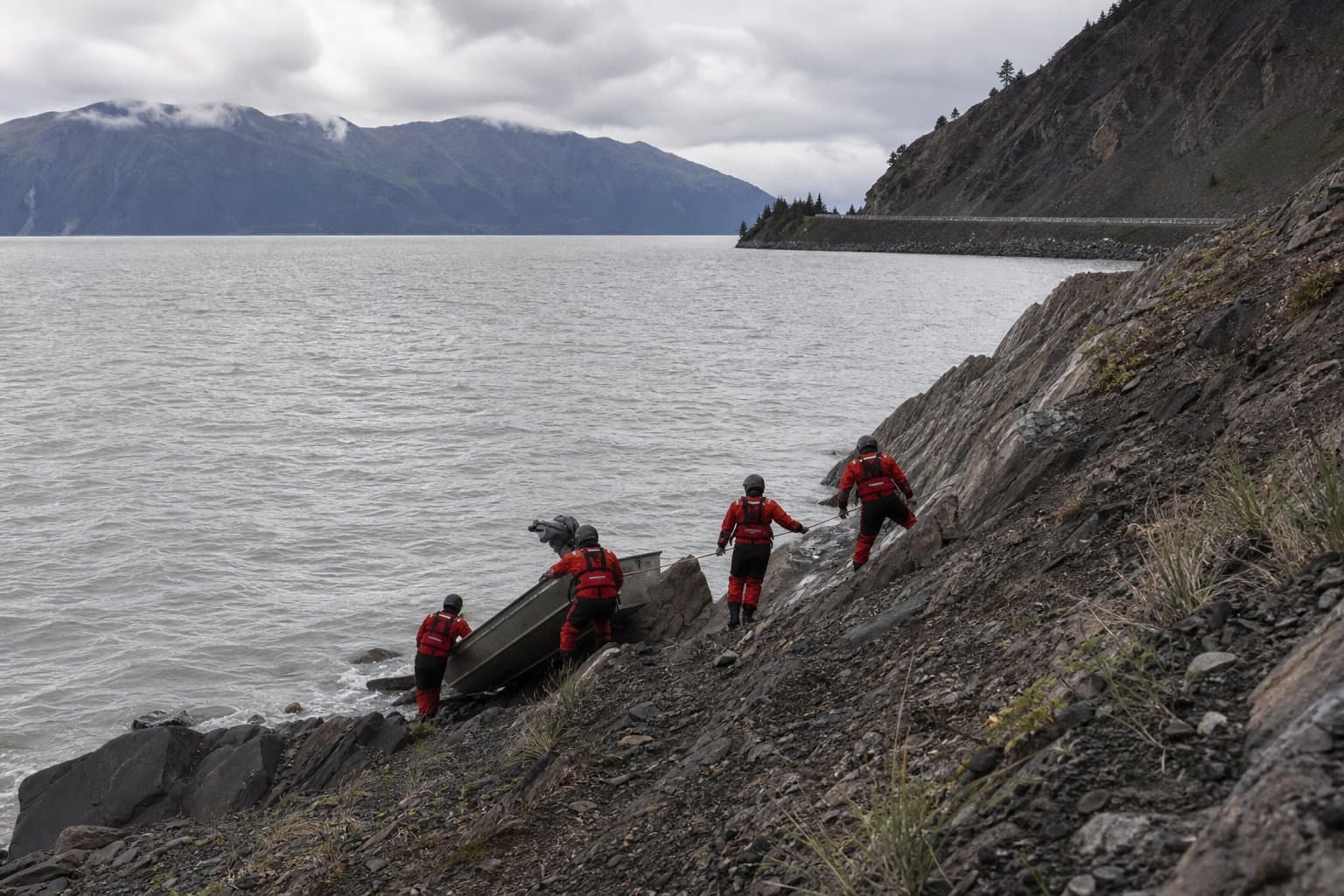
With a boat the only near-term option, crews disconnected the motor from their rescue vessel, hand-carried the motor and hull roughly 30 to 40 feet down steep rocks, and reassembled it at the water's edge. Girdwood Fire and Rescue said of the shoreline, "There is nothing here to facilitate any kind of a boat launch." Crews have said the delay stemmed from infrastructure and jurisdictional constraints rather than responder inaction. McCormick's resolution attributes the gap to the state transportation department having closed access to the water without building a dock, and points to a similar rescue in May 2023 that also failed to free a trapped visitor before the rising tide reached him.
More broadly, it describes the Girdwood case as part of a pattern across Alaska, where it says coastal and tidal-water rescues are repeatedly constrained by limited shore access, long transport distances and scarce aviation assets. It also notes that the Girdwood Valley Service Area cannot spend tax funds on Turnagain Arm water rescues, leaving the department to fund equipment and training through donations.
The department says a public safety access point at Mile 89.5 was removed during a Seward Highway rehabilitation project begun in 2018 and never replaced. The state transportation department has said it cannot build a launch because potential sites fall outside its right of way, with shoreline divided among state, federal, Chugach National Forest and municipal ownership. To untangle that, the resolution asks the delegation to broker coordination among those landowners over right-of-way and permitting barriers, with a single lead agency made accountable for delivering a launch.
Beyond the immediate ask, it presses the state transportation department to build permanent water access into the Seward Highway Corridor Study and the proposed Safer Seward Highway project, rather than retrofit it later. It cites an unvalidated estimate of roughly $1 million for a launch, which it argues is modest against the more than $138 million already spent rehabilitating the same stretch of highway and a fraction of the roughly $1.5 billion the state's preferred Safer Seward Highway design is now estimated to cost.
Whether a launch can be built at all remains an open question McCormick's measure itself frames as needing professional study. The same conditions that hampered the rescue — some of the largest tides in North America, fast bore tides, shifting glacial mudflats and unstable ground — are what make any fixed structure on that shoreline difficult, and the transportation department has said no site it controls is suitable. The central request is not for construction but for the assessments and coordination that would determine whether, where and how a launch is feasible.
There is also a question the resolution does not take up: whether the public should build infrastructure to make a known-dangerous activity safer. The Turnagain Arm bore tide has drawn surfers and paddleboarders chasing a rare, miles-long wave through frigid, fast-moving water, and some would argue the risk of pursuing it falls on those who choose it, not on taxpayers. The counterargument is that a launch is not really about the sport: responders currently have no way to reach anyone in that stretch of the Arm — a swamped boater, a stranded hiker, anyone who ends up in the water — and emergency access to a corridor where people predictably get into trouble is the kind of thing government routinely provides, like a guardrail on a dangerous curve. With the Assembly's vote cast, which of those framings prevails now rests with the congressional delegation the resolution is addressed to.
Source: Anchorage Assembly, Anchorage Assembly: AR No. 2026-230: A RESOLUTION OF THE ANCHORAGE ASSEMBLY URGING THE ALASKA CONGRESSIONAL DELEGATION TO IDENTIFY AND SECURE FEDERAL FUNDING FOR AN EMERGENCY BOAT ACCESS POINT ON TURNAGAIN ARM ().
Drafted with AI. Edited by Cale Green (3 revisions). No full editor review is on record. Who is accountable.
Stay informed. Support what matters.
Free, permanent access to local news you can verify. Subscribe to support Walter AlaskaNews and go ad-free.
Related Coverage
Troopers recover paddleboarder's body from Turnagain Arm sandbar
Alaska News · 3mo ago
Mat-Su Assembly declares Talkeetna flood emergency, seeks state aid for permanent fix
Alaska News · 2mo ago
Anchorage Assembly considers $1.75M federal grant to replace port's 1960s electrical system
Alaska News · 3mo ago
The Anchorage Assembly recognized September as Suicide Prevention Awareness Month
Alaska News · 1mo ago
Anchorage Assembly weights resolution would back JBER buildout as base housing nears full
Alaska News · 1mo ago
Comments
Sign in to leave a comment.
No comments yet. Be the first to share your thoughts.