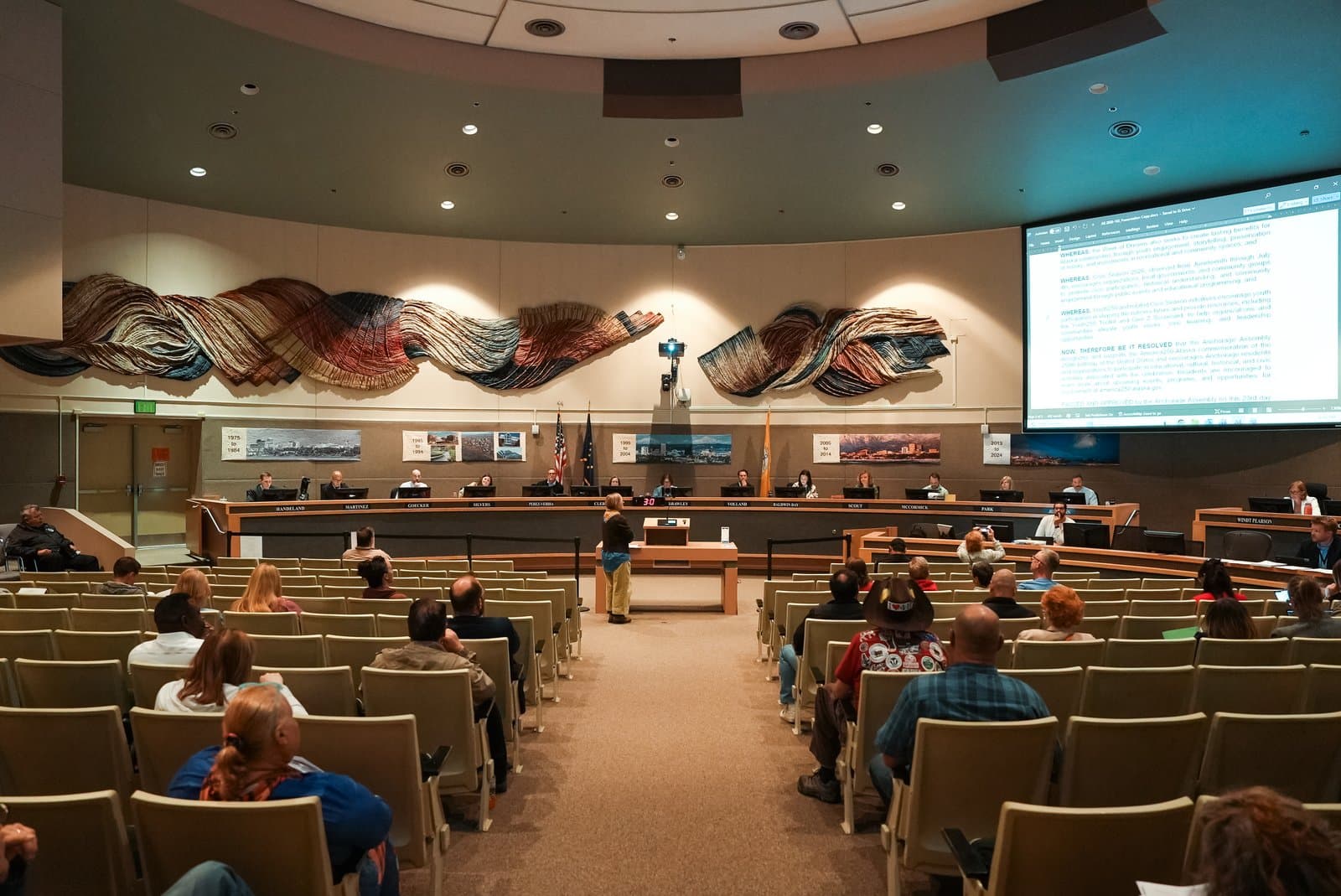
Photo of the inside of the Anchorage Assembly Chambers from June 2026
Anchorage delays surveillance rules as sponsors and mayor remain divided
Anchorage's police surveillance system will keep running under department policy while Assembly sponsors and Mayor Suzanne LaFrance's administration try to reconcile competing rules for it.
The Assembly closed public testimony Tuesday, then voted 12-0 to postpone AO 2026-108 until Oct. 20. Members plan at least one work session before then.
The unresolved question isn't whether police should have rules. It's which protections must be fixed in municipal code and which can stay in policies the department can change on its own.
The original sponsors proposed a 14-day retention limit, restrictions on automated license plate readers, Assembly approval for new surveillance technology and a ban on predictive analytics. The mayor's substitute would put some protections in code but leave data-retention periods to APD policy and allow predictive analysis as one factor in police decisions.
Assembly Member Daniel Volland said the sponsors and administration weren't fully aligned and that a new sponsor substitute contains stronger protections. He said the Assembly had "put the cart before the horse" by funding the Real Time Crime Center before adopting enforceable rules.
"Any protections for the public are just a matter of internal APD policy," Volland said. He noted a police chief can change those policies without an Assembly vote.
Other members warned against overstating what APD is doing now. Assembly Member Kameron Perez-Verdia said Anchorage isn't conducting mass surveillance and argued that more time would produce workable rules without interfering with legitimate investigations.
Current APD policies impose a 14-day limit on unpreserved license plate and crime-center data, according to the administration.
The delay preserves the status quo: APD's integrated camera and license-plate surveillance system will continue operating under department policy while the Assembly decides which limits belong in law. The public record still does not disclose which analytical capabilities are enabled or how routinely officers search, track or combine the available data.
Source: Anchorage delays surveillance rules as sponsors and mayor remain divided ().
Drafted with AI. Edited by Cale Green (2 revisions). Reviewed by Cale Green. Who is accountable.
From prior coverage
Stay informed. Support what matters.
Free, permanent access to local news you can verify. Subscribe to support Alaska News and go ad-free.
Related Coverage
Anchorage paid to expand the crime center, then put off the rules
Alaska News · 1w ago
Mayor's substitute puts Anchorage's surveillance network before the Assembly Tuesday
Alaska News · 3d ago
Anchorage weighs surveillance rules 11 months after buying the system
Alaska News · 2w ago
As a crime center vote nears, Anchorage weighs whether its privacy limits should be policy or law
Alaska News · 3w ago
Anchorage Assembly takes up a $599,000 crime center purchase and surveillance limits
Alaska News · 2w ago
Comments
Sign in to leave a comment.
No comments yet. Be the first to share your thoughts.