
Sign wavers hold signs for Sen. Dan Sullivan, Rep. Nick Begich, governor candidate Bernadette Wilson and Ballot Measure 2 on the evening of Election Day, Nov. 3, before polls closed. (Alaska News)
Analysis: Ranked choices would put Begich just over 50% as counting continues
On the ballots counted so far, Republican Rep. Nick Begich would narrowly pass 50% in Alaska's U.S. House race once voters' backup choices are applied, an Alaska News analysis of state ballot data shows. But nonpartisan Bill Hill has led among early and absentee ballots, and tens of thousands of ballots are still uncounted.
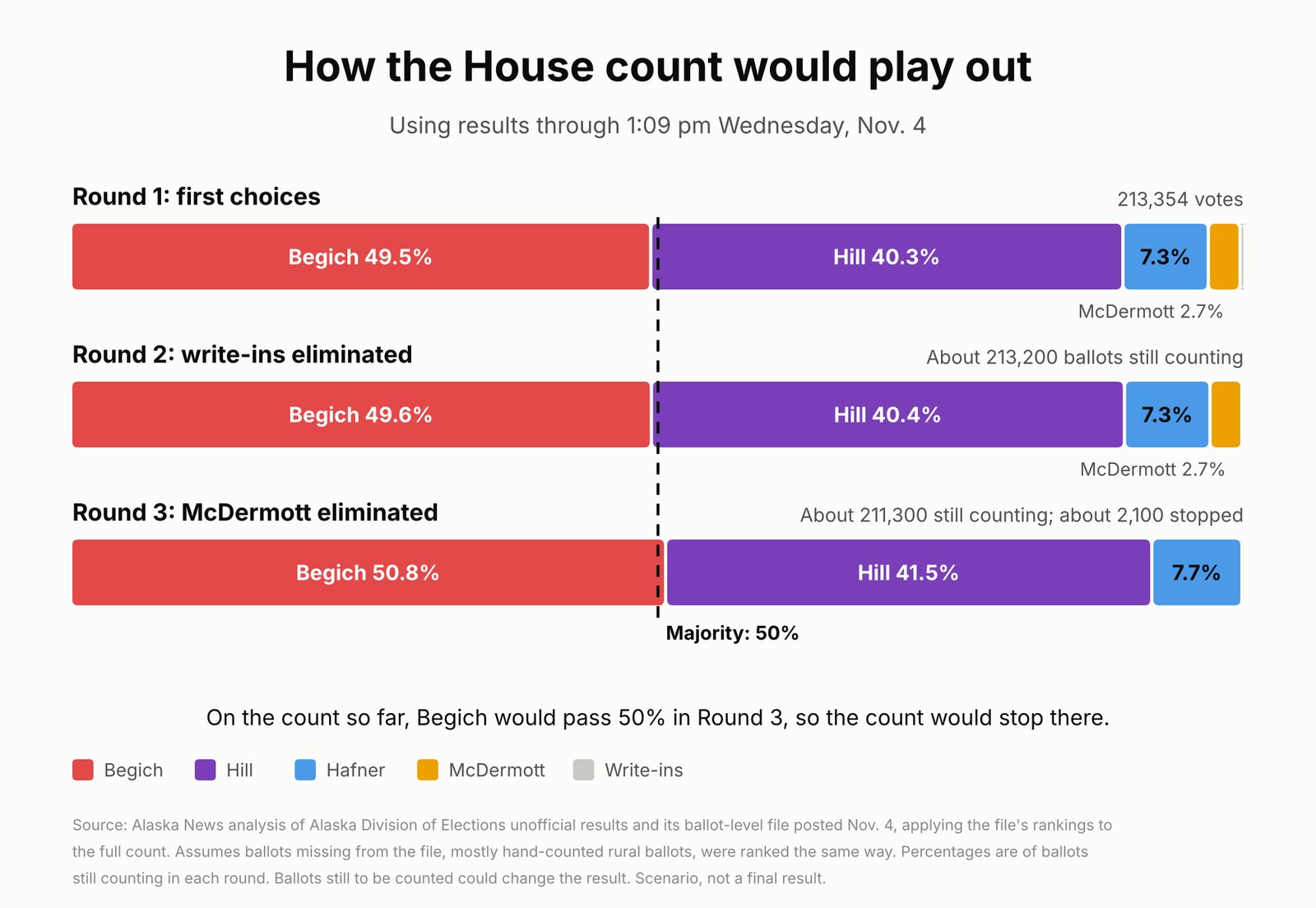
Begich has 49.5% of first-choice votes in the Division of Elections' latest report, posted at 1:09 pm Wednesday. Hill, a Bristol Bay commercial fisherman and retired educator, has 40.3%. Democrat Eric Hafner has 7.3% and Libertarian Jim McDermott has 2.7%.
Hill has won about half of the early and absentee votes counted so far, to Begich's 42%, and more of those ballots are still to be counted. Begich won 52% of Election Day votes, to Hill's 37%.

Hafner, the only registered Democrat in the race, is serving a federal prison sentence in New York and has no apparent ties to Alaska, The Associated Press reported last month. The Alaska Democratic Party endorsed Hill.
The division also posted a ballot-level file early Wednesday, which records how each ballot was marked without identifying voters and covers most, but not all, of the ballots counted so far. In it, 94% of the ballots that ranked Hafner first ranked Democrat Mary Peltola first for Senate, and 92% ranked Democrat Jonathan Kreiss-Tomkins first for governor, about the same as ballots that ranked Hill first. About one in seven ballots that ranked Peltola first for Senate ranked Hafner first for the House.
Hafner's voters were more likely than the front-runners' to use their backup choices. About 45% of the ballots that ranked him first marked no other choice, compared with nearly 60% of those that ranked Hill first and more than three-quarters of those that ranked Begich first. Most of Hafner's voters who did rank someone else picked Hill next.
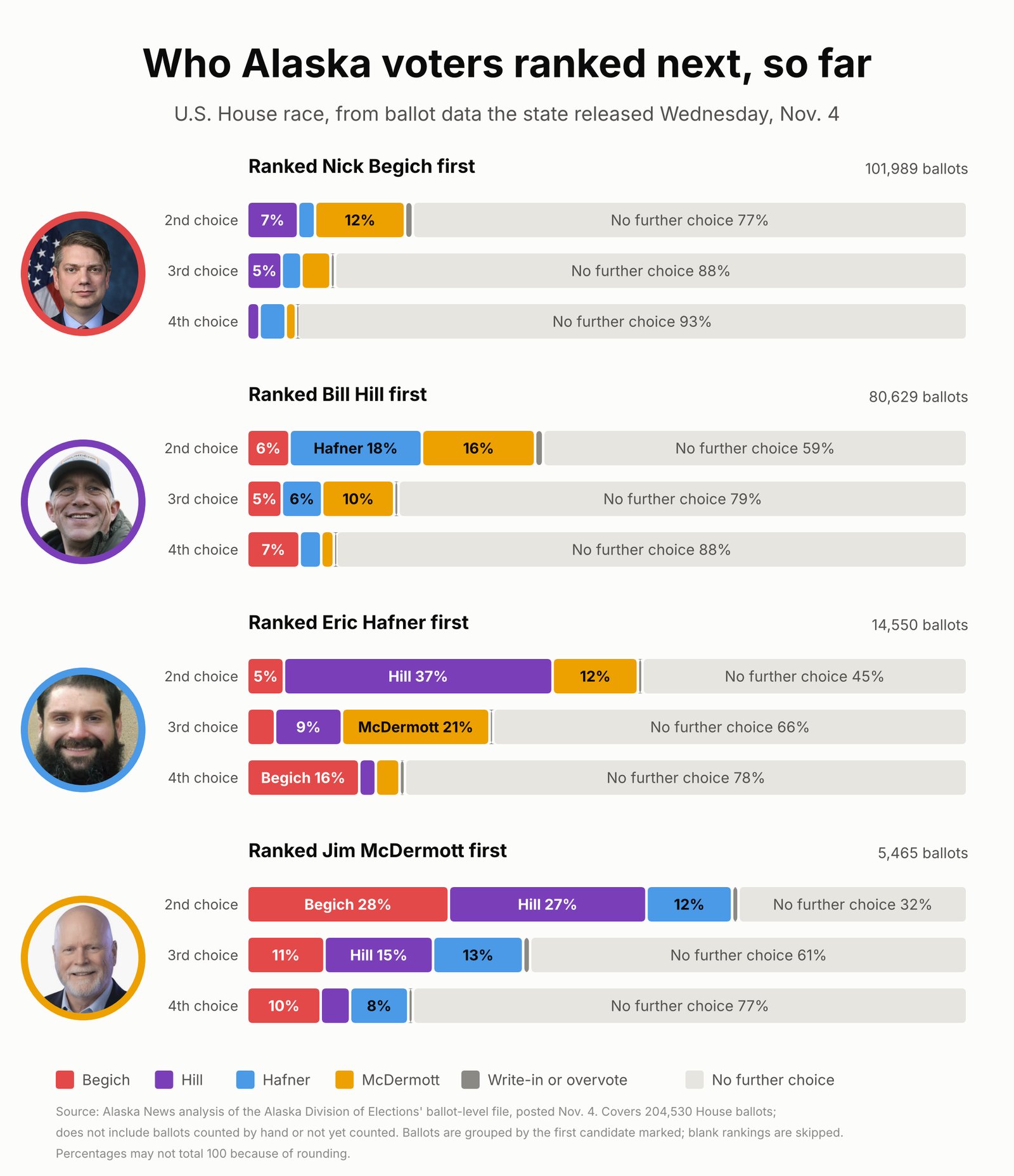
Alaska News ran the ranked-choice rounds on that file and, using the same method as its analyses of the Senate and governor's races, applied voters' rankings to the full preliminary count. McDermott, in last place, would be eliminated after write-ins, and his ballots would split almost evenly: about 28% would move to Begich, 28% to Hill and 12% to Hafner, and about a third would stop counting.
That would give Begich about 50.8% of the votes still counting. Under Alaska's rules, the count stops once a candidate has a majority, so there would be no final round between Begich and Hill.
That is not a final result. The division plans to count early votes cast from Oct. 30 on and questioned ballots starting Nov. 10, and absentee ballots postmarked by Election Day can arrive through Nov. 13 from inside the U.S. and through Nov. 18 from overseas.
By Alaska News' math, Begich would clear 50% outright, with no ranked-choice count, if he wins about 51% of the votes still to be counted. That's more than his share of early and absentee votes so far but less than his Election Day share. He would still pass 50% once McDermott's ballots move if he wins about 47% or more. Both marks shift by only a point or two whether 50,000 or 100,000 ballots remain.
Below 47%, the count would go to a final round between Begich and Hill after Hafner is eliminated. About 45% of the ballots that ranked Hafner first would move to Hill and 6% to Begich, and the rest would stop counting. On the current count, voters' rankings give Begich about 53% in that round. Hill would pull ahead if Begich won less than about a third to two-fifths of the votes still to be counted, depending on how many ballots remain. That's lower than his share of the early, absentee or Election Day votes counted so far.
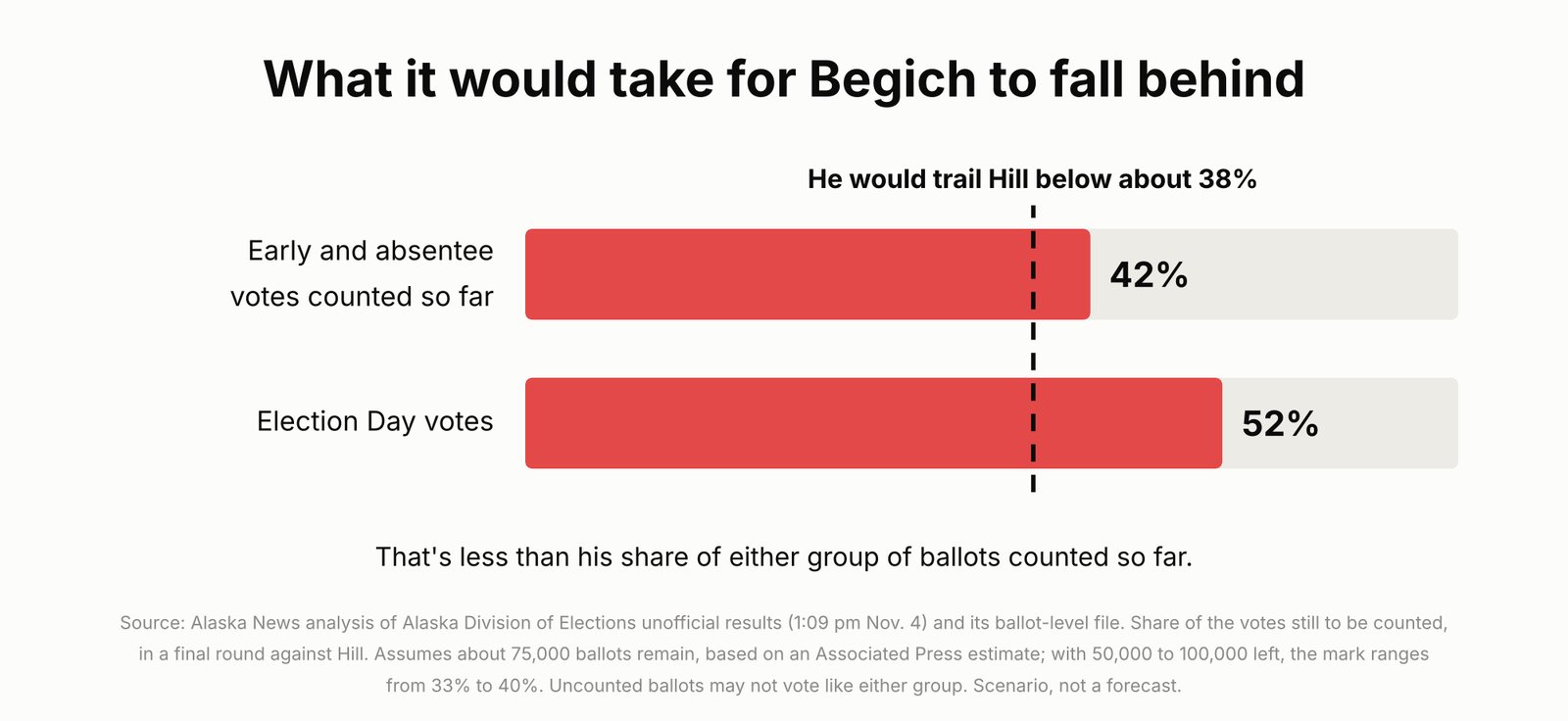
If the uncounted ballots vote like the early and absentee ballots counted so far, the count would reach that final round, and Begich would lead by roughly 4,000 to 8,500 votes. The ballots still to be counted include early votes cast later in the campaign, absentee ballots and questioned ballots, a different mix than the ballots counted so far.
The ballot-level file doesn't include ballots counted by hand, the division says, which leaves out Election Day ballots from many rural precincts. Those voters favored Hill on first choices. The file covers 204,530 of the 215,906 ballots cast in the House race, and applying its rankings to the full count assumes voters missing from it ranked the candidates the same way.
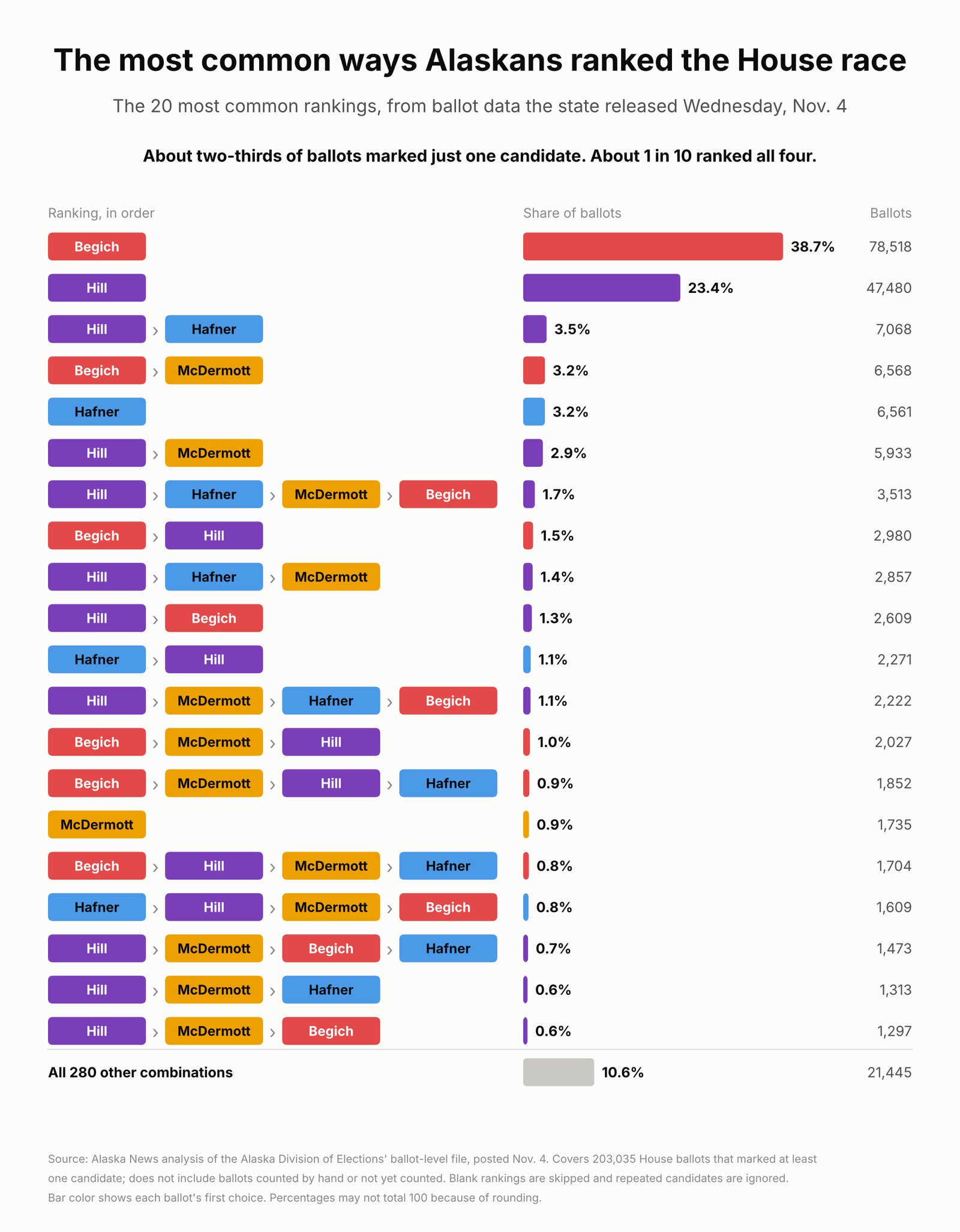
Across the file, about two-thirds of House ballots marked just one candidate, and about 1 in 10 ranked all four.
The ranked-choice count for races without a majority is scheduled for Nov. 18. Two years ago, Begich won the seat in a ranked-choice count. He had 48.4% of first-choice votes and finished with 51.2% after Hafner and Alaskan Independence Party candidate John Wayne Howe were eliminated.
What did you make of this story? (no account needed)
Get Alaska News in your inbox
Create your free account and get the day’s top stories around 6 each morning, in a few minutes’ read.
The day's top stories around 6 each morning. Unsubscribe in one click.








Comments
Sign in to leave a comment.
No comments yet. Be the first to share your thoughts.