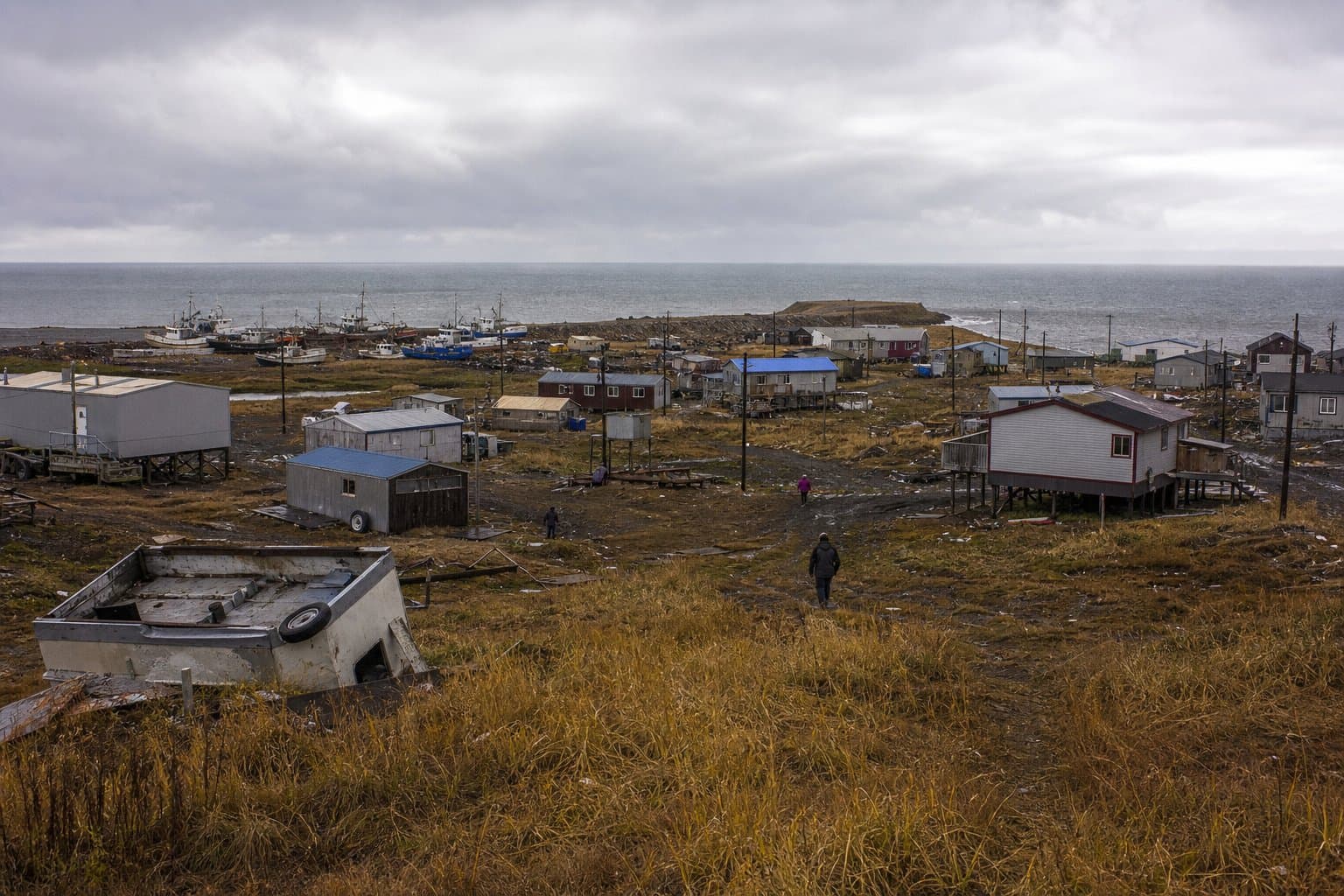
AI image
Alaska will not ask HUD to move its own Merbok villages into the 80 percent tier
Villages the state itself added to its Typhoon Merbok damage list will stay on the smaller side of a $38,493,000 federal grant, under a rewritten recovery plan now open for public comment until 11:59 p.m. Oct. 9. The grant is meant for 53 communities the U.S. Department of Housing and Urban Development or the state designated Most Impacted and Distressed.
The 281-page draft changes no dollar figures. Every line in the budget table matches the version HUD approved on Sept. 1.
At least 80 percent of the grant must be spent in the three regions HUD named Most Impacted and Distressed, the Bering Strait, Kashunamiut and Lower Yukon REAAs, the regional school districts covering rural Alaska outside city and borough systems. No more than 20 percent may go to the three the state added, Lower Kuskokwim, Yupiit and the Pribilof Islands. In dollars that is $24,635,520 against $6,158,880.
The request to move communities across that line came from the Alaska Institute for Justice, an Anchorage legal group working with Tribes in the region, in comments on the 2025 draft. It wrote of "communities in the Lower Kuskokwim Area that suffered devastating impacts to housing infrastructure from this storm." The state answered then that it would use 2026 outreach to evaluate and, "if able to justify," ask HUD to change the designations.
This draft revises that answer. The amendment now answers that "citizen engagement activities provided insufficient data to support a request to HUD to change the assignment of MID communities for the Typhoon Merbok CDBG-DR," the disaster recovery block grant program. The state adds that while there is political support for the change, "reported storm intensity and level of damage from Typhoon Merbok was significantly greater in the HUD-identified MID areas than in the State-identified MID areas."
HUD permits such a request. The amendment prints the route: a grantee may ask formally, with data showing similar or worse impacts, high poverty, older housing stock or fewer recovery resources. Alaska is not asking.
The state's indicator table shows the gap. Among HUD-identified communities, 74 percent completed the community survey, against 35 percent of state-identified ones. Seventy-five percent reported high severity damage, against 29 percent. Fifty-five percent received FEMA Public Assistance, against 33 percent. The entire community leadership evidence base is 29 communities, 20 on one side and nine on the other, and the state records that in most cases neither side could give an exact number of houses damaged. Administration and planning together take $7,698,600, more than the entire amount that may be spent in the state-identified MID areas.
Infrastructure gets nothing under the plan, despite $63,328,109 in remaining unmet infrastructure need, 70.8 percent of the plan's total unmet need of $89,474,125. The amendment explains the zero by pointing to a separate pot of money: FEMA and the state already approved nearly $109 million in July 2024 to rebuild damaged infrastructure and public buildings. Nearly four years after the September 2022 storm, about 15 percent of FEMA's $90.9 million rebuild obligation had been paid out, this newsroom reported. The plan calls its own remaining-need estimate a likely underestimate.
The mitigation program moves from open application to direct solicitation. "Under direct solicitation, the State will identify and invite specific eligible communities to develop and submit projects for consideration. This approach is being used due to the limited financial resources available," the amendment says. That shifts the choice of who gets mitigation dollars from the communities to the state. The budget stays at $5,021,000 and the award cap at $1,000,000, but the expected number of awards rises from five or six to 10 or 12.
Every account here is the state's own draft, including the 108 public comments it reprints with replies.
The only public hearing on Substantial Amendment #2 is a Zoom webinar at 10 a.m. Sept. 24, hosted on the account of Agnew::Beck Consulting, the Anchorage firm under an $800,000 contract to write the plan, not on a state platform. Registration is required to testify. Written comments may also be filed through the state's online form or by email or mail through the Typhoon Merbok grant page.
Source: stpaulak.com, Alaska is rewriting its Merbok recovery plan without moving a dollar, and one sentence in it tells the state-identified villages they will not be moved into the 80 percent ().
AI-assisted. No editor review is on record for this article. Who is accountable.
Stay informed. Support what matters.
Free, permanent access to local news you can verify. Subscribe to support Walter AlaskaNews and go ad-free.
Related Coverage
Nearly four years on, Alaska has been paid 15 percent of Merbok's $90.9 million
Alaska News · 1mo ago
Alaska villages can rebuild after Halong. They can't use the money to move.
Alaska News · 11mo ago
State opens comment on $5.8 million Cook Inlet setnet relief plan
Alaska News · 1mo ago
Kipnuk households paid $18 million; no village infrastructure project
Alaska News · 4d ago
Alaska has spent a fifth of its open federal disaster money, with six weeks on the clock
Alaska News · 1mo ago
Comments
Sign in to leave a comment.
No comments yet. Be the first to share your thoughts.