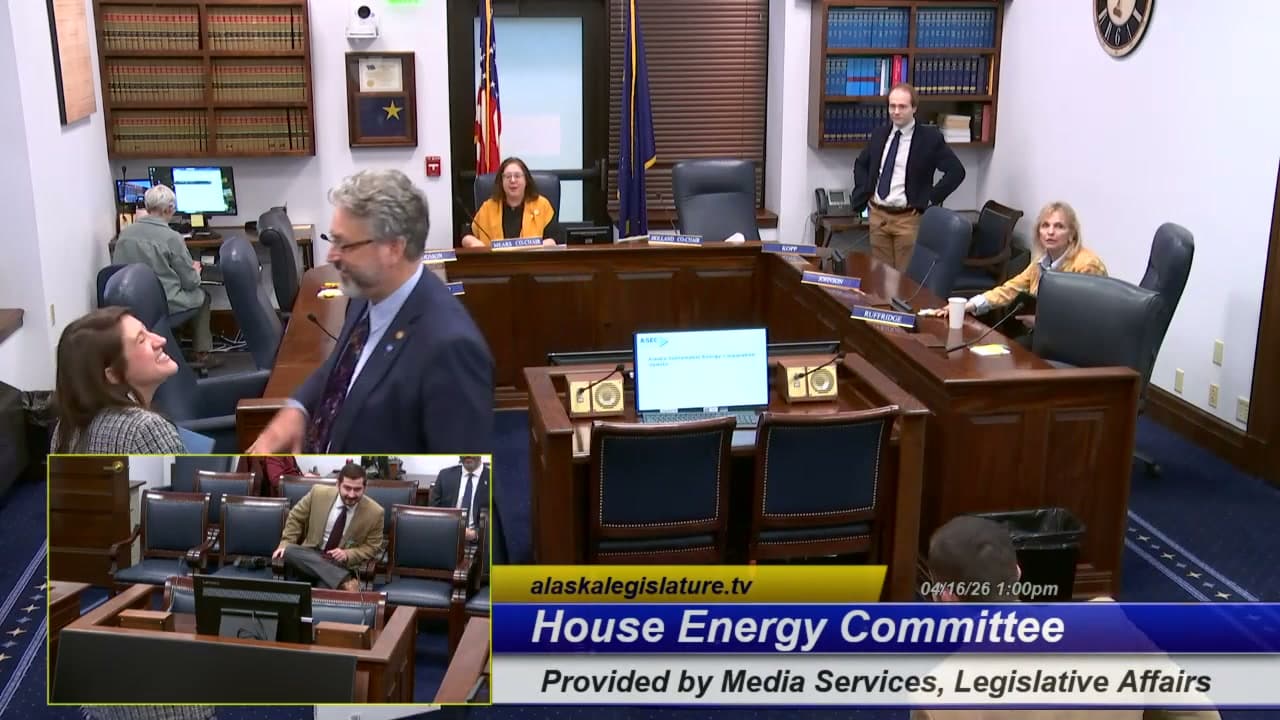
Alaska Sustainable Energy Corporation reports progress on green financing
The Alaska Sustainable Energy Corporation briefed state lawmakers Thursday on its first year of operations as a financing intermediary for sustainable energy projects across Alaska.
Melanie Lucas-Conwell, director of the corporation, told the House Energy Committee that the nonprofit subsidiary of Alaska Housing Finance Corporation has positioned itself as a bridge between capital sources and energy projects rather than a traditional lender. The corporation was established under House Bill 273, signed by Governor Mike Dunleavy on July 31, 2024, and incorporated on November 5, 2024.
"Our role is not to replace private lenders, and it is not to function as a grant program," Lucas-Conwell said. "Our role is to help build financeable transactions, reduce barriers that prevent projects from moving forward, and position public capital in a way that can attract and work alongside private capital."
The corporation has secured $4.7 million through an agreement with the Alaska Energy Authority to administer the U.S. Department of Energy's Energy Efficiency Revolving Loan Fund program. The program will offer loans of up to 15 years for residential energy efficiency improvements identified through energy audits, including insulation, windows, electrical panels, and potentially solar and heat pumps when paired with efficiency measures.
Lucas-Conwell said the corporation targets a first-half 2027 launch for the residential loan program. Because principal and interest return to the fund over time, the structure is designed to continue supporting additional loans beyond the federal performance period.
A request for information issued last June identified approximately $177 million in financing needs across the state, with total project sizes reported at about $434 million. Responses came from tribal entities, community facilities, private developers, and local governments, with projects ranging from building improvements to larger generation and infrastructure proposals.
Representative Ky Holland asked how the corporation differs from existing state agencies. Lucas-Conwell explained the corporation was created to fill a gap where the Alaska Industrial Development and Export Authority focuses on lending from its own capital, the Alaska Energy Authority handles larger commercial projects and grant programs, and Alaska Housing Finance Corporation concentrates on public housing and mortgages.
"When looking at, especially in the last few years, federal grant opportunities that the state might have been able to receive, there seemed to be a gap in terms of which agency or department the state might have been able to receive those grant funds from or towards, and that's where the ASEC was created from," Lucas-Conwell said.
The corporation operates with two staff members and uses Alaska Housing Finance Corporation's shared services for administrative support, accounting, and human resources. Lucas-Conwell was hired in October 2024 as the corporation's first employee, with a program coordinator joining two months later.
"One of our challenges with this revolving loan fund is that we only have two staff members and limited operating budget at this point in time," Lucas-Conwell said.
Lucas-Conwell said the corporation has pursued approximately $21 million in federal grant applications during a period of uncertain federal funding. The corporation also explored a $10 million low-interest loan opportunity with the Coalition for Green Capital but did not pursue it further due to federal funding uncertainties and ongoing litigation.
Representative Bryce Edgmon noted that earlier legislative efforts to establish a traditional green bank in Alaska had failed politically. He questioned whether the current hybrid model is achieving what a fully capitalized green bank might have accomplished.
"We were both co-chairs. There was, we had $10 million in the budget, and then it got stripped out or vetoed or something happened to it as a state matching funds," Edgmon said.
"Here we are about a year and a half later with something that's very fledgling," Edgmon said. "And you're not able to attract the capital that I thought, and I think others thought, would be out there if we'd established a green bank."
Lucas-Conwell acknowledged that successful green bank models in other states typically start with seed capital that can be leveraged to attract additional funds. The corporation has relied on federal funds for that seed capital, which has not fully materialized as originally anticipated. Without that initial capitalization, the corporation has been unable to achieve the scale and leverage ratios that established green banks in other states use to multiply their impact.
"As a new entity that has no track record, we do need to build up that track record and show that we can set up loan funds and are showing some successes," Lucas-Conwell said.
Representative Holland asked what the corporation would do with $10 million in state capitalization. Lucas-Conwell said she would likely focus on loan guarantees or loan loss reserves that could leverage funds 10-to-1 or 20-to-1 by working with outside lenders, rather than establishing in-house lending operations that would require more staff and operational funding.
"If we provided loan guarantees or a loan loss reserve for these projects, we could be able to leverage these funds 10 to 1, 20 to 1, and so therefore unlocking a lot more dollars than just the $10 million," she said.
The corporation's statutory authority covers building energy efficiency, renewable energy generation, electrical infrastructure, clean transportation, and combined heat and power projects. Lucas-Conwell said the broad definition allows the corporation to support practical improvements that reduce energy use and lower operating costs, not just large or highly visible projects.
Lucas-Conwell said early conversations with lenders about the residential energy efficiency program have been positive. She noted that recent federal policy changes have increased willingness to discuss loans rather than grants.
"I am hopeful that there is a renewed interest in financing versus grant funding as a result of the macroeconomics of our country at this moment in time," Lucas-Conwell said.
Co-Chair Ashley Mears said the corporation represents part of a suite of state tools to support private energy development and reduce Alaska's reliance on imported fuel. She said the committee may explore ways to support the corporation's work.
The corporation will share a booth with Alaska Housing Finance Corporation at the Alaska Sustainable Energy Conference in May and will attend the Alaska Rural Energy Conference in October with more details about the energy efficiency loan program.
This article is based on a public meeting — Alaska Legislature: House Energy, 4/16/26, 1pm ().
AI-assisted. How we use AI Transcript byLucas Brown
Stay informed. Support what matters.
Free, permanent access to local news you can verify. Subscribe to support Alaska News and go ad-free.
Related Coverage
Alaska Sustainable Energy Conference explores future of statewide energy systems
Alaska News · 4mo ago
Housing agency buys 600+ acres statewide to spur development
Alaska News · 5mo ago
Alaska House panel considers doubling bulk fuel loan cap amid price crisis
Alaska News · 4mo ago
Senate Finance reviews bill to double bulk fuel loan cap to $1.5M
Alaska News · 4mo ago
Alaska House doubles bulk fuel loan cap to $1.5 million
Alaska News · 4mo ago
Comments
Sign in to leave a comment.
No comments yet. Be the first to share your thoughts.