Alaska House panel considers doubling bulk fuel loan cap amid price crisis
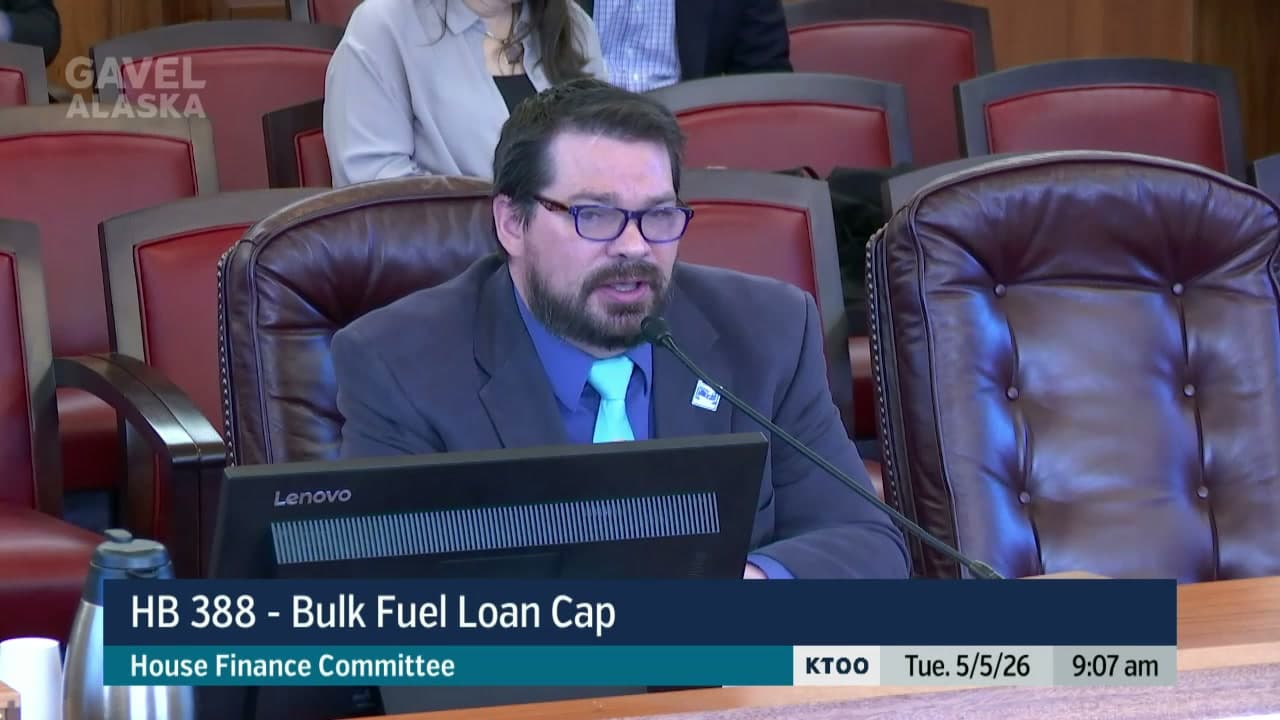
The Alaska House Finance Committee heard testimony Tuesday on legislation to double the maximum bulk fuel loan available to rural communities as fuel prices surge and supply shortages threaten western Alaska.
House Bill 388 would raise the cap on the Bulk Fuel Revolving Loan Fund from $750,000 to $1.5 million per borrower. The program serves communities under 2,000 population, providing short-term financing for bulk fuel purchases that borrowers repay within 12 months.
Sandra Moller, director of the Division of Community and Regional Affairs, told the committee fuel prices have increased $3 to $4 per gallon compared to last year. Some communities are seeing 100 percent price increases. Last winter, gasoline prices ranged from $3.65 in Southeast Alaska to as high as $11.50 in the Northern Interior, she said.
"If there is a $5 increase times 90 million gallons, that is $450 million," Moller said, citing a University of Alaska study. "That shows the amount of impact that we are looking at. We currently think it is in the $3 range, so that is a little higher."
Global supply disruptions add urgency to the price crisis. Co-Chair Neal Foster referenced concerns about fuel availability in western Alaska.
"A letter recently came out saying that there was the possibility that 140 million gallons that go into western Alaska may or may not be there, or maybe it is going to be a partial," Foster said. "And what does that mean for small rural communities that rely on that for heating, but not only heating, but also the electricity to run power plants."
The program currently holds about $22 million in capital. Moller presented two scenarios for additional funding needs. Under one scenario, if all current borrowers reached the new $1.5 million cap, the fund would need $25 million in additional capitalization for a total of $47 million.
"In Scenario B, we took the average loan amount, which is about $350,000, we increased it 100 percent for all those borrowers, and that is what these $25 million would represent," Moller said.
The program served 77 to 78 borrowers last year, the highest number in its history and a significant increase from 54 applicants three years ago. Moller said the division expects that number to grow but cannot predict by how much. The program maintains a 99.5 percent collection rate.
Mike Poston, director of sales for Vitus Energy, told the committee his company is referring more customers to the state loan program this year. Vitus transports fuel to western Alaska but does not finance purchases.
"When we compare prices that we were charging last year to the ones this year, that 100 percent increase, that is a real number," Poston said. "The number of borrowers that are going to need more money because of the cap is going up."
Caitlin Conway, intergovernmental affairs manager for the Alaska Municipal League, said the crisis will affect communities statewide, not just rural Alaska. She urged the legislature to ensure adequate capitalization of the fund.
"Without this bill, when communities must stick to the $750,000 cap, even though the price is going double, the loan will not get communities as far," Conway said. "This is going to lead to under-ordering, meaning communities will not have enough fuel to make it through the year."
The bill also removes an alternative minimum cap of $1.8 million for pooled loans, where multiple communities combine resources. Under current law, pooled loans are capped at either the number of communities times $750,000 or $1.8 million, whichever is less. The bill would eliminate the $1.8 million floor.
Moller noted the last comparable price spike occurred in 2022, but federal COVID relief funds and energy rebates helped communities absorb those costs. No such assistance exists this year.
The committee took no action Tuesday. Foster said the panel would hear public testimony on the bill at its next meeting.
This article is based on a public meeting — HFIN-260505-0900 ().
AI-assisted. How we use AI Transcript byLucas Brown
Stay informed. Support what matters.
Free, permanent access to local news you can verify. Subscribe to support Alaska News and go ad-free.
Related Coverage
Senate Finance reviews bill to double bulk fuel loan cap to $1.5M
Alaska News · 4mo ago
Alaska lawmakers hear warnings of rural fuel crisis, weigh loan program expansion
Alaska News · 5mo ago
Alaska House doubles bulk fuel loan cap to $1.5 million
Alaska News · 4mo ago
Alaska doubles bulk fuel loan cap to $1.5 million for rural communities
Alaska News · 2mo ago
Rural Alaska fuel prices could hit $25/gallon, lawmaker warns
Alaska News · 5mo ago
Comments
Sign in to leave a comment.
No comments yet. Be the first to share your thoughts.