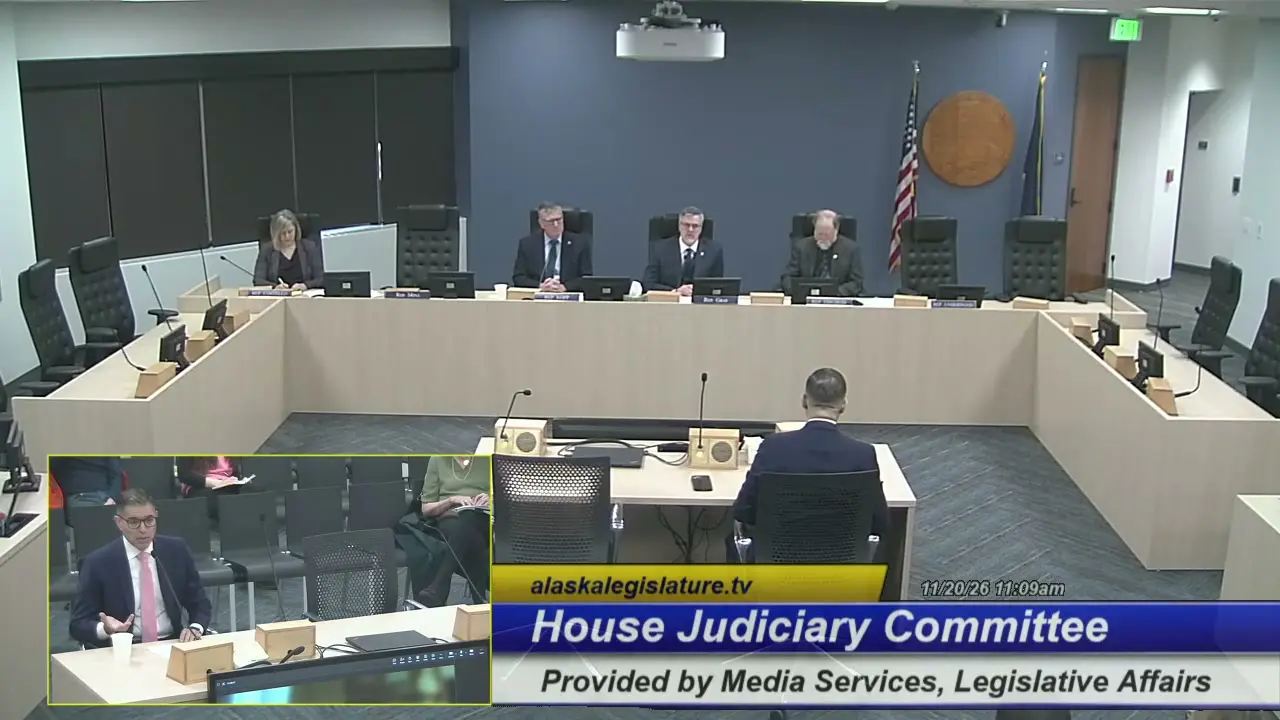
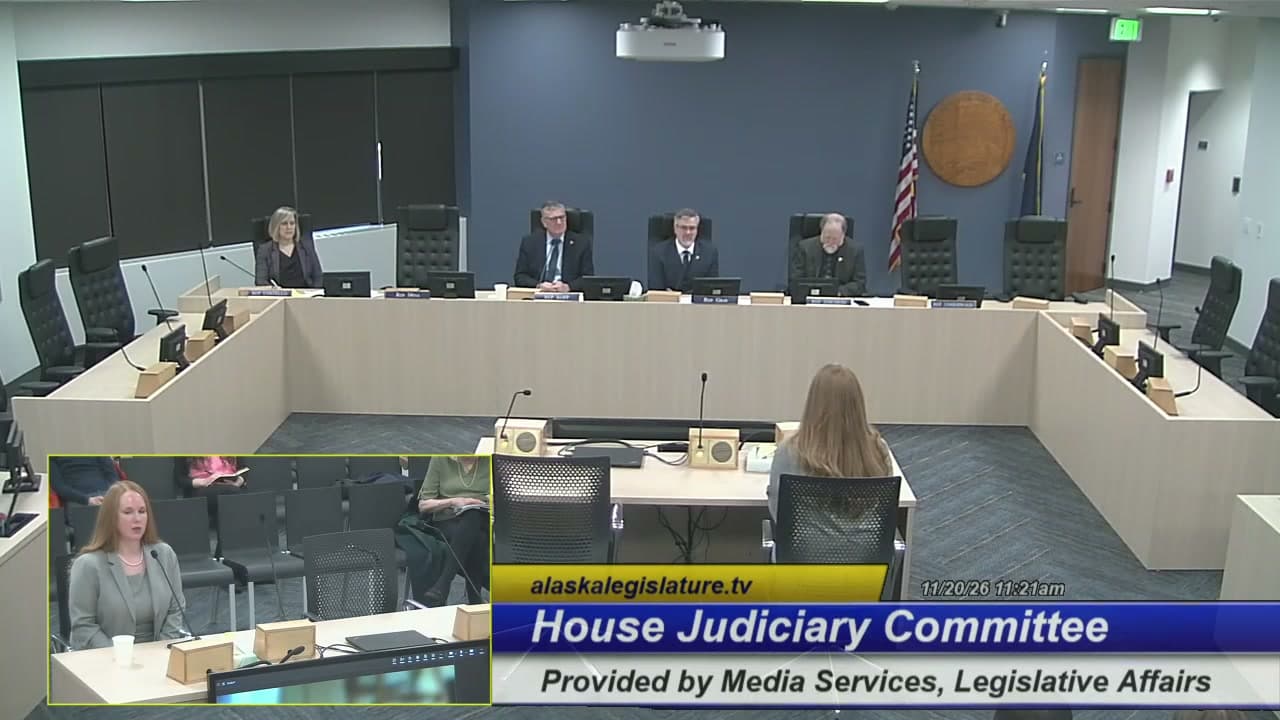
Frame from "Alaska Legislature: House Judiciary - November 20, 2026 10:00am" · Photo source
Alaska jails held 130 people for ICE this year, up from 13 in all of 2024
The Alaska Department of Corrections held 130 people for Immigration and Customs Enforcement this year through Oct. 19, Rep. Andrew Gray told the Alaska House Judiciary Committee on Friday. The department held 13 people in all of 2024.
The yearly counts come from department records the ACLU of Alaska obtained through public records requests, according to the group's memo to Gray in the hearing packet. The department held 18 people for ICE in 2022 and 14 in 2023. In 2025 it held 99, Gray said, not counting 41 men flown in from Washington. He said 55 people were held from July through September alone, more than in 2022, 2023 and 2024 combined.
Most holds are short, Gray said. The most common length is three days, but one in five people held this year stayed a week or more. One man was held 128 days before a federal judge ordered his release.
Gray, who chairs the committee, opened the Anchorage hearing by noting that immigration detention is civil confinement, not punishment, and that people in removal proceedings have not been convicted of crimes. The Department of Corrections did not testify. Gray said the commissioner told the committee by email Friday that the state held no ICE detainees that day. The department agreed to answer the committee's questions in writing.
Alaska has no federal immigration detention facility, so detainees are held in Alaska jails until they are released or transferred, most often to the Northwest ICE Processing Center in Tacoma, according to the ACLU memo. Gray said the department is paid $243.24 a day per detainee, the rate set in ICE's May order to the department.
Under a 2020 agreement with the Department of Homeland Security, corrections staff can also serve ICE arrest warrants on people in state custody before their release on state charges. By the ACLU's count, 40 of the 130 people held this year, or 31%, were kept in custody that way. The memo assumed a warrant had been served whenever an ICE hold immediately followed release on state charges.
David Bier, director of immigration studies at the Cato Institute, testified that ICE arrests in Alaska grew from one a month in December 2024 to 22 a month by July 2026, for 184 total since January 2025. He said the figures come from ICE's own records, obtained through public records requests by the Deportation Data Project at UC Berkeley and UCLA.
In Alaska this year, Bier said, 68% of people booked into ICE detention had no criminal conviction and 14% had a violent conviction. Nationally, the figures were 70% and 6%.
Bier said only about 30% of ICE arrests in Alaska this year enforced an existing removal order. The state's warrant agreement is one of ICE's 287(g) agreements with state and local agencies. "These 287 agreements are voluntary. They can be terminated at any time," Bier said.
Letier Barreto, a hospice nursing assistant, told the committee he was held at the Anchorage Correctional Complex after ICE detained him June 11. He said that for several days he shared a small space with two other detainees and slept on the floor next to the toilet, then spent 117 days in administrative segregation, alone in his cell about 23 hours a day. He said he was strip-searched after attorney visits about a dozen times, in a room with the door open. A federal judge ordered his release Oct. 15. He asked the committee to examine segregation, lockdowns, visitation, strip-search privacy and independent oversight.
The committee also received a sworn declaration from a man held at the complex for 38 days this past summer. It says an immigration judge had already granted him protection from removal. "Meaning that there was no legal reason for him to be held, much less in a prison," Gray said. He said the department had not yet had a chance to respond.
Immigration attorneys Nicholas Olano and Laura Nations said bond hearings for people held in Alaska moved from Portland to Tacoma in 2025, and that since August, two Tacoma judges have not allowed attorneys who are not there in person to appear by video. That makes it harder for Alaska attorneys to represent detainees transferred out of state, they said.
Michelle Giroux, executive director of Hope Community Resources, said an employee detained at the Anchorage airport in August was moved to Tacoma, Louisiana and Mississippi before returning in October, disrupting care for clients with autism.
The committee held a hearing in June 2025, 12 days after the 41 men were flown to Anchorage from Tacoma, and an investigative hearing on the detention of minors by ICE in February.
Gray closed by summarizing proposals raised at the hearing: independent routine oversight of conditions, minimum protections in state law for civil immigration detainees such as limits on unnecessary strip searches, a ban on accepting civil detainees from other states, bond hearings held in Alaska, and possible limits on ICE arrests near courthouses and schools. "We should look at our 287 agreements and decide whether or not we should continue any of them," he said.
Gray said the federal public defender's office for the District of Alaska is willing to file habeas petitions, which challenge the legality of a detention, for people ICE arrests and holds in the state. The office can be reached at 907-646-3400.
What did you make of this story? (no account needed)
Made by our human newsroom with AI. How humans and AI work here · Grow with our newsroom · Transcript byLucas Brown
Keep Alaska News free for everyone.
No paywall, ever. Members pay so everyone can read the meetings and records Alaska News covers.
Get Alaska News in your inbox
Create your free account and get the day’s top stories around 6 each morning, in a few minutes’ read.
Top stories, around 6 each morning.
Stories on what you follow, on Sundays.
This article is based on a public meeting of Alaska State Legislature — Alaska Legislature: House Judiciary - November 20, 2026 10:00am ().
Watch key moments from the source meeting. Click to expand.











Comments
Sign in to leave a comment.
No comments yet. Be the first to share your thoughts.