Alaska House panel advances penny rounding bill amid federal mint halt
The Alaska House State Affairs Committee heard legislation Thursday that would establish how businesses round cash transactions to the nearest nickel, a response to the federal government's decision to stop producing pennies.
House Bill 281 would require symmetrical rounding for cash purchases when exact change is unavailable. Transactions ending in one or two cents would round down to zero, while those ending in three or four cents would round up to five cents. The pattern continues with six and seven cents rounding down to five, and eight and nine cents rounding up to the next dime.
The federal government halted penny production in early 2025 after production costs reached 3.69 to 3.7 cents per coin. The U.S. Mint struck its final regular pennies by June 2026 after exhausting its supply of copper-zinc blanks. Though more than 100 billion pennies remain in circulation, shortages emerged quickly as consumers began hoarding the coins. Pennies remain legal tender, and retailers should continue accepting and providing penny change while the coins are still in circulation.
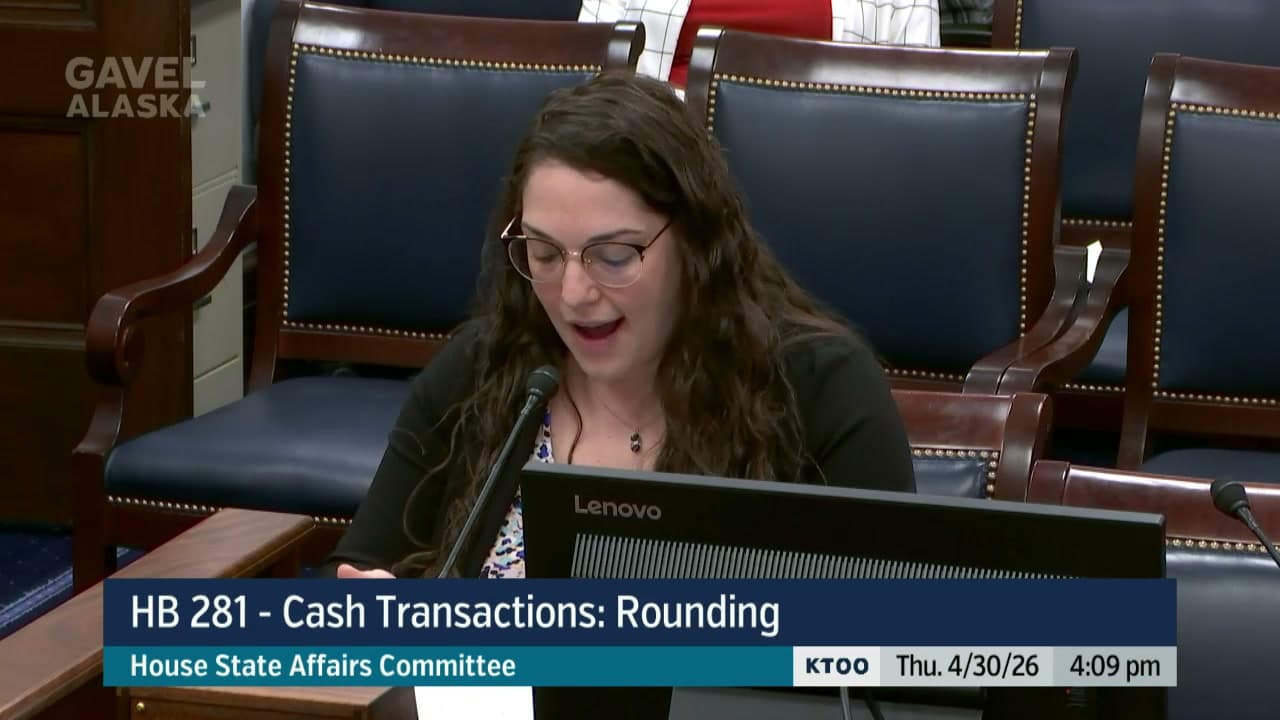
"Already both consumers and businesses are not able to make exact change when dealing with cash transactions," said Melodie Wolterdink, staff to bill sponsor Representative Sadler, who was traveling Thursday.
The rounding requirement would apply only to the 10 to 20 percent of transactions still conducted in cash. Credit card, debit card, check, and mobile payments would remain unaffected and continue to calculate to the penny.
Representative Carrick, who chairs the committee, noted the issue carries particular weight in rural Alaska communities where cash transactions remain more common and access to small change is limited.
"This is really important, especially in small communities where you do not have maybe more cash transactions going on. You do not have any ability to do small change too," Carrick said.
Wolterdink said Alaska is following guidance from the National Conference of State Legislatures as multiple states move to address the penny shortage ahead of potential federal action. The approach aims to create consistency across point-of-sale systems that operate nationwide.
"It seems like a lot of states are moving forward because I think states will actually take action sooner than the federal government on this," Wolterdink said. "And so we are following kind of general guidelines of what has worked in other states, and particularly when we are thinking about small businesses and their point-of-sale systems."
Representative Himschoot said the bill mirrors Canada's approach when that country eliminated its penny. She noted that a Hammer and Wikan grocery store manager in Petersburg recently wrote to the local newspaper alerting consumers to prepare for the change.
Himschoot said she plans to propose an amendment adding a printable graphic that businesses could display at checkout counters to explain the rounding rules to customers. She said the addition would not generate state costs, similar to signage requirements in previous consumer notification legislation.
Wolterdink said Anchorage-area businesses have already begun posting signs requesting that customers bring in pennies to help maintain exact change capabilities before mandatory rounding takes effect.
The committee met in Gruenberg 120 and set the bill aside Thursday without taking action. An amendment deadline was not announced. The committee is scheduled to meet again Tuesday at 3:15 p.m.
This article is based on a public meeting — Alaska Legislature: House State Affairs, 4/30/26, 3:15pm ().
AI-assisted. How we use AI Transcript byLucas Brown
Stay informed. Support what matters.
Free, permanent access to local news you can verify. Subscribe to support Alaska News and go ad-free.
Related Coverage
Alaska House panel advances penny-rounding bill to standardize cash transactions
Alaska News · 4mo ago
Alaska House passes gold, silver legal tender bill unanimously
Alaska News · 4mo ago
Senate panel advances bill to stabilize Alaska school funding with enrollment averaging
Alaska News · 4mo ago
House panel advances retirement savings program for private workers
Alaska News · 4mo ago
Alaska Legislature Passes Bill Recognizing Gold, Silver as Legal Tender
Alaska News · 4mo ago
Comments
Sign in to leave a comment.
No comments yet. Be the first to share your thoughts.