Video Clips
Quoted moments from Alaska public meetings, hearings, and press conferences.
Clips from Alaska State LegislatureClear


0:26
Bert Stedman“that integrated structure you talked about, I think for the state's 25% share, included our royalties plus a gas tax to create that 25% alignment with the 3 major producers in that project, which seems to be quite dissimilar from the merchant structure or this tolling structure that you just mentioned.”
SFIN-260527-0900 ·


0:25
Bert Stedman“we need to look at that. Mr. Chairman, and then get into more discussion on the dilution issue, the equity dilution issue, which the state would be facing as a residual owner right now at 25% with no equity participation coming into the project yet from, from a third party.”
SFIN-260527-0900 ·


0:40
Bert Stedman“this committee has spent year after year after year dealing with construction projects all across the state and we have massive inflation and cost escalations over the last decade to the point where we've had to put in tens of millions of dollars backfill for OMB— excuse me, not OMB, but our contractors to facilitate the completion of their contracts”
SFIN-260527-0900 ·


0:38
Nicholas Fulford“the difference between those two scenarios is very material indeed. So, so it, it brings the question away from, you know, a kind of substantial improvement in project economics versus where you're at in terms of this penny, two pennies, whatever it is to get the project economic.”
House Finance, 5/26/26, 1:30pm ·

0:28
Sara Hannan“one of the more common things I see through it, that chart, both from property tax and sales tax, is a 10-year abatement of taxes, not permanent or in perpetuity. So when—. Talk to me about how come in Alaska we're looking at longer abatement than that, or is 10 years work? And it —seems to work in Louisiana, Texas, and maybe Maryland.”
House Finance, 5/26/26, 1:30pm ·
0:59
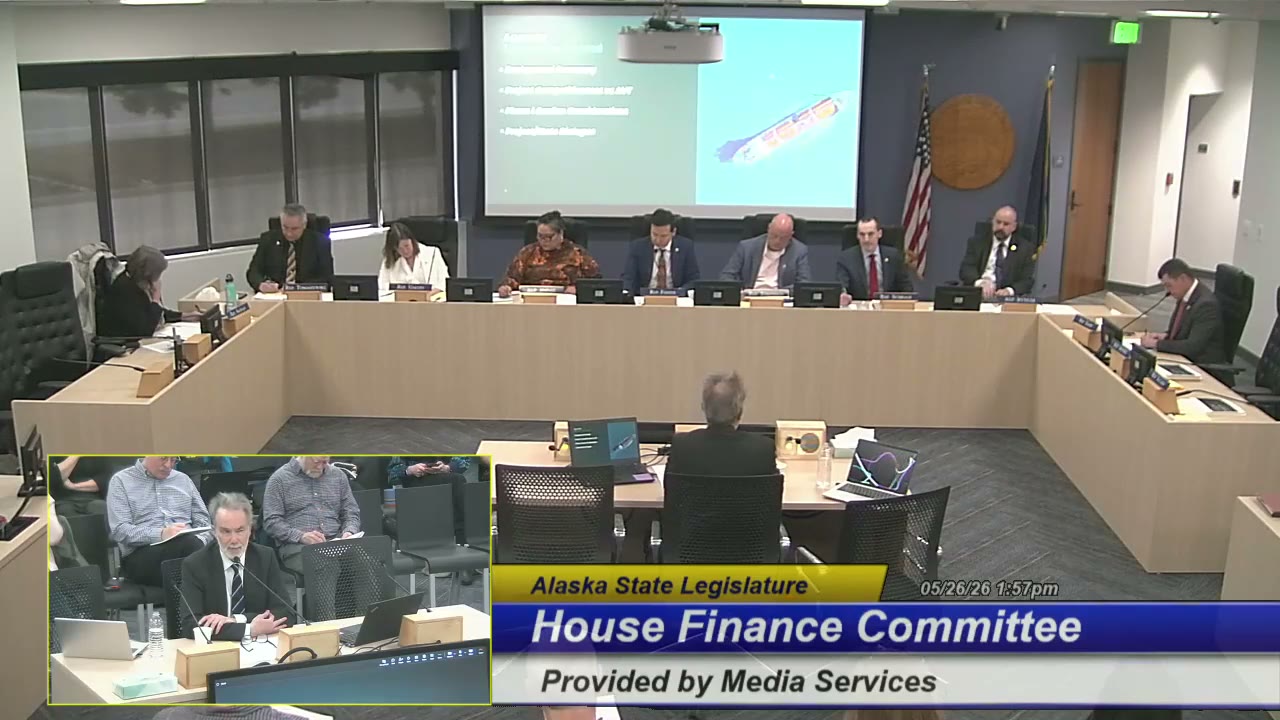
Nicholas Fulford“from a fiscal stability point of view and, and being able to predict what's going to happen, you know, 5, 10, 20 years down the road, that's the other problem with property tax is that you don't really know what that tax is going to be. And as lenders and other people look at the project and they look at that degree of unpredictability, effectively they'll assign a risk to it and the cost of capital or the cost of debt will be higher and the project will be less competitive.”
House Finance, 5/26/26, 1:30pm ·


1:08
Nicholas Fulford“the one thing that you could probably do which would help that dialogue go forward is really what we're here discussing today, which is to put in place a more appropriate framework around property tax or whatever replaces it. Because undoubtedly what goes on in the legislature, you know, obviously it has a lot of interest from within the state, but, you know, some of these buyers who are looking at the project are also looking at what the legislature is doing.”
House Finance, 5/26/26, 1:30pm ·

1:10
Nicholas Fulford“Really relatively quickly, we ramp up to about a $600 million tax requirement. And as you look at these slides, the way I like to look at it always is in the effect that this has on delivered gas, because ultimately that's the kind of competitive framework you're looking at.”
House Finance, 5/26/26, 1:30pm ·

0:50
Nicholas Fulford“if you took 12.5% as the going rate for LNG, With the 6-cent tax, AVT, Alaska would be profitable somewhere around the sort of $65, $70 a barrel. So really any price greater than $65 or $70 a barrel, Alaska would be in the money. Equally with the property tax, you can see that that shifts slightly to the left— sorry, to the right. And, and you're really in more of a sort of 70-75.”
House Finance, 5/26/26, 1:30pm ·