Quoted moments from Alaska public meetings, hearings, and press conferences.
Adam Prestidge
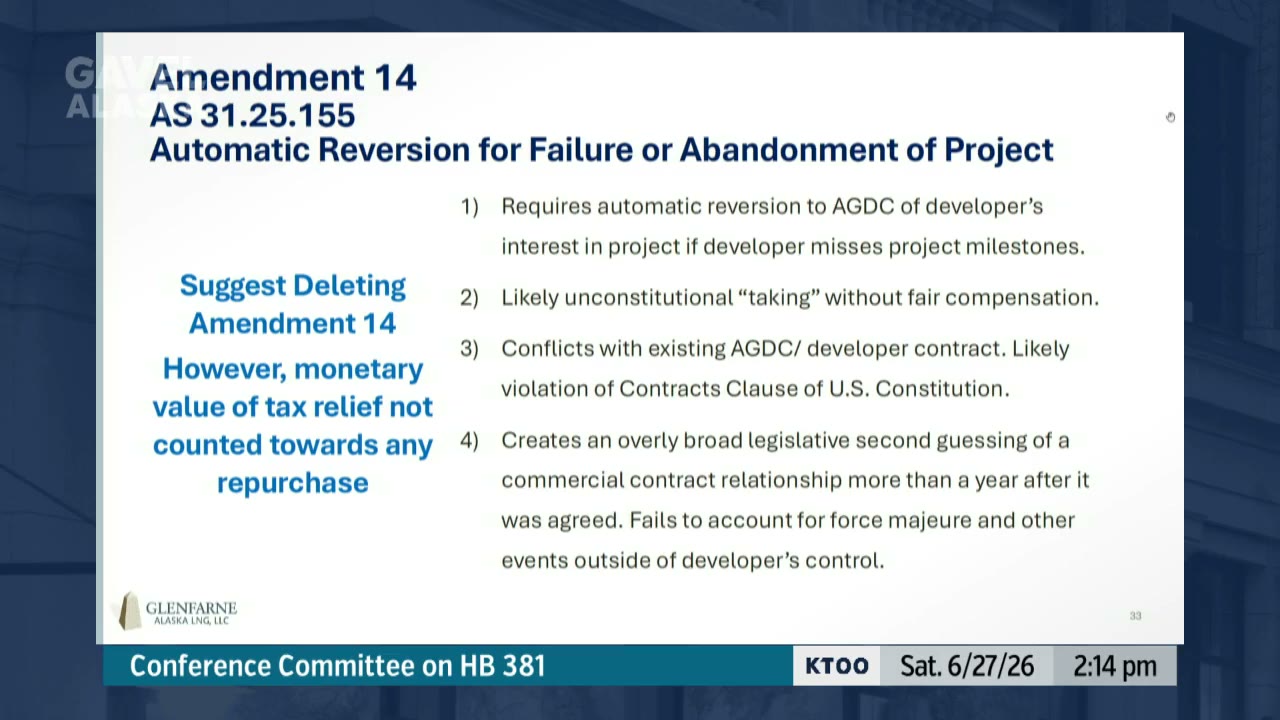
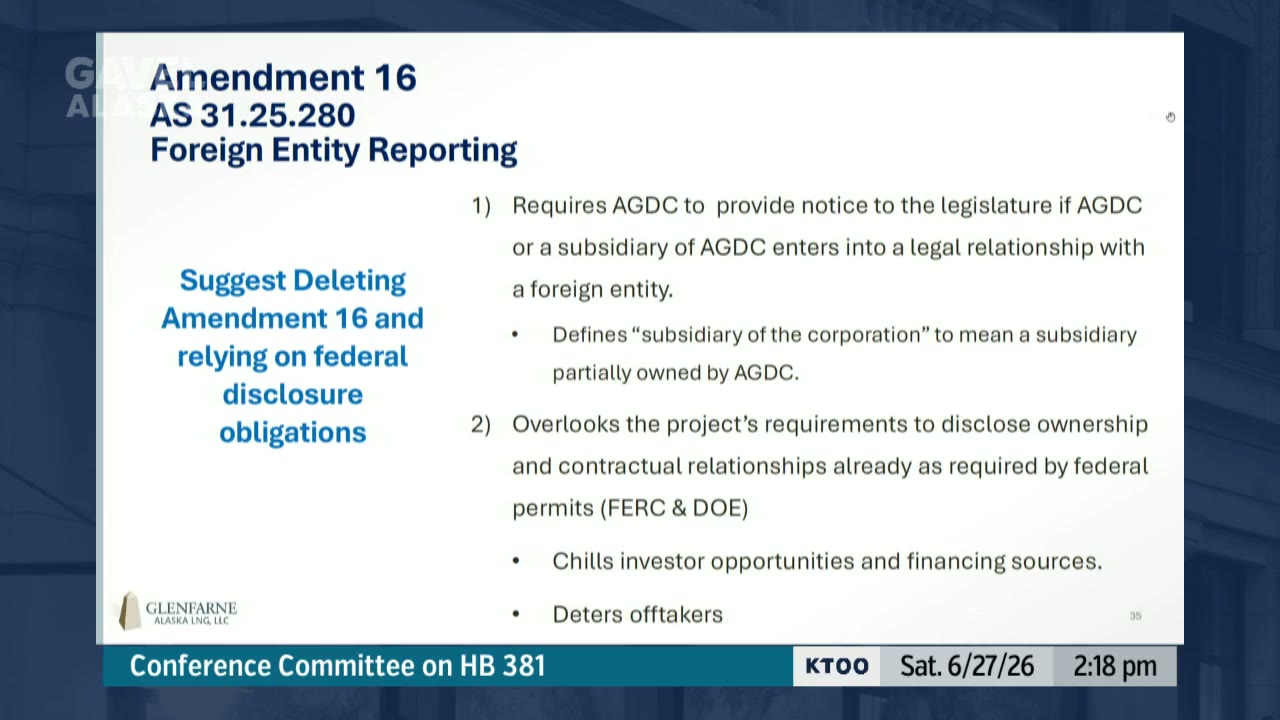
“Amendment 14, uh, um, Summarizing, relates to the state's clawback option, which we discussed at some length in the hearing yesterday. It basically takes the carefully negotiated arrangement between Glenfarm and AGDC and removes all of the, I guess, the careful considerations around it and institutes an automatic reversion to the state with no compensation to, to the developer in the event that a milestone is lapsed. It's— we'd view that as extremely punitive to the project. Our legal counsel advises us that that could potentially qualify as an unconstitutional taking and potentially a violation of the Contracts Clause of the U.S. Constitution and would severely hinder the developer's ability and willingness to continue to operate in the state of Alaska.”Alaska Legislature: Joint Conference on HB381, 6/27/26, 2PM · Jun 27, 2026
Adam Prestidge
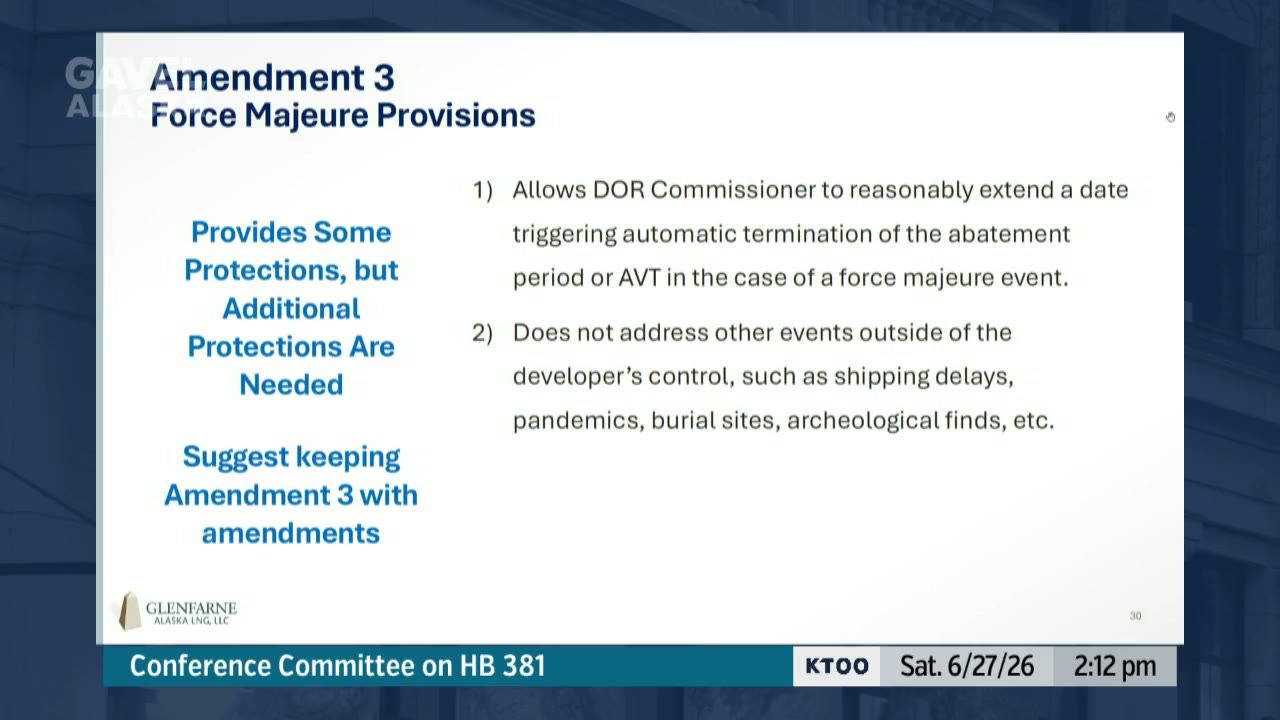
“Amendment 3 provided force majeure allowance, basically that if there is a date, a deadline for the project, it can be reasonably extended by the Department of Revenue Commissioner in the event of a force majeure. That is a helpful addition. It is good for the project.”Alaska Legislature: Joint Conference on HB381, 6/27/26, 2PM · Jun 27, 2026
Adam Prestidge
“It could be a little bit broader because force majeure is really kind of acts of God outside of the control of the project. There can be other delays to a project like this that wouldn't necessarily be picked up within a force majeure definition, such as archaeological finds or shipping delays. And so we'd advocate that it would be beneficial to the project to look at broadening that definition a little bit.”Alaska Legislature: Joint Conference on HB381, 6/27/26, 2PM · Jun 27, 2026
Adam Prestidge
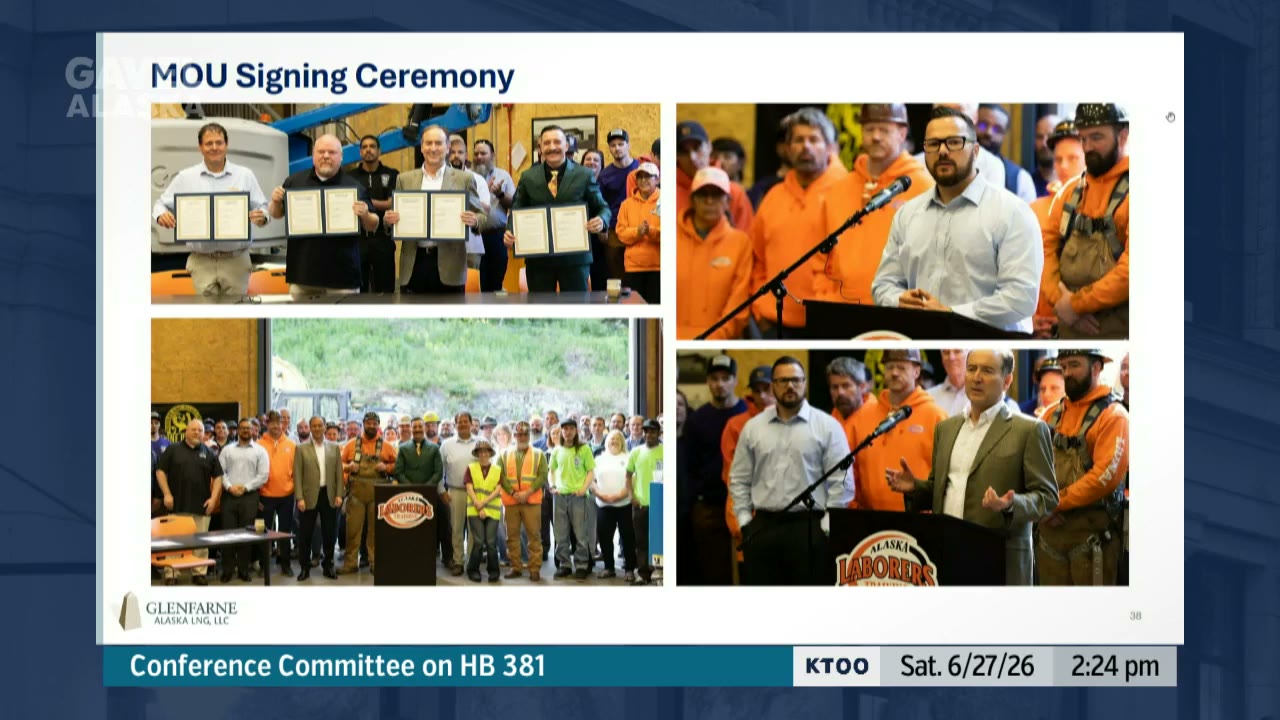
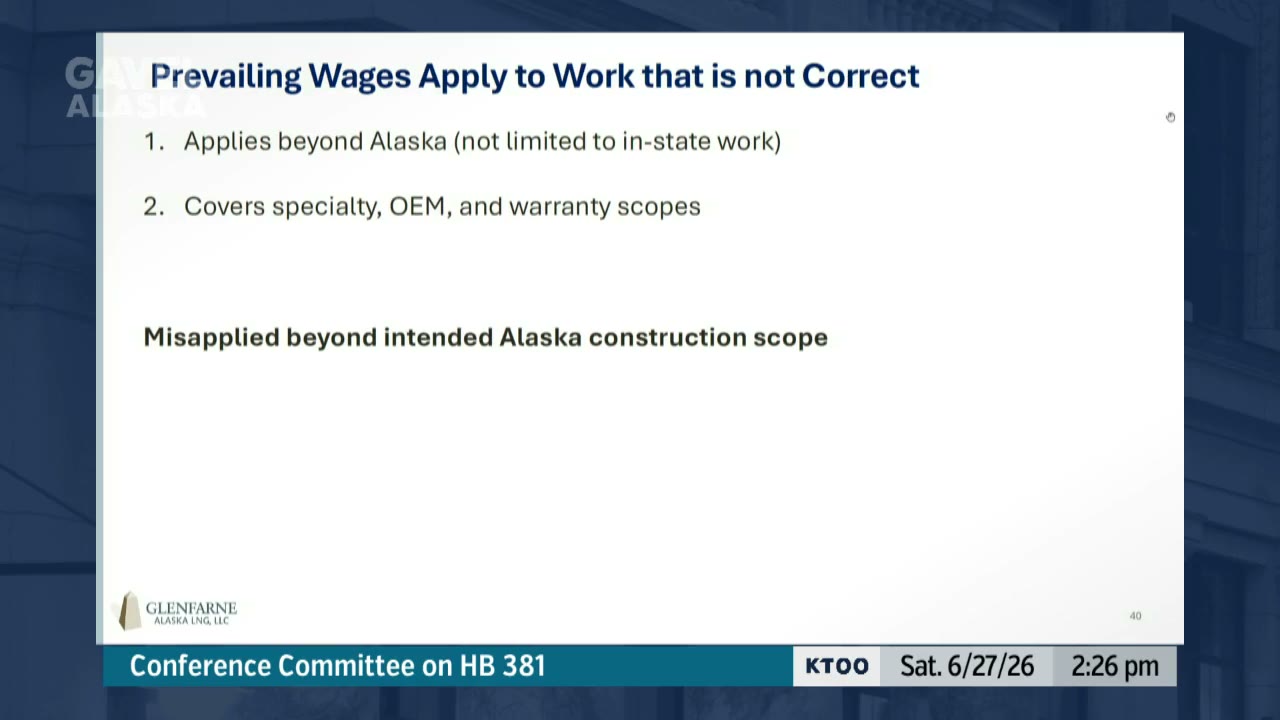
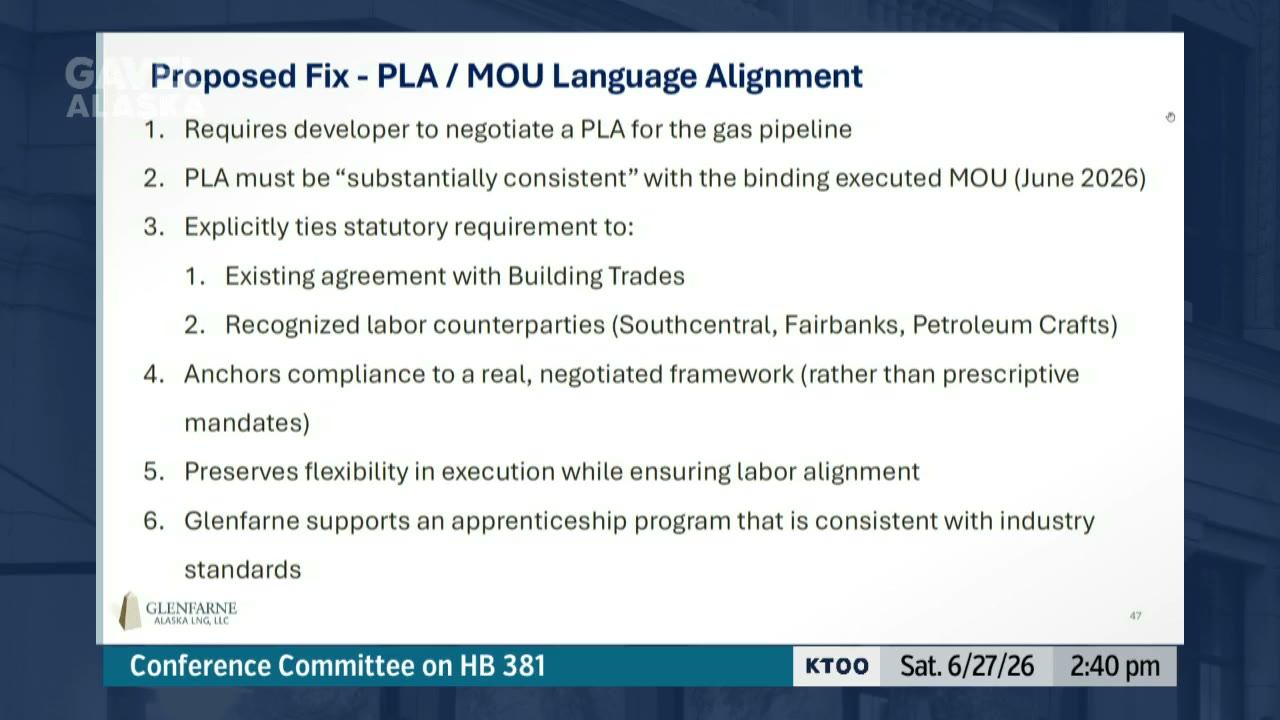
“On June 11th, uh, Glenn Fahren signed, executed, and announced a binding memorandum of understanding with the building trades councils from Fairbanks and Anchorage. And so, uh, what did that do? It set up a framework for future project labor agreements.”Alaska Legislature: Joint Conference on HB381, 6/27/26, 2PM · Jun 27, 2026
Adam Prestidge
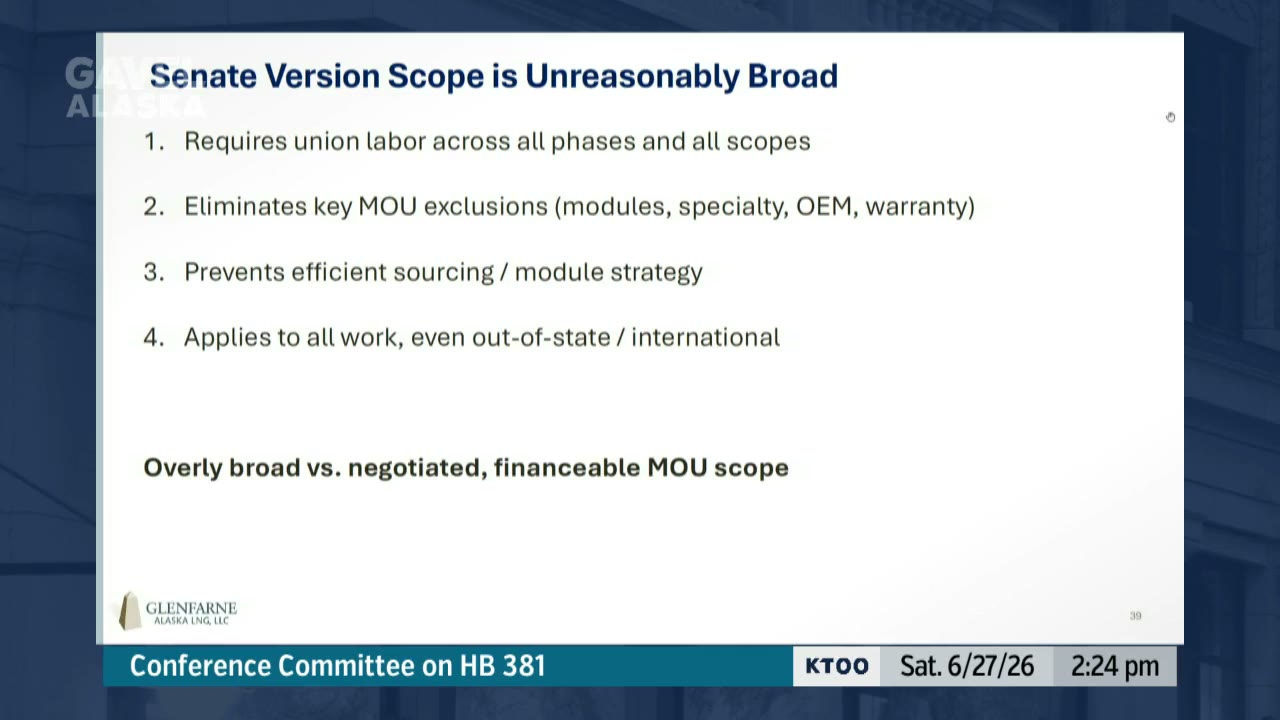
“the scope of the amendment that was offered on the floor is very broad and doesn't reflect the careful discussion that the two parties worked on over the course of a 6-month negotiation and doesn't reflect the level of detail and complication that goes into labor planning for a mega project like this. And so I talked at the outset a little bit about the scope, how there are some exclusions. Most of the— a significant part of the project is allocated to be worked on by labor unions. The amendment that was proposed removes all of that and simply says all phases, all scopes, all contractors, all subcontractors must sign a PLA.”Alaska Legislature: Joint Conference on HB381, 6/27/26, 2PM · Jun 27, 2026
Adam Prestidge
“Senator Steadman, I don't think there's any question on the labor side that this is a binding agreement. I think there was confusion or there was a concern that others out there thought that it wasn't, but I certainly believe that they agree that it's binding, want it to be binding. We feel the same way. It just seems that unfortunately some have interpreted it based on those headlines as non-binding, and that might be why some legislators thought it would be helpful to insert this amendment.”Alaska Legislature: Joint Conference on HB381, 6/27/26, 2PM · Jun 27, 2026
Adam Prestidge
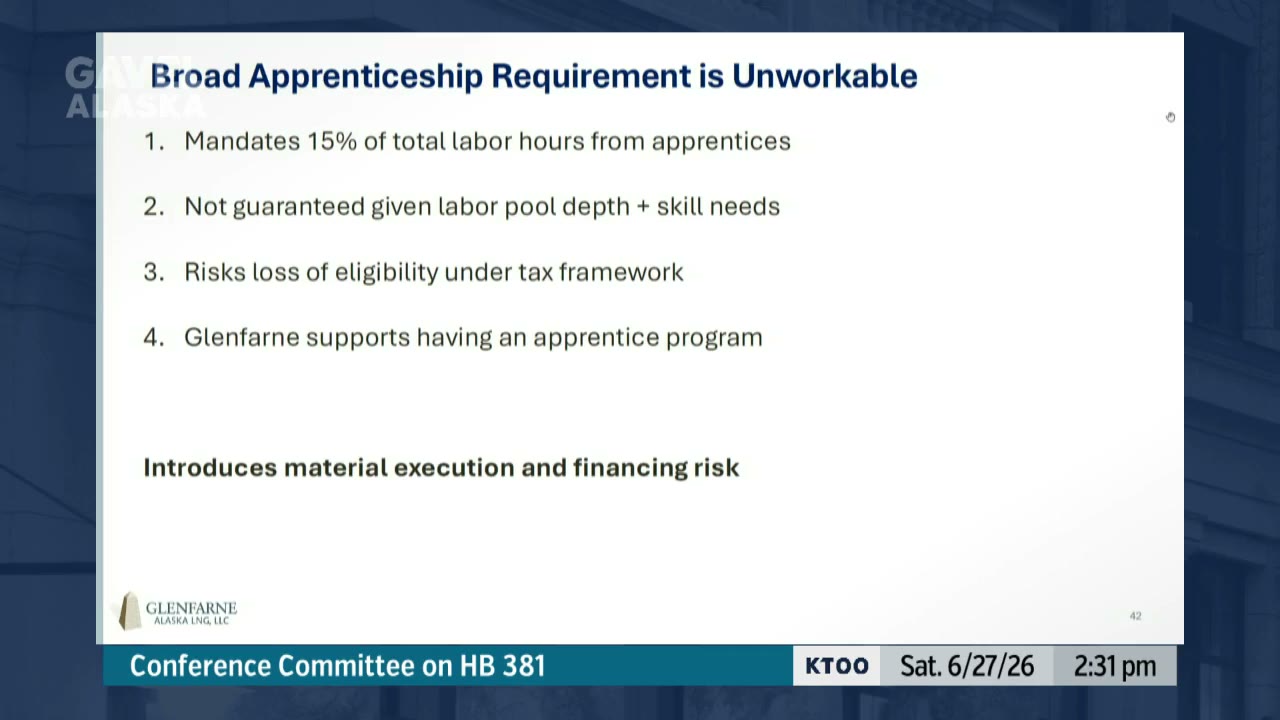
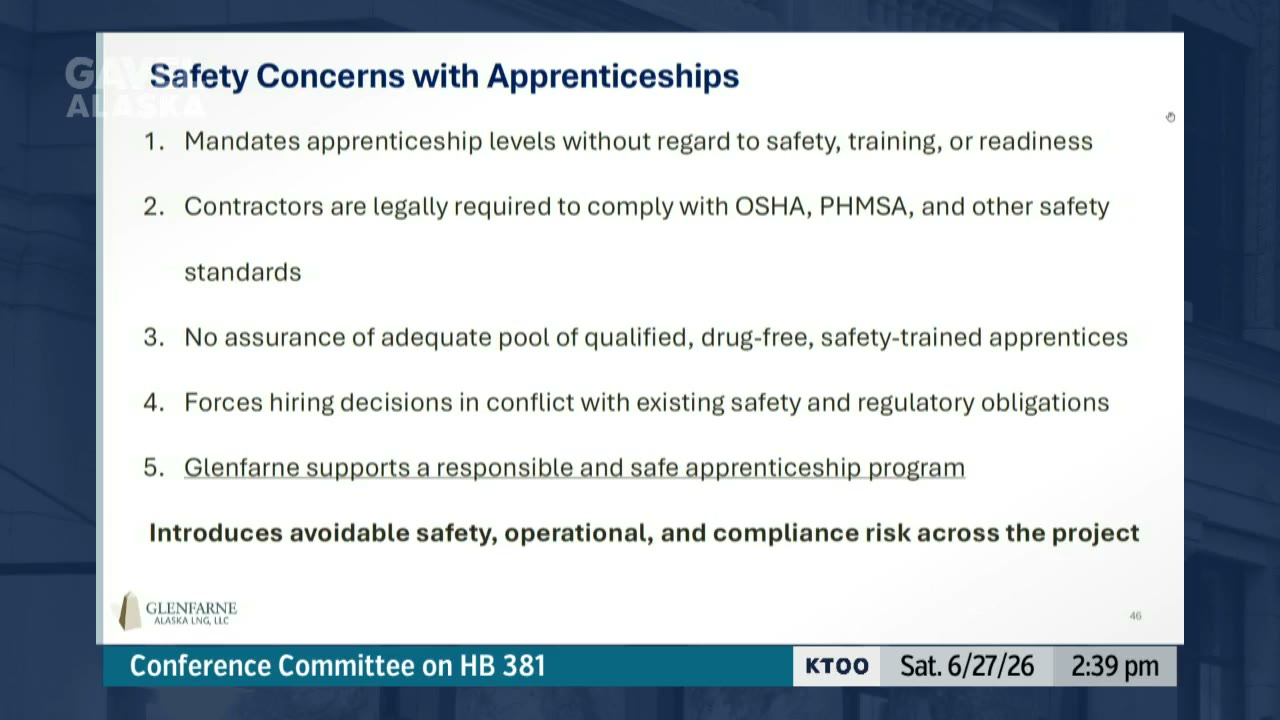
“having a bright line 15% requirement creates a lot— creates unworkable challenges for the project. First of all, there's no consideration in the amendment if there weren't available enough personnel to perform 15% of the hours as apprentices. It's just a flat requirement, 15% of the hours must be done by apprentices. And so the question would immediately come up, Well, if there weren't enough apprentices available to perform that much work, would we lose our tax eligibility?”Alaska Legislature: Joint Conference on HB381, 6/27/26, 2PM · Jun 27, 2026
Adam Prestidge
“we'd be fully supportive of taking an additional step to have the bill, the legislation, require that the project establish an apprenticeship program that is consistent with industry standards and would be negotiated between the project and the appropriate labor unions”Alaska Legislature: Joint Conference on HB381, 6/27/26, 2PM · Jun 27, 2026
Bryce Edgmon
“why wasn't this analysis done with other states? 99 Days later. You know, why on behalf of Alaska's interests did we not do the benefits? Because when I see these numbers, Alaska's PT, Proposed Rate, of 9.4% essentially tower over what other states that have non-elective taxes.”Alaska Legislature: Joint Conference on HB381, 6/27/26, 2PM · Jun 27, 2026
Dan Stickel
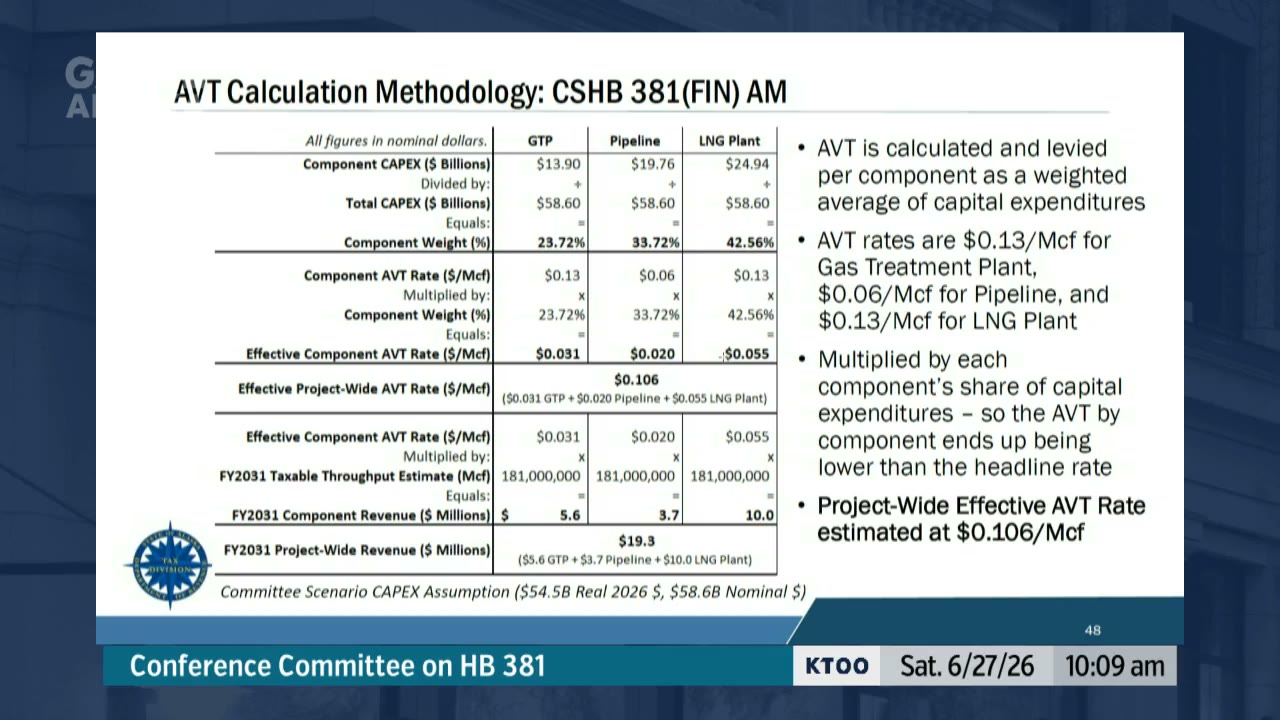
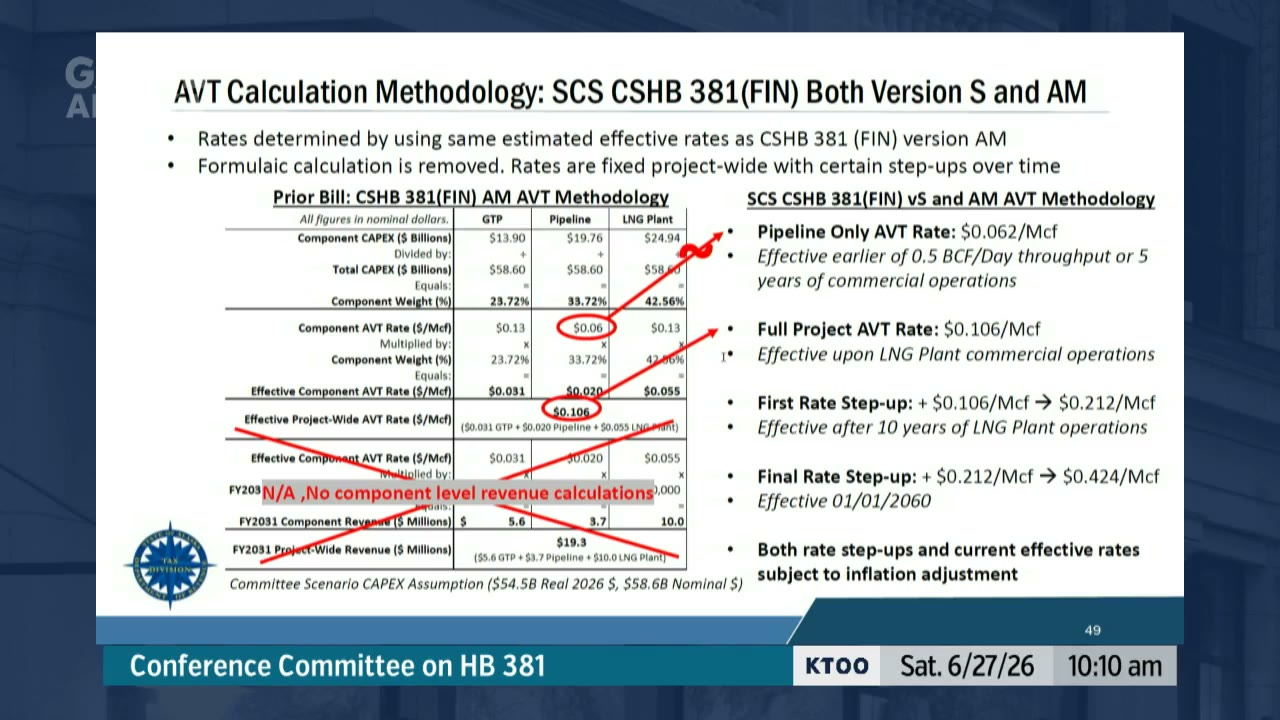
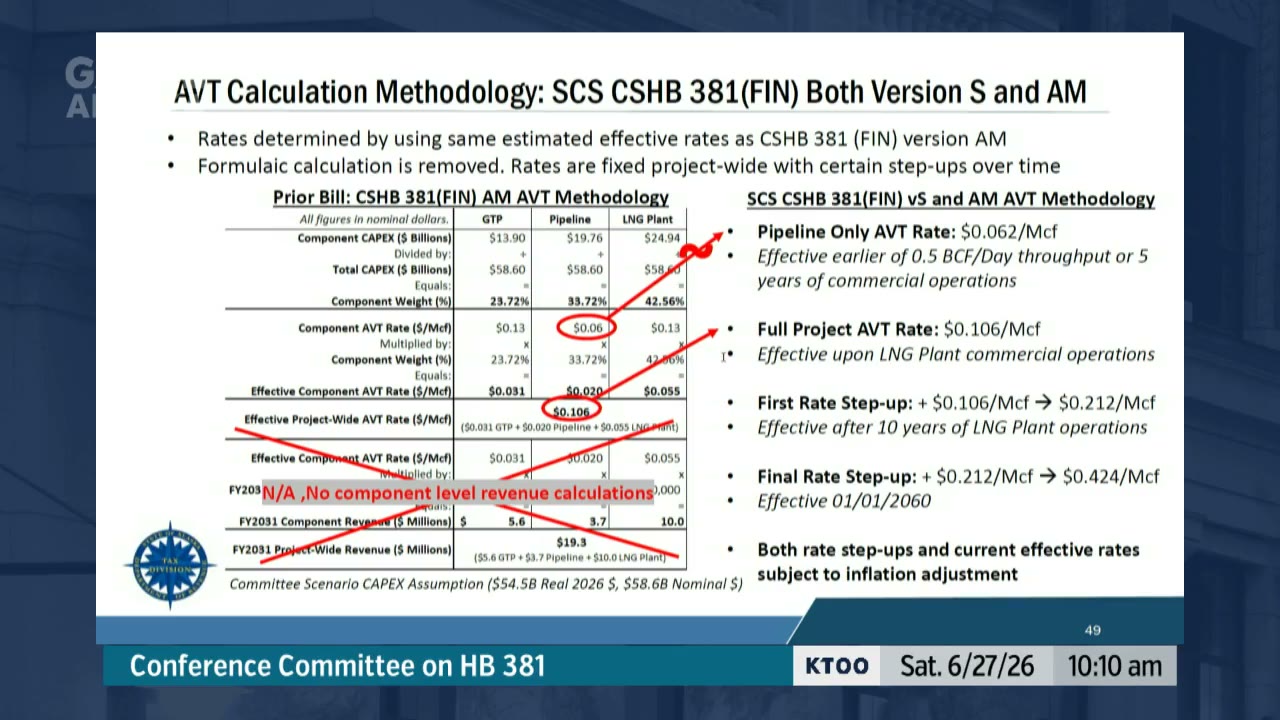
“for a pipeline-only portion of the project, you'd have a 6-cent per MCF tax rate, and then once the full project was in operations, we would estimate that the tax rate on a weighted average basis would be about 10.6 cents per 1,000 cubic feet.”Alaska Legislature: Joint Conference on HB381, 6/27/26, 10am · Jun 27, 2026
Mike Cronk
“if we do nothing, these numbers go away, we have nothing here. There's zero revenue brought to this state. There's zero revenue brought to many communities.”Alaska Legislature: Joint Conference on HB381, 6/27/26, 10am · Jun 27, 2026
Dan Stickel
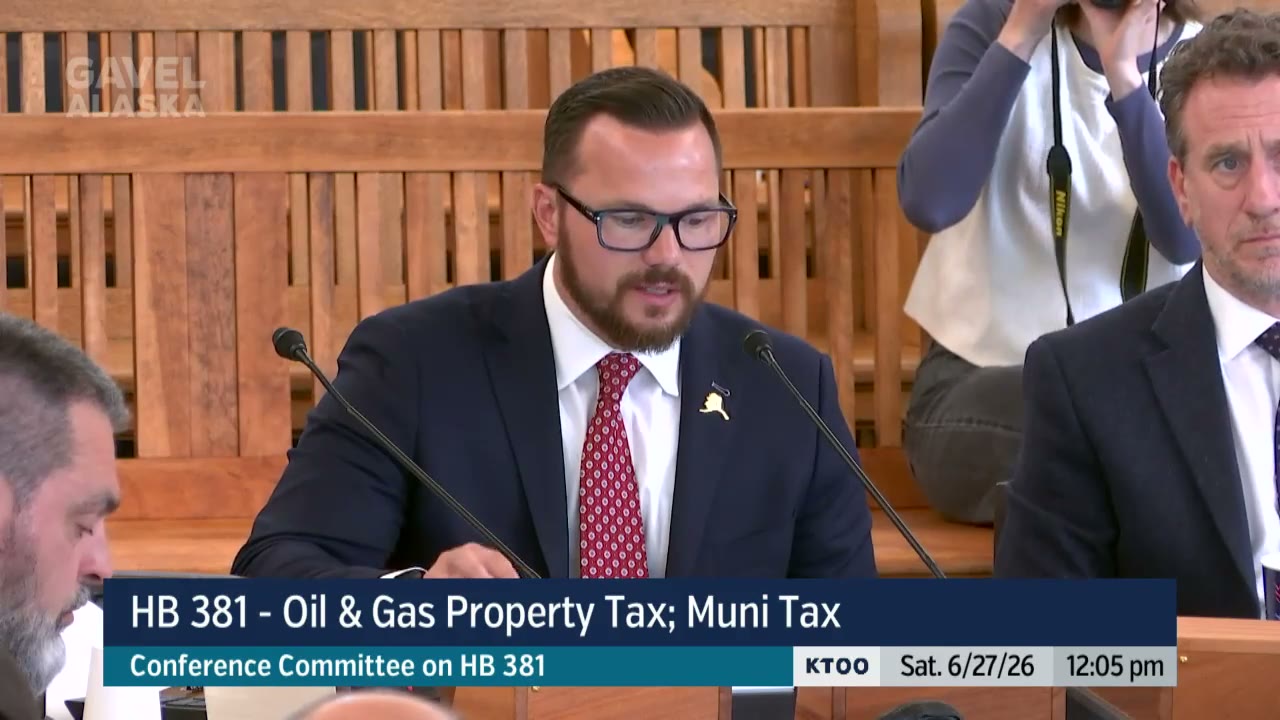
“The first effective 10 years, after 10 years of LNG export operations, where the tax rate doubles. And then the second effective in 2060, where the tax rate doubles. Again.”Alaska Legislature: Joint Conference on HB381, 6/27/26, 10am · Jun 27, 2026
Dan Stickel
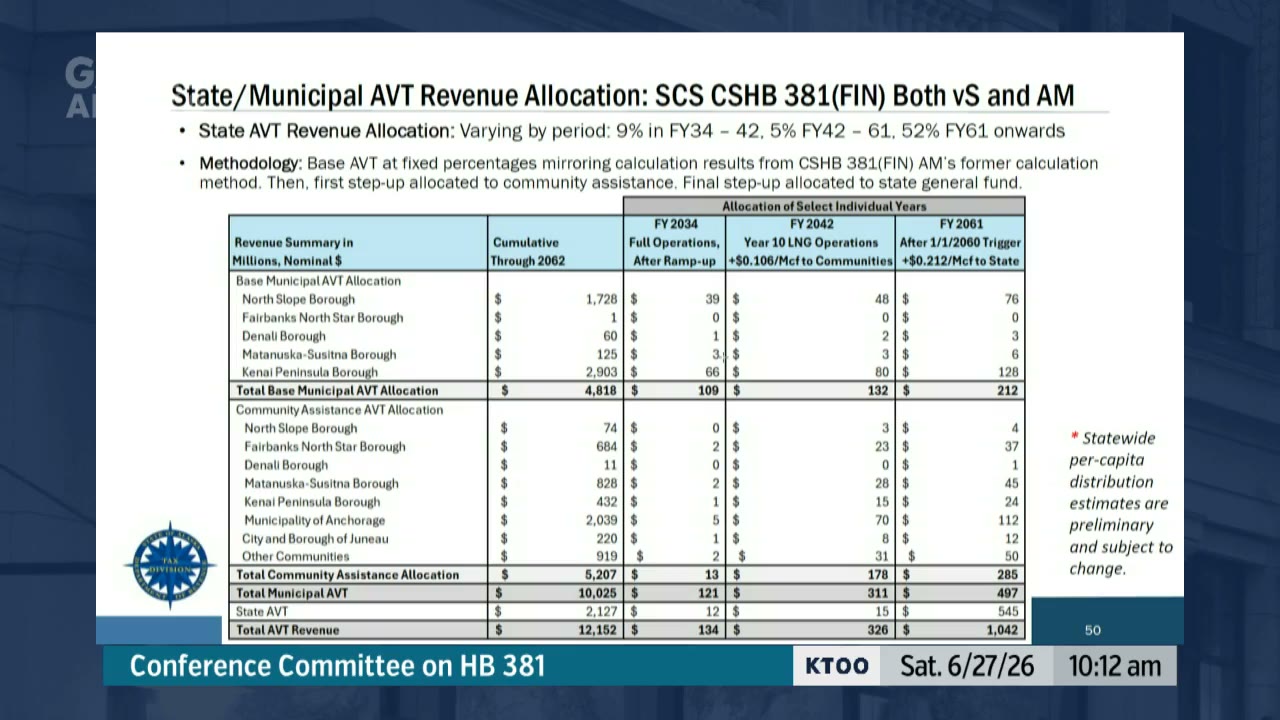
“It does start with the same effective tax rates as the House version and simply fixes those rates and allocations in, in statute. The Senate version then added in the two doublings of the tax rate that was a major change from the House version.”Alaska Legislature: Joint Conference on HB381, 6/27/26, 10am · Jun 27, 2026
Dan Stickel
“the Senate version of the bill removes some of the complexity in the calculation that was in the prior version of the bill.”Alaska Legislature: Joint Conference on HB381, 6/27/26, 10am · Jun 27, 2026
Dan Stickel
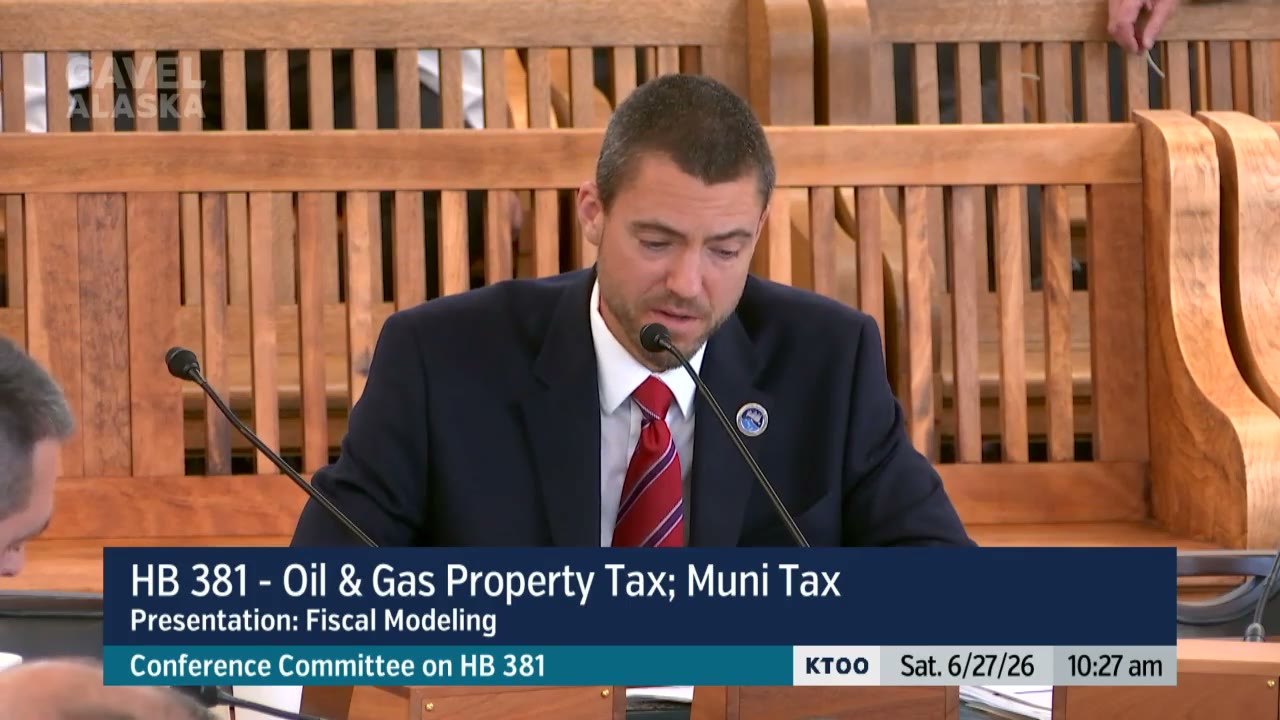
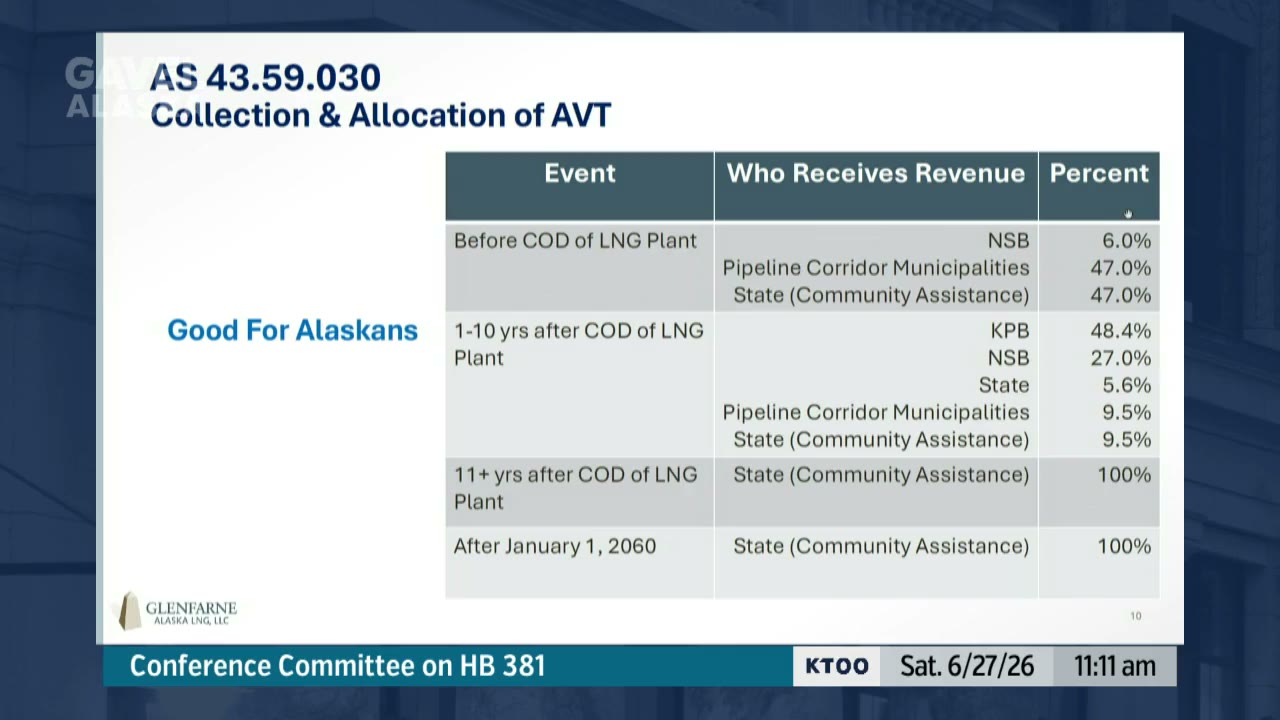
“for the first doubling of the tax rate, 100% of that doubling would go to community assistance, and then for the second doubling of the tax rate, 100% of that that next doubling would go to the state unrestricted general fund.”Alaska Legislature: Joint Conference on HB381, 6/27/26, 10am · Jun 27, 2026
Dan Stickel
“But then increase to 52% of the total AVT with the second doubling of the tax rate.”Alaska Legislature: Joint Conference on HB381, 6/27/26, 10am · Jun 27, 2026
Dan Stickel
“through 2062, which is the to the extent of our modeling, $32.2 billion to the state. And those are cumulative nominal under our baseline modeling assumptions.”Alaska Legislature: Joint Conference on HB381, 6/27/26, 10am · Jun 27, 2026
Dan Stickel
“total state benefits under our baseline model assumptions, which which we talked about yesterday, through 2042 would be $7.5 billion to the state.”Alaska Legislature: Joint Conference on HB381, 6/27/26, 10am · Jun 27, 2026
Dan Stickel
“In the version that passed the House, our break-even price was $8.57 under our baseline scenarios for gas delivered into the global market. Under the version that passed the Senate, it was $8.62 per 1,000 cubic feet. So a 5 cents per 1,000 cubic feet increase from the House version to the Senate version.”Alaska Legislature: Joint Conference on HB381, 6/27/26, 10am · Jun 27, 2026
Bert Stedman
“I think after January 1st, 60, 100% goes to the general fund, not community assistance. Is that right?”Alaska Legislature: Joint Conference on HB381, 6/27/26, 10am · Jun 27, 2026

Adam Prestidge
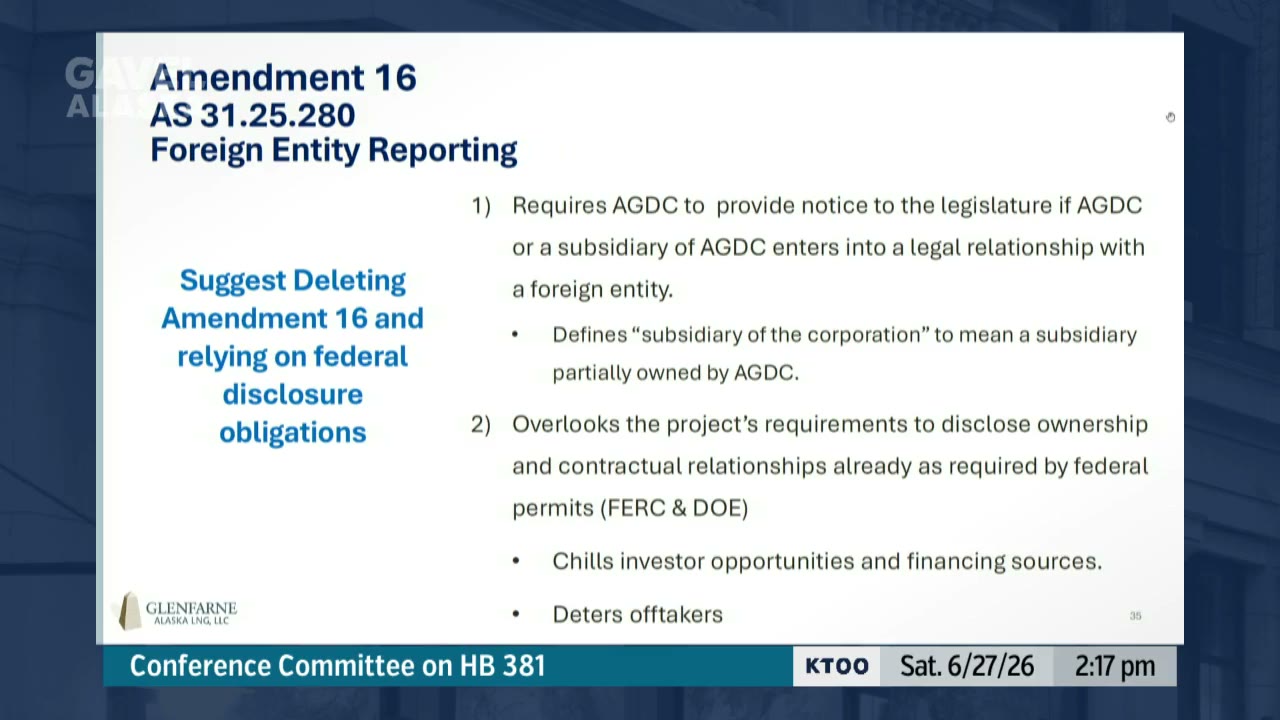
“The deadline of 2037 is well within— well beyond the project completion deadline, even if we put a couple years of contingency on that. And so a 2037 deadline doesn't have that same risk profile to the FID investors. And so for that reason, we suggest deleting the 2032 deadline.”Alaska Legislature: Joint Conference on HB381, 6/27/26, 10am · Jun 27, 2026
Adam Prestidge
“The 2032 completion of construction is more about managing theoretical risk that lenders and investors will look at when they make an investment decision on the project. And so regardless of how we all want to move fast, Regardless of the timing around the energy availability out of the Cook Inlet, lenders and investors will just see this numerically and assign it a hypothetical risk that will make the project more expensive. And so we don't see it adding any additional incentive that isn't there already. It just adds risk to the project that will be priced into the financing.”Alaska Legislature: Joint Conference on HB381, 6/27/26, 10am · Jun 27, 2026
Adam Prestidge
“our practical expectation is that we will complete the project ahead of these timelines, and so the deadline or the timeline that you said The end of the year for FID maintains— continues to be our target. And we would— if we were to follow a target construction schedule, even with some delays, we would complete the project before December 31st, well before December 31st, 2032.”Alaska Legislature: Joint Conference on HB381, 6/27/26, 10am · Jun 27, 2026
Bryce Edgmon
“the reason why I'm, I guess, at this juncture supportive of keeping in the 2028 timeline, if anything at all, it's just speaking of risk, poring through the Gaffney Klein document that was presented to the legislature in December 2025 that talks about all these sort of jurisdictions around the globe and the need for property tax relief and some sort of relief to get these very expensive front-end projects, gas line infrastructure, into place, is supported by years of analysis and efforts.”Alaska Legislature: Joint Conference on HB381, 6/27/26, 10am · Jun 27, 2026
Adam Prestidge
“we as the project developer at 8 Star have no objection to the 2028 FID deadline. We're only raising concerns around the 2032 completion of construction deadline.”Alaska Legislature: Joint Conference on HB381, 6/27/26, 10am · Jun 27, 2026

Dan Stickel
“the capital expenditure weighting and the project component weighting, that applied both for calculating the initial tax rates, but then also applied for calculating the sharing out to municipalities. And that sharing out to municipalities has also been fixed in statute. In the Senate version of the bill. So removing some of that complexity. The other addition that the Senate made is the two step-ups.”Alaska Legislature: Joint Conference on HB381, 6/27/26, 10am · Jun 27, 2026

Dan Stickel
“under the House version of the bill, the alternative volumetric tax was calculated and levied on a per-component basis as a— using a weighted average of capital expenditures. And so once the full project was complete, we would look at the, the total capital expenditures that were spent on each component of the project, being the treatment plant, the pipeline, and the LNG export facility.”Alaska Legislature: Joint Conference on HB381, 6/27/26, 10am · Jun 27, 2026
Dan Stickel
“they moved away from this weighted average approach and instead just put in the flat rates for each component of the project. So they took that about 6 cents per MCF rate on the pipeline component and made that a 6.2 cents per 1,000 cubic feet tax rate for phase 1 of the project. And then they took that 10.6 cents per thousand cubic feet weighted average with the capital expenditures weighting and just made that the tax rate once LNG exports began.”Alaska Legislature: Joint Conference on HB381, 6/27/26, 10am · Jun 27, 2026
Dan Stickel
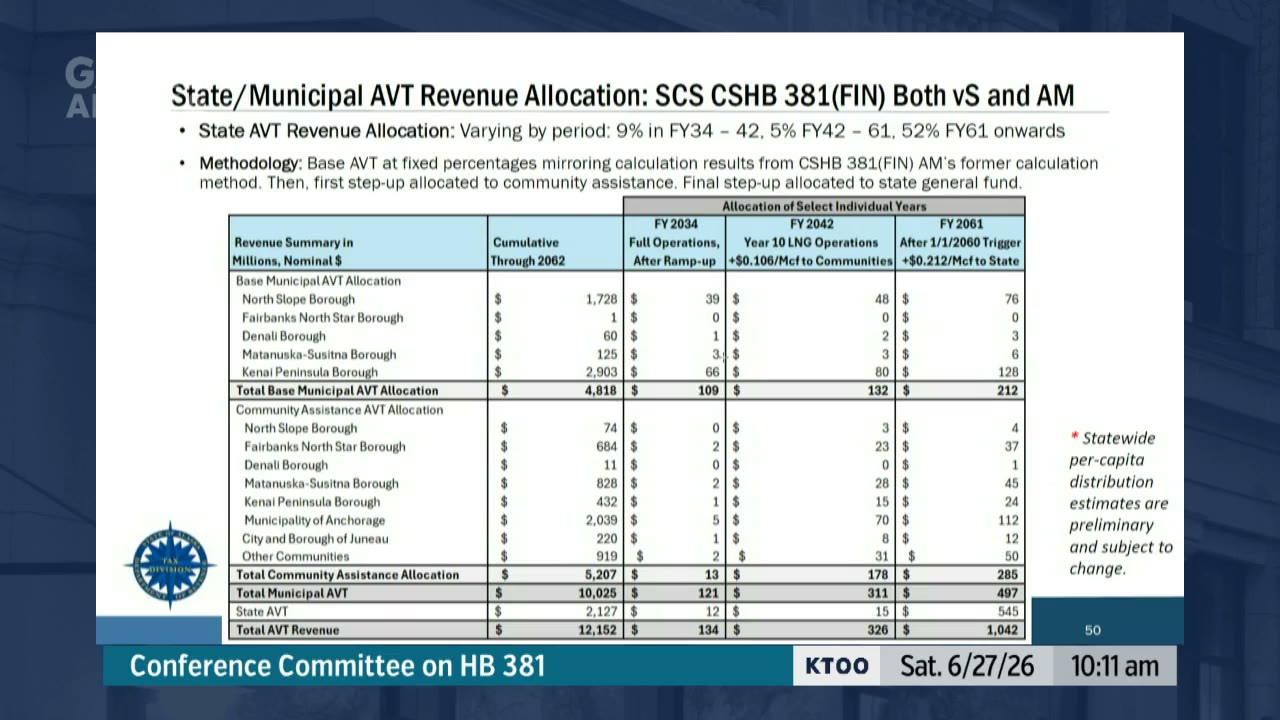
“in those early years, the vast majority of the revenue is allocated to the communities that the project is directly in. So $109 million of the AVT in 2034 would go to those 5 municipalities, with an additional $13 million spread statewide to community revenue sharing and $12 million to the state. And then the second column shows after the first step up in the alternative volumetric tax, and that additional step up goes entirely to community revenue sharing.”Alaska Legislature: Joint Conference on HB381, 6/27/26, 10am · Jun 27, 2026
Dan Stickel
“the state starts out receiving about 9% of the AVT revenue. That will drop to 5% with the first doubling of the tax rate.”Alaska Legislature: Joint Conference on HB381, 6/27/26, 10am · Jun 27, 2026
Dan Stickel
“in fiscal year 2061, which would be the first full fiscal year after the the second step up of the alternative volumetric tax. At that point in time, after adjusting for the inflation, there would be $212 million shared directly with the communities that the project resides in, an additional $285 million shared across the state based on population for community revenue sharing, and then the state at that point in time would get a little over $500 million.”Alaska Legislature: Joint Conference on HB381, 6/27/26, 10am · Jun 27, 2026

Lyman Hoffman
“On the first bullet point where the Senate version removes the calculation complexities, does the department have an opinion on that? Especially since it has the same effective rate as the House version simplification, does that reduce the amount of work to the department.”Alaska Legislature: Joint Conference on HB381, 6/27/26, 10am · Jun 27, 2026

Adam Prestidge
“That penalty is— would be losing the tax— the tax treatment of the project. The result of that would be at the front end, investors would look at this as additional risk, And they would have to price in that risk into how they invest in the project. And so the ultimate outcome of this would be making the project more expensive and require more investment capital.”Alaska Legislature: Joint Conference on HB381, 6/27/26, 10am · Jun 27, 2026

Dan Stickel
“fixing the percentages does increase some of the certainty and makes it easier to calculate and plan. Removes one item of potential contention going forward.”Alaska Legislature: Joint Conference on HB381, 6/27/26, 10am · Jun 27, 2026

Adam Prestidge
“the 2028 deadline, it puts a bit of a risk on the developer and it puts an incentive on the developer, but it does that at a time before billions of construction dollars have been put at risk on the project. And so essentially putting that 2032 deadline puts additional risk on all the investment dollars that doesn't serve the benefit of actually accelerating anything. And the issue that then comes up is if there were a delay in construction, if there were litigation, if there was COVID, you know, an epidemic, that's just, those are all hypothetical risks that could occur, that have occurred on other projects, that lenders and investors are going to be nervous about.”Alaska Legislature: Joint Conference on HB381, 6/27/26, 10am · Jun 27, 2026

Bryce Edgmon
“I feel like I think if FID isn't, for Phase 1, arrived at by 2028, there's justification for this issue to come back before the legislature to have a longer runway to engage in this discussion. I would submit to you or anyone else that we should not have gotten this bill on March 20th. We should have gotten this a lot earlier so we could, to pour over this in a way that complies with all the sort of what-if scenarios that are out there and also to be maybe a better partner to you as a developer overall to get our work done in a longer frame of time. So I guess at this point I'm not convinced that removing that 2028 FID deadline— and remember, it's just for Phase 1, it's not for Phase 2. You know, I don't know that it serves our best interests”Alaska Legislature: Joint Conference on HB381, 6/27/26, 10am · Jun 27, 2026

DeLena Johnson
“this continuing resolution has been one of the things that has been of some concern because what we don't want to happen is we do not want to take it up, gavel out, not come back for a month, and sometimes things like that have happened. I just want to put on the record the conversation that I've had with you, Mr. Speaker, and what I understand the intention to be.”Alaska Legislature: House Floor Session - July 20, 2026 10:00am · Jul 20, 2026

DeLena Johnson
“the intention is to adjourn to, I think, around the 1st of July. With the intention that the conference committee will be meeting during that 10 days that we won't be in session, but they will have the opportunity to take things up, that people would be working in good faith and come to a resolution on this.”Alaska Legislature: House Floor Session - July 20, 2026 10:00am · Jul 20, 2026

DeLena Johnson
“my hope and my goal and my conversation has been that there will be a good faith effort to pass legislation that will continue the conversations that we're having, and that this won't be an excuse to not be here, that this will be— is just a method of being able to make things work well and work smoothly and acting in good faith and working with the other body to bring this legislation to a conclusion.”Alaska Legislature: House Floor Session - July 20, 2026 10:00am · Jul 20, 2026

Speaker C
“After the holiday, the project pays a tax based on how much gas is flowing through it, not at guessed-on property assessment values, but on real throughput. The rate is currently 6 cents per 1,000 cubic feet in the pipeline and 13 cents on the gas treatment plant and carbon capture and 13 cents on the LNG export plant.”Alaska Legislature: House Floor Session - June 12, 2026 10:30am · Jun 12, 2026

Speaker C
“The bill now ensures that the RCA cannot approve gas sales contracts that force Alaska ratepayers to pay for cost overruns on the project.”Alaska Legislature: House Floor Session - June 12, 2026 10:30am · Jun 12, 2026

Speaker C
“we have heard from the Department of Revenue and our legislative consultants that the current rate is, is competitive. The amount of ABT currently in the bill is considered the maximum extractable rate consistent with the project moving forward.”Alaska Legislature: House Floor Session - June 12, 2026 10:30am · Jun 12, 2026

Speaker A
“34 Yeas, 5 nays. By a vote of 34 yeas to 5 nays, House Bill 381 has passed the House.”Alaska Legislature: House Floor Session - June 12, 2026 10:30am · Jun 12, 2026

Ashley Carrick
“this legislation is not what determines whether or not this project has a green light and the developer moves forward. With developing. But what this bill means to me today, Mr. Speaker, and what passing this legislation ultimately is to me, is about ensuring those protections for our communities and still maximizing the opportunity that this pipeline could bring”Alaska Legislature: House Floor Session - June 12, 2026 10:30am · Jun 12, 2026

Zack Fields
“I would argue that an alternate volumetric taxation structure is fundamentally more pro-growth, fundamentally more fair to local governments, and fundamentally more fair to all residents of the state who benefit from state-funded public services.”Alaska Legislature: House Floor Session - June 12, 2026 10:30am · Jun 12, 2026

Speaker C
“The tax framework only takes effect if the developer commits to 3 things: putting up the funding for the Municipal Impact Fund— that's between $40 and $80 million— signing a project labor agreement that covers all 3 major facilities, and building the Fairbanks Spur Line with construction starting within a year of getting the permits.”Alaska Legislature: House Floor Session - June 12, 2026 10:30am · Jun 12, 2026

Speaker C
“In this version, 93% of the alternate volumetric tax in the North Slope Borough on the gas treatment plant carbon capture facility, and 93% of the alternate volumetric tax in the Kenai Peninsula Borough on the LNG export plant goes to that community, as it should, with the 7% balance going back to the state.”Alaska Legislature: House Floor Session - June 12, 2026 10:30am · Jun 12, 2026

Dan Saddler
“It's long been clear that during all the fiscal analysis over the years that Alaska's property tax situation has been a major impediment to the economics of building an 800-mile steel pipeline to bring our tremendous amount of resources to market.”Alaska Legislature: House Floor Session - June 12, 2026 10:30am · Jun 12, 2026