Generated Image
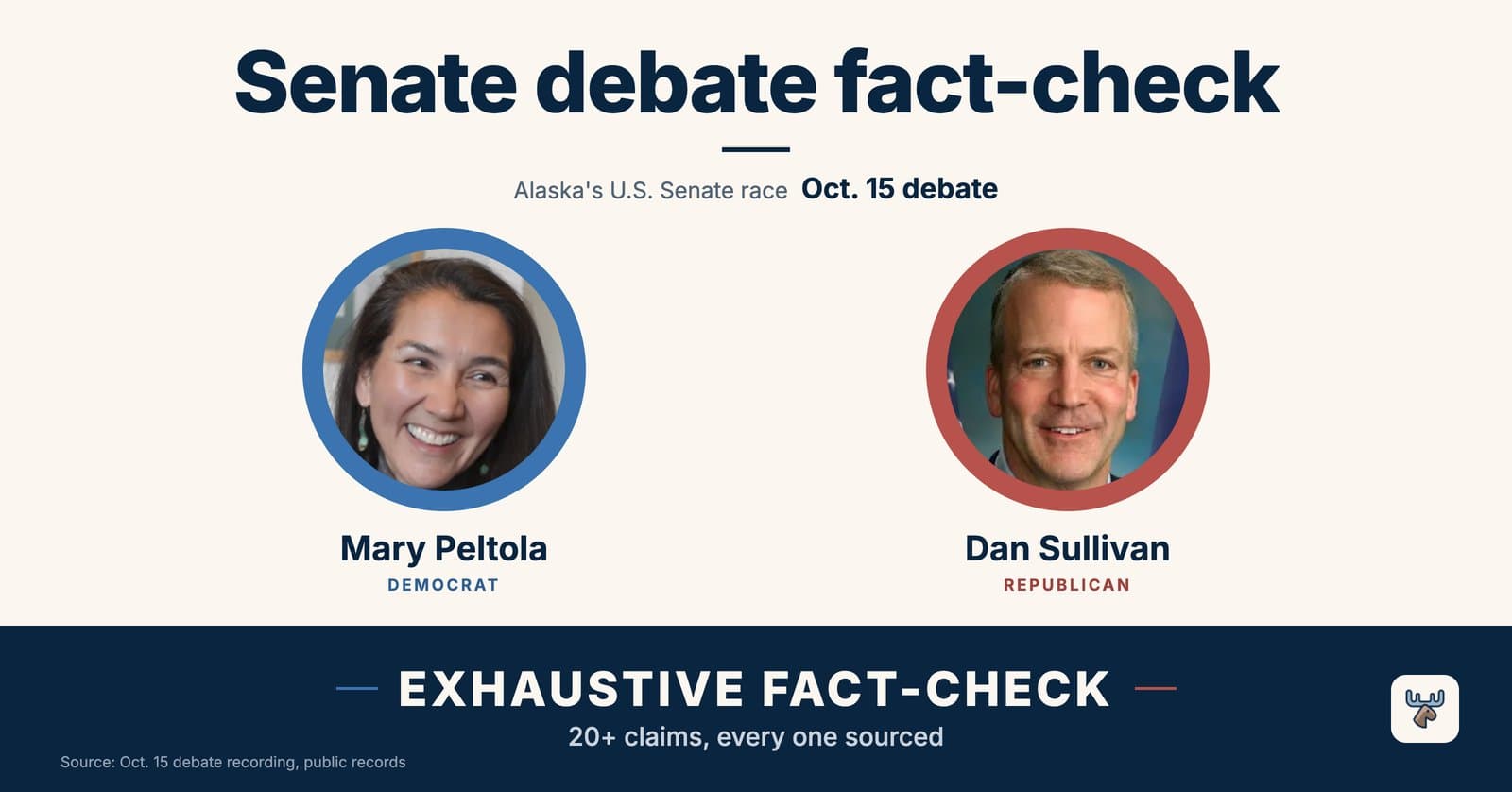
Sullivan and Peltola got key facts wrong in a heated Senate debate, records show
Republican Sen. Dan Sullivan and Democrat Mary Peltola accused each other of lying again and again in Thursday night's U.S. Senate debate, and at one point the moderator warned she would have their microphones shut off if she had to. By Alaska News' count of the transcript, Peltola said "lie," "lies" or "lying" five times and Sullivan four.
The hour, broadcast statewide by Alaska Public Media, Alaska's News Source and KTOO, was the last in the stations' Debate for the State series before the Nov. 3 election. Early voting begins Monday. Lori Townsend moderated, and Liz Ruskin of Alaska Public Media and Will Courtney of Alaska's News Source asked the questions. Alaska Public Media's recording of the full debate is here; times in this story show about where each quote can be found in that recording.
It got personal early. After Sullivan said Peltola "defines the rigged system," she answered, "Dan just keeps telling lies and Alaskans are sick of it." When Sullivan said she had voted against a troop pay raise "because she wanted more transgender surgeries for our troops," Peltola cut in: "That is absurd." Moments later she told him, "Dan, you should be ashamed of yourself for propagating these lies."
Later, Sullivan stopped to ask the moderators whether the candidates had been given the questions in advance. Courtney and Townsend said neither had. Sullivan said he was watching his opponent read from questions "that seem to be answered," and Peltola said, "I'm prepared!" Peltola read from note cards for about half her answers to the moderators' questions and Sullivan also used notes, Alaska News found, and Ruskin later posted on social media that Sullivan had clarified he didn't believe the hosts gave anyone the questions. Minutes later, Sullivan told Peltola, "You're walking through the revolving door so much, you must be getting dizzy up here." After he raised a New York Times story about Peltola's treatment of her staff, Townsend called for decorum. "If I have to have mics shut off, I will," she said.
Near the end, it turned warmer. Asked for one nice thing about the other, Sullivan said his wife, Julie, invited Peltola to his Marine Corps retirement ceremony, and Peltola came. Peltola called it a lovely service and said she could name three lovely things about Dan and Julie Sullivan: their daughters.
In between, both candidates made specific claims about votes, money and laws that can be checked. Alaska News checked more than 20 of them against Senate and House roll calls, Alaska House journals going back to 2002, federal health and campaign finance records and the candidates' own statements.
The results cut both ways. Sullivan said Peltola missed a 2008 vote to advance the gas line; the House Journal shows she voted for it and was excused for the next day's revote. Peltola said Sullivan voted to raise the Social Security retirement age; he voted against the most direct proposal to do that. Sullivan named the wrong senator as the one who blocked his bycatch bill. Peltola said she is being outspent three to one, but ad-tracking data and federal filings from before the debate showed a much narrower gap. Counting the campaigns' own spending, her side had spent more through September.
Is Peltola being outspent three to one?
What Peltola said (58:12): "I'm being outspent three to one right now because of Dan's supporters, specifically Elon Musk."
Verdict: Mostly False. Outside groups have spent more for Sullivan, but not three to one. The ad tracker her campaign cited showed Republicans ahead nearly three to one in mid-September, counting ads booked but not yet aired. By Sept. 30, the same tracker showed about 1.4 to 1, with bookings for the rest of the race even. Federal filings show outside groups spending about 1.4 times as much for Sullivan, and counting the campaigns' own spending, Peltola's side had spent more.
Peltola's campaign pointed to a Sept. 11 chart from AdImpact, a firm that tracks political ads. It showed Republicans had aired or booked $34 million in Alaska Senate ads to Democrats' $12.2 million, about 2.8 to 1, though most of the Republican total, $23.1 million, was for ads that hadn't aired yet.
By Sept. 30, AdImpact's figures showed Republicans had aired $26.6 million in ads to Democrats' $14.3 million, and the two sides had about the same amount booked for the rest of the race, $14.4 million for Republicans and $14.5 million for Democrats. That's about 1.4 to 1 in all. From Sept. 28 to Oct. 11, spending on ads that aired in the race split about 53% to 47% in Republicans' favor, according to the Wesleyan Media Project, which analyzes AdImpact data. AdImpact's figures count ads only, including the campaigns' own.
Through Oct. 14, the day before the debate, outside groups reported spending about $37.5 million to support Sullivan or oppose Peltola and about $27.4 million to support Peltola or oppose Sullivan, by Alaska News' tally of Federal Election Commission filings. That's about 1.4 to 1 overall and about 1.3 to 1 since Sept. 1. Sullivan's side led by more than three to one only until early August, when about a tenth of it had been spent.
The campaigns' own spending runs the other way. Through Sept. 30, Peltola's campaign had spent about $29.3 million, three times the $9.7 million Sullivan's campaign had spent since his 2020 reelection, FEC reports show. Counting both kinds of spending through Sept. 30, the latest campaign reports, Peltola's side had spent about $45.4 million and Sullivan's about $36 million.
Musk's own super PAC, America PAC, had reported about $662,000 in spending for Sullivan or against Peltola through Oct. 14, less than 2% of the outside money on Sullivan's side. But Musk gave $158 million in September to Senate Leadership Fund, its FEC report shows, and that group had reported more independent spending for Sullivan in Alaska than any other, about $12.1 million. Federal filings don't show whether Musk's money paid for its Alaska ads.
The health care claims
The sharpest policy fight was over health care: the 2025 tax-and-spending law, which Peltola called "the big beautiful bill" and Sullivan called the "Working Families Tax Cuts Act," and the enhanced Obamacare tax credits that expired at the end of 2025. Both candidates went beyond what the record shows. The law's biggest Medicaid changes are set to start in 2027, and the expired credits have made private coverage much more expensive.
Sullivan (31:41): The law "did not cut Medicaid for Alaskans, funding for Alaskans at all." Verdict: Mostly false. The law adds work requirements for some adults on Medicaid expansion, requires some enrollees to renew every six months and limits retroactive coverage, according to the state Department of Health. Once the work requirement takes effect, which is set for January 2027, 9,452 to 13,611 Alaskans could lose coverage, a state-commissioned analysis projects, and even people who qualify for an exemption could lose coverage if the state can't verify it, Alaska News has reported.
On funding, Sullivan has more of a point for now. Alaska is the only state that doesn't use the provider taxes the law limits, and the federal government still pays 90% of the cost for expansion enrollees. But fewer people on Medicaid means less federal money: KFF, applying Congressional Budget Office estimates, projected the law would reduce federal Medicaid spending in Alaska by about $2 billion over 10 years. In Petersburg, the hospital's chief executive and a board member have split over whether the law is a cut or mainly a paperwork burden.
Peltola (30:36): "10,000 Alaskans immediately off of Medicaid." Verdict: Mostly false. Enrollment did fall by about that much after the law was signed, from 220,373 in July 2025 to 209,461 in May 2026, the latest final count, according to the federal figures behind a Georgetown University tracker her party cites. But that's a drop in the monthly total, not a count of people the law removed. During that period, none of the law's eligibility changes had started. The first, affecting some noncitizens, took effect Oct. 1 of this year, two weeks before the debate. Enrollment was already falling, down about 28,000 in the nine months before the law passed as the state worked through pandemic-era eligibility reviews. Both clinic closures her party cites came before the law's eligibility changes took effect, and the five "at risk" hospitals come from a list Democratic senators made before the law passed.
Peltola (30:36): Restoring "healthcare tax credits that Dan Sullivan voted against seven times." Sullivan (31:41): "I actually bucked my party and voted to extend the premium tax credits on Obamacare twice." Verdicts: Peltola's count is mostly true. Sullivan's "twice" is half true. Sullivan did vote no seven times in fall 2025, though six were repeat votes on the same Democratic funding bill, and all but one of the seven were procedural. He also voted against two extension measures earlier in 2025, in February and June. On Dec. 11, 2025, he was one of four Republicans who voted to advance a three-year extension, his only such vote in the Senate record since January 2025.
His campaign told FactCheck.org that when the Senate voted on "plans to lower health care costs," he "voted yes on both the Democratic plan and the Republican plan." But only the Democratic plan extended the credits; the Republican bill would have paid into health savings accounts instead. He filed amendments to both bills to extend the credits for two years, but neither came to a vote.
His jab that Peltola "never voted at all" to extend them is half true: she didn't, but she never had the chance. The House passed the extension through 2025 in August 2022, days before the special election that sent her to Congress, and it didn't run out until a year after she left.
Peltola (30:36): "Tens of thousands of Alaskans across our state can no longer afford private healthcare insurance." Verdict: Exaggerated. Losing the credits did make private insurance much more expensive. The average monthly premium after subsidies for marketplace sign-ups rose from $223 in 2025 to $344 in 2026, federal enrollment data show, and KFF estimated that a 60-year-old earning just over the subsidy cutoff now pays about $2,190 a month for a benchmark plan, up from $555.
But no public data count how many Alaskans can no longer afford coverage, and the numbers that do exist don't reach tens of thousands. Only about 26,000 Alaskans buy their own insurance, according to the state Division of Insurance, so her figure would mean nearly all of them. Peltola's campaign pointed to a KFF projection that the law and the expired credits together will leave about 29,000 more Alaskans uninsured in 2034. But that looks eight years ahead, and KFF attributes about 22,000 of it to Medicaid and about 6,000 to the marketplace, where people buy private plans. So far, the number of Alaskans paying for marketplace coverage fell by about 3,500, or 13%, from February 2025 to February 2026, federal data show.
What’s behind Sullivan’s charges about Peltola’s staff?
What Sullivan said (26:55): "25 staffers quit on Mary Peltola because she abused them physically and emotionally. And then she slanders every other group: African Americans, special needs individuals."
Verdict: The turnover figure is mostly true. The rest is reported and partly disputed. About two dozen staffers did leave, but the record doesn't show they all quit because she abused them physically and emotionally.
The New York Times story Sullivan cited was based on interviews with nine anonymous former staff members, along with text messages and photos. Citing the research site LegiStorm, it reported that about two dozen staff members left Peltola's congressional office. Her aides said at the time that the office was replacing staff left over from her Republican predecessor, Don Young, but only five of the two dozen had worked for Young, and two former staffers told the Times her volatility was also a major factor. Former aides described angry, profane outbursts, and the Times reported that staff were sometimes driven to tears and often discussed quitting.
The Times reported a shove in February 2024, described by a staffer who was there and two others who heard about it soon after, as well as text messages sent at the time. The aide left Peltola's team soon after. Her campaign denied it was a shove and said she bumped him accidentally. Four former staffers said they heard her use a slur for gay people, which the campaign denied. The paper also published a text in which she used a slur for people with intellectual disabilities, and the campaign said she regretted it.
The African Americans charge matches an Alaska Landmine report Oct. 9 that two anonymous former staffers said Peltola used a slur for Black people in 2024. Her campaign called that report "an outright lie."
Alaska News could not independently verify these allegations. Peltola's campaign told the Times there was no pattern of abusive behavior and that she sometimes struggled with grief after the deaths of her mother and husband in 2023. Several people who worked with her over the years described positive experiences to the Times. Tyson Fick, who advised her on fishing policy in Congress, said she was "awesome and demanding" and sometimes "raised her voice," but "I don't think it was ever an abusive scenario." In the debate (39:58), she called many of the allegations "outright fabrications" or exaggerations.
Has Peltola been a lobbyist?
What Sullivan said (25:07): "She made almost half a million dollars last year as a D.C. lobbyist." He went on: "She did it when she left the state legislature. She set up a lobbying firm."
Verdict: Mostly true about her past state lobbying. The rest is exaggerated and disputed. Last year she wasn't registered as a lobbyist, and her campaign won't say whom she advised.
Six years after leaving the state House in 2009, Peltola, then Mary Sattler, registered as a state lobbyist through her business, Sattler Strategies. She was registered from 2015 through 2017, for clients including the City of Bethel and the Association of Village Council Presidents, and state records show no registration for her since.
Last year was different. She joined the law firm Holland & Hart in March 2025 as an Anchorage-based senior director on its federal affairs team, and the firm said she draws on strong relationships within federal agencies, Congress, Alaska state government and Native communities "to advance client objectives." She isn't registered as a federal lobbyist, and as a former House member she was barred from lobbying Congress for her first year out of office, though she could contact federal agencies, Alaska News has reported. Her campaign said she held an advisory role, followed the ethics guidelines for former members of Congress and "never lobbied the federal government." Asked which clients she advised and whether she contacted state officials for them, the campaign said her role was "to offer strategic advice to clients" but didn't answer either question. Her Senate candidate financial disclosure lists $342,400 from the firm for March 2025 through January 2026, so not all of it came last year, and she gets close to half a million only by adding $95,000 from two fellowships.
Who took money from Epstein's associates?
What Sullivan said (28:17): "Mary Peltola has taken $140,000 in Epstein associates' money."
What Peltola said (29:16): "That is a patent lie. That is an absolute fabrication out of thin air. Dan Sullivan's taken $10,000 that we know of."
Verdict: His figure is exaggerated. Hers is half true. Neither is made up. The 13 donors behind his figure did give Peltola's campaigns $144,767, but only five of them, who gave $45,600, had documented contact with Epstein or his staff after his 2008 plea. Hers rests on two donors who gave $9,193, of which $7,693 reached Sullivan's campaign, and Alaska News found no direct exchange between Epstein and either man. Running the same test on other donors, Alaska News found more on both sides, including two who gave Peltola's campaigns $4,600 and five who gave Sullivan's campaign $17,000. One is Leon Black, who gave Sullivan $2,800 in 2019. A review commissioned by Apollo, the investment firm Black co-founded, found he paid Epstein $158 million from 2012 through 2017 for tax, estate-planning and other advice, but found no evidence he was involved in Epstein's crimes. The House held Black in contempt Sept. 16 for defying subpoenas in its Epstein investigation.
Each side's account of Sullivan's votes also leaves out part of the record. He said he "voted to release the Epstein files." The release law passed the Senate by unanimous consent, meaning no senator objected, though no individual votes were recorded. But in September 2025, he voted to table an amendment that would have required the files' release. The Senate tabled it 51-49, and the record doesn't single out his as "the deciding vote," as Peltola's August ad says. Appearing in the files, or having had contact with Epstein, is not evidence of wrongdoing. Alaska News has the full breakdown.
Did Peltola miss the 2008 gas line vote?
What Sullivan said (51:47): "In 2008, she took a vote on the gas line, but she missed the vote. She missed the vote to advance the gas line."
Verdict: Half true. She did miss the House's final vote on it, a revote the next day, but she had voted for it the day before.
On July 22, 2008, the Alaska House voted 24-16 to approve HB 3001, which approved a license for TransCanada under the Alaska Gasline Inducement Act, Gov. Sarah Palin's gas line program. The House Journal lists Peltola, then serving as Mary Nelson, as a yes vote. The next day, the House voted on the bill again on reconsideration, and the journal lists her as excused. The Senate approved the license Aug. 1.
Did Peltola vote against a troop pay raise?
What Sullivan said (13:15): Peltola "did vote against pay raises for our troops because she wanted more transgender surgeries for our troops."
What Peltola said (13:46): "The first time I voted on the NDAA, there was trick language in there... three other times I voted hard yes in support of our troops."
Verdict: Sullivan's claim is half true. Peltola's account is mostly true, though she undercounted her own yes votes.
Peltola cast five passage votes on the annual defense bill and voted no once, on the July 2023 version. It backed a 5.2% military pay raise, and it would have raised base pay further for the lowest enlisted ranks. It also carried amendments to reverse the Pentagon's policy of covering travel for service members seeking abortions and to bar Pentagon coverage of gender-transition care, and nearly every Democrat voted against it. She voted yes on the final bill that December, which kept the 5.2% raise and dropped the extra raise for junior enlisted troops and both amendments. Military raises follow a formula set in federal law, and the 5.2% raise followed it, FactCheck.org found.
She also voted yes on the other three. In June 2024, that included a House version with similar abortion-travel and gender-transition restrictions, added in amendments she had voted against. That no vote in 2023 was her second, not her first, and she voted yes four times, not three.
Who blocked Sullivan's bycatch bill?
What Sullivan said (33:01): "It moved out of the Commerce Committee in a bipartisan way... And I brought it to the Senate floor. Every Republican voted for it. Maria Cantwell, the Washington state senator, blocked it."
Verdict: Half true. He's right about the committee vote and his push on the floor, but Massachusetts Sen. Ed Markey, not Cantwell, blocked his request to pass it. No senator voted on it, though Sullivan thanked Republicans on the floor for clearing it, meaning none of them objected.
The Senate Commerce Committee advanced the Bycatch Reduction Act Sept. 16 by voice vote, which doesn't record how each senator voted. On Sept. 23, Sullivan asked the full Senate to pass it by unanimous consent, a shortcut any one senator can stop, and Markey objected, as Alaska News reported at the time. Cantwell is the committee's top Democrat. Sullivan's broader argument is that she would chair it and stop his bill if Democrats win the Senate, a prediction the record can't settle.
Did Peltola miss a fifth of her votes?
What Sullivan said (43:00): Peltola "missed almost 20% of her votes in the House, almost 20% of her votes when she was in the State House, almost 40% of her meetings when she was in the Bethel City Council. 16 years in elected office."
Verdict: Mostly true.
Peltola missed 235 of 1,370 roll calls in Congress, or 17.2%, by Alaska News' count of House Clerk records, and 128 of those came in September 2023, the month her husband died in a plane crash. Leaving out that month, she missed about 9%. The state House and city council figures, 18.6% of votes and 22 of 60 meetings, come from a Fox News report that cited legislative and city records but didn't publish them. Peltola's campaign told Fox that her state House absences included three maternity leaves and that, leaving out excused absences, her rate was about 6%. Her elected service adds up to about 14 years, not 16.
Has South Korea committed to Alaska LNG?
What Sullivan said (52:14): "The Koreans have appropriated the money and committed" to the project.
Verdict: Half true, and partly disputed by South Korea. It passed a law in March to carry out $350 billion in U.S. investment, but the joint U.S.-South Korean fact sheet released Oct. 1 names no dollar figure for Alaska LNG, and Seoul said its investment in the project remains under review, Alaska News reported. The next day, President Donald Trump said, "They're still studying it," Alaska News reported. Sullivan himself said in the debate that the amount "is still being negotiated." Alaska News translated Korean government material with AI.
Sullivan also said (50:56) he had "no idea" where Peltola stands on the project, but her campaign welcomed the Korean announcement last month, and in the debate she said she is "in strong support" of a gas pipeline and listed terms she wants, including project labor agreements and full royalties.
Quick checks
Iran war votes: Mostly true. Peltola (8:40) said Sullivan "voted for this price hiking war in Iran 14 times." He voted no on all 14 Senate votes since March 4 on measures to remove U.S. forces from hostilities with Iran that Congress hasn't authorized. Those were votes against ending the war, not votes to start it. Murkowski voted yes on seven.
Retirement age: Half True. Peltola (17:31) said Sullivan "has repeatedly voted to jeopardize Alaska seniors' hard earned benefits, including voting to raise the retirement age." Sullivan has voted against Democratic-backed measures meant to protect Social Security: in 2015, one that would have made it harder to pass bills that cut benefits or raise the retirement age, and twice in 2017, in January and December. He has voted for others, including 2025 amendments to keep Social Security offices open and protect its phone service. And at an August 2014 debate as a candidate, he said, "I do think we need to look at raising the age," as written about in the Anchorage Daily News. But he hasn't voted to raise it. The most direct Senate vote on raising it, a 2024 amendment by Sen. Rand Paul, failed 3-93, with Sullivan voting no.
Pensions and income tax: True. Sullivan (45:56) cited Peltola's "vote to get rid of pensions for teachers, troopers, nurses" and her "vote to impose a state income tax." As Mary Kapsner, she voted for the 2005 law that put public employees and teachers first hired after July 1, 2006, in retirement accounts instead of pensions, and in 2002 voted for a state income tax that the Senate rejected. She called them "bipartisan plans."
Data center vote: Half true. Sullivan (25:07) said every Senate Democrat voted against the "AI Responsibility Act," which would make data centers "pay their own way." Alaska News found no vote on a bill by that name. The closest match, a Sept. 30 vote to advance the Ratepayer Protection Act, a House bill that would require state utility regulators to consider making large data centers pay the full cost of grid upgrades built to serve them, fell short of the 60 votes needed, 57-43. Every Republican and four Democrats voted yes.
Barr's rural Alaska money: Mostly true. Sullivan (56:05) said Attorney General William Barr's 2019 money for rural law enforcement "was more like 60 million," not $10 million. The emergency declaration came with $10.5 million. The U.S. Attorney's Office counted $62.1 million for rural public safety by July 2020, but most of it, including $42 million in tribal grants, came through regular Justice Department grant programs rather than the emergency declaration.
Alaska's rural health award: Mostly true. Sullivan (31:41) said Alaska got "the biggest award... $1.4 billion" from the law's rural health program. Alaska's $272.2 million first-year award is the second-largest, behind Texas' $281.3 million, and $1.4 billion assumes five years at that amount, though later awards can change. The state took applications this spring for the first year's money for projects on the rural health workforce, technology and access to care.
Obamacare raised premiums "almost 1,000%": Mostly False. Premiums have roughly tripled since 2013. Sullivan (31:41) said Obamacare "cranked up insurance premiums by almost 1,000%." Alaska's average individual-market premium went from $344 a month in 2013, before the Affordable Care Act's main rules took effect, according to HHS, to $1,043 for 2026, according to federal enrollment data, about 200% higher. HHS found Alaska's increase through 2017 was the second-steepest of the 39 states using HealthCare.gov. Plans before the law could turn away people with pre-existing conditions and cover less, and the 2013 figure covers the whole individual market while 2026 covers marketplace sign-ups, so the comparison isn't exact. Since the marketplaces opened in 2014, the benchmark plan for a 40-year-old has risen 142%, according to KFF.
Heating assistance "doubled": Mostly true. Sullivan (19:56) said low-income energy assistance for Alaska had doubled. His office announced an added $10 million in August on top of a $12.2 million allocation, an increase of about 82%.
Sullivan's wealth: Mostly true. Peltola (26:20) said Sullivan "went to DC with $3 million" and "now has $8 million." By Alaska News' calculation from his Senate financial disclosures, which report only broad ranges, his reported net worth, not counting his home, was between about $1.5 million and $3.8 million when he first ran in 2014 and between about $3 million and $11.8 million at the end of 2025. Her figures match estimates by the financial data firm Quiver Quantitative, which leave out debts. But Quiver's own yearly estimates show his wealth falling in several years, most recently 2024, so he hasn't "gotten richer every single one of those years."
How Alaska News checked the claims
Starting the night of the debate, Alaska News used AI tools to transcribe it, flag statements that could be tested against a public record and pull the underlying documents: 14 Senate roll calls on Iran, five House defense bill votes, Alaska House journals from 2002, 2005 and 2008, the federal rural health awards for all 50 states, Alaska Department of Health modeling, campaign finance filings, ad-tracking reports, federal Medicaid and insurance enrollment data, Senate financial disclosures and the candidates' own releases. Alaska News editors reviewed the findings and sources before publication. Alaska News sent questions to both campaigns. Peltola's campaign responded, and Sullivan's campaign did not respond to questions sent Friday. Policy promises, predictions and opinions were not rated, and a few claims Alaska News couldn't settle by publication were left out. The fact-check also drew on Alaska News' earlier reporting and on reports by other outlets.
Stay informed. Support what matters.
Free, permanent access to local news you can verify. Subscribe to support Alaska News and go ad-free.
Related Coverage
Sullivan and Peltola trade Epstein donor attacks that outrun the record
Alaska News · 5d ago
At Senate debate, Sullivan suggests Peltola had questions; moderator says no
Alaska News · 1d ago
Sullivan and Peltola clash in a combative first forum, previewing a bitter Senate race
Alaska News · 1mo ago
In Kodiak, Sullivan and Peltola agreed on the problems and fought over the fix
Alaska News · 1mo ago
Peltola's energy platform draws fire from both sides in the race
Alaska News · 2mo ago
Comments
Sign in to leave a comment.
No comments yet. Be the first to share your thoughts.