Seward survey respondents favor a local electric cooperative as city releases rate models
Sixty-two percent of respondents to Seward's second electric utility survey ranked a local electric cooperative as their first choice for running the system, city staff said Monday. Eighty-eight percent of respondents said it is very important that all ratepayers, inside and outside city limits, have a say in the outcome.
Under the franchise option respondents preferred, the city keeps ownership of the utility's assets while a member-governed cooperative runs them under a long-term agreement. A municipal utility authority, a city-owned utility run by a board outside the council's structure, drew 22 percent of first-place rankings, and a sale to a Railbelt cooperative, one of the region's member-owned utilities, drew 15 percent. The results reflect 347 surveys completed between Aug. 25 and Sept. 25, and staff are aiming for 400 responses.
The question returned after voters rejected a proposed sale to Homer Electric Association in 2023, after which the city contracted with Matanuska Electric Association to manage the utility. Electric General Manager Brian Hickey said a two-year pause on revisiting the issue expired in October 2025, adding "the current model that the utility has been operating under for many, many years hasn't worked."
Hickey's models run three alternatives through 2045 under four scenarios, including restructured governance with or without the Godwin/Fourth of July project and a sale modeled on MEA's cost data. In his base case, a household using 750 kilowatt-hours a month would pay about $174 with hydro, $195 after a sale, and $212 without hydro. The presentation did not clearly state which projection year those figures represent. A City of Seward document lists a winter 2024 utility charge of 14.51 cents per kilowatt-hour, up from an old rate of 8.51 cents.
The largest driver in the models is the federal Investment Tax Credit under elective direct pay, which lets a public entity receive the credit as a payment. Hickey said breaking ground before 2033 could return 30 to 50 percent of a construction cost he estimates at $190 million to $200 million in the base case, or $285 million in the worst case.
The study behind those inputs will stay proprietary while federal regulators weigh competing claims to the site. Chugach Electric filed a preliminary permit application, which would give the holder priority to seek a license, for a hydro project on Godwin Creek on Feb. 6. The city filed its own for Godwin and Fourth of July creeks on April 16. A decision is expected late this year or early 2027.
Hickey said a City Council work session could come before year's end or in early 2027. The city has also applied for a $2 million state grant for geotechnical drilling, reservoir mapping and fish studies, which would begin next summer if awarded.
Matanuska Electric, council members and ratepayers outside city limits were not heard at the city's presentation. The Seward Electric Future Survey remains open.
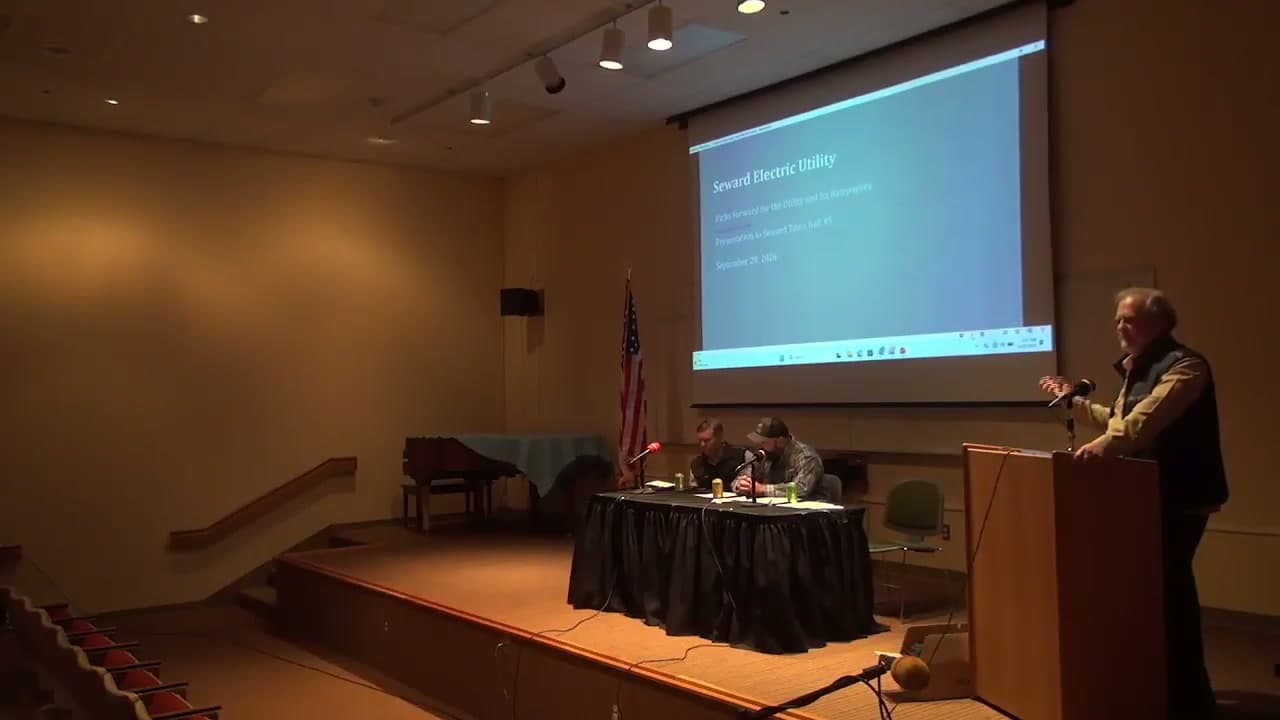
This article is based on a public meeting of City of Seward — Seward Electric Community Town Hall Meeting 9/28/26 ().
AI-assisted. How we use AI Transcript byWalter AlaskaNews
Stay informed. Support what matters.
Free, permanent access to local news you can verify. Subscribe to support Melinda Communities.News and go ad-free.
Related Coverage
Alaska Energy Survey Shows Strong Support for Renewables, Mixed Views on Nuclear
Alaska News · 5mo ago
Cordova's co-op wants a data center to soak up unsold hydropower
Alaska News · 2mo ago
Seward would allow rainwater catchment in new subdivisions, but only by waiver
Alaska News · 3w ago
Chugach Electric proposes 3.5% rate hike to cover $11.2 million shortfall
Alaska News · 2mo ago
Seward council approves five-year lease moving food pantry to senior center
Alaska News · 1w ago
Comments
Sign in to leave a comment.
No comments yet. Be the first to share your thoughts.