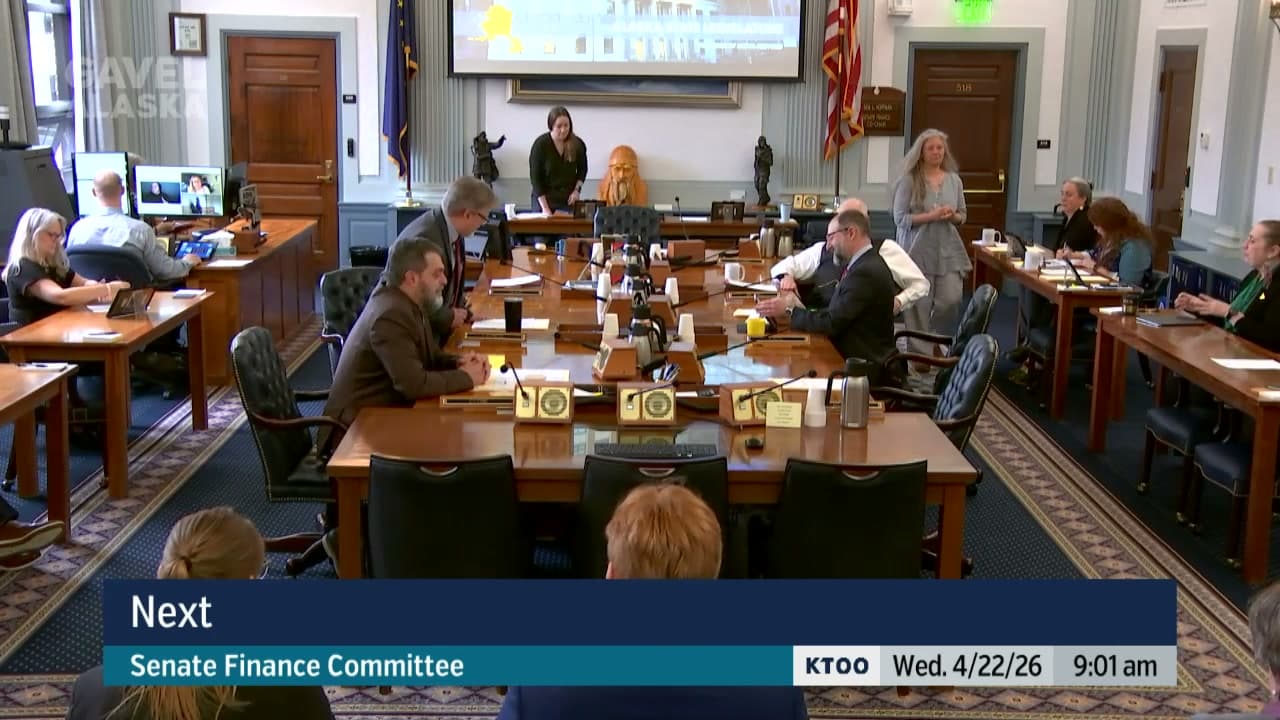
Senate Finance hears bill to add faculty regent to University board
The Senate Finance Committee heard testimony Thursday on legislation that would add a tenured faculty member to the University of Alaska Board of Regents.
House Bill 10, sponsored by Representative Ashley Carrick of Fairbanks, would expand the board from 11 members to 12 by creating a two-year seat for a faculty regent. The Board of Regents currently includes a student regent who serves a two-year term with full voting powers. The faculty member would be selected through what Carrick described as a rigorous process, appointed by the governor, and confirmed by the legislature. The bill includes a six-year sunset provision.
"This legislation is being brought forward to provide better representation for this key stakeholder group," Carrick said. "Our university system currently has a voting member with all board powers and responsibilities. That's reserved for a student regent. This legislation adds a faculty member for that same purpose."
The change would require seven votes to pass a motion, up from the current six. Carrick said most regent votes are unanimous, so the committee does not anticipate challenges around voting. The bill carries a fiscal note of $4,500 for travel costs to and from board meetings.
Jacqueline Kasen, chair of the University of Alaska Faculty Alliance, said all three faculty senates passed resolutions supporting the bill. She distinguished between collective bargaining, which governs compensation and working conditions, and shared governance, which involves collaborative decision-making on educational matters.
"A faculty regent would not function as a labor leader, but would provide programmatic insight," Kasen said. "The Board of Regents would gain a more comprehensive view of the university if faculty had a seat at the table throughout the process, including executive sessions."
Kasen said faculty create and deliver curricular programs and understand the teaching and learning relationship in ways that complement the board's focus on economic incentives and constraints. She noted that a recent 30-page consultant report on the board's student-first agenda mentioned faculty only three times, each focused on a retention metric involving consultant software.
"The relative absence of faculty in the student-first agenda underscores the region's knowledge vacuum when it comes to the many ways faculty mentor students in reaching academic and career goals," Kasen said.
Dr. Mary Wagner, faculty at the University of Alaska Southeast, said strong governance requires not only financial and public oversight but also academic expertise. She said faculty bring direct knowledge of curriculum, accreditation, student learning, and academic quality.
"Adding a faculty regent strengthens alignment between board decisions and the academic mission they are meant to support," Wagner said.
Wagner noted that Alaska recognized the value of board-level perspective over 50 years ago with the addition of a student regent. She said a faculty regent would operate under the same fiduciary responsibility to act in the best interest of the university as a whole, including recusal where appropriate.
Dr. Ingrid Johnson, faculty in the Justice Department at the University of Alaska Fairbanks, said faculty know what happens in classrooms, faculty meetings, and committee meetings in ways that board policies do not necessarily reflect.
"So many of the core functions, and arguably the most core functions of the University, which are teaching and learning, there are, that perspective is not necessarily represented on the Board of Regents without a faculty member on the board," Johnson said.
Dr. Jill Dumasnell, a mathematics professor at the University of Alaska Southeast and president of United Academics, the statewide union representing over 1,100 full-time faculty members, said adding a faculty regent would complement the existing student regent and ensure faculty perspectives are utilized when governance decisions are made.
Dumasnell said it is rare for the current Board of Regents to have any member with past or present experience as a full-time faculty member. Currently, one faculty member is allowed seven minutes to address the board at each meeting. Other faculty members must call in to a one-hour public testimony period and are allowed only two minutes to speak.
"Concerns about tie votes or conflicts of interest can be easily resolved since a majority is by definition more than 50 percent," Dumasnell said. "Then a tie vote clearly fails, as it is not a majority. Conflicts of interest can also be avoided as they are now by disclosure and recusal from decisions, discussion, and voting."
Dumasnell said a faculty regent would abstain from votes relating to the United Academics Collective Bargaining Agreement, just as other procedural issues are regularly handled in board and committee work.
The bill passed the House and is now before the Senate Finance Committee. Senator Elvi Gray-Jackson is sponsoring a companion bill in the Senate. The committee took no action Thursday and set the bill aside for future consideration.
This article is based on a public meeting — Alaska Legislature: Senate Finance, 4/22/26, 9am ().
AI-assisted. How we use AI Transcript byLucas Brown
Stay informed. Support what matters.
Free, permanent access to local news you can verify. Subscribe to support Alaska News and go ad-free.
Related Coverage
Senate panel advances bill adding faculty member to university board
Alaska News · 4mo ago
Dunleavy vetoed a faculty seat on the board that governs the University of Alaska
Alaska News · 3w ago
Alaska Senate advances university regents reform bill with 2027 start date
Alaska News · 4mo ago
Senate Finance considers $1M teacher loan repayment pilot program
Alaska News · 4mo ago
Senate Finance subcommittee recommends $1.17 billion university budget
Alaska News · 5mo ago
Comments
Sign in to leave a comment.
No comments yet. Be the first to share your thoughts.