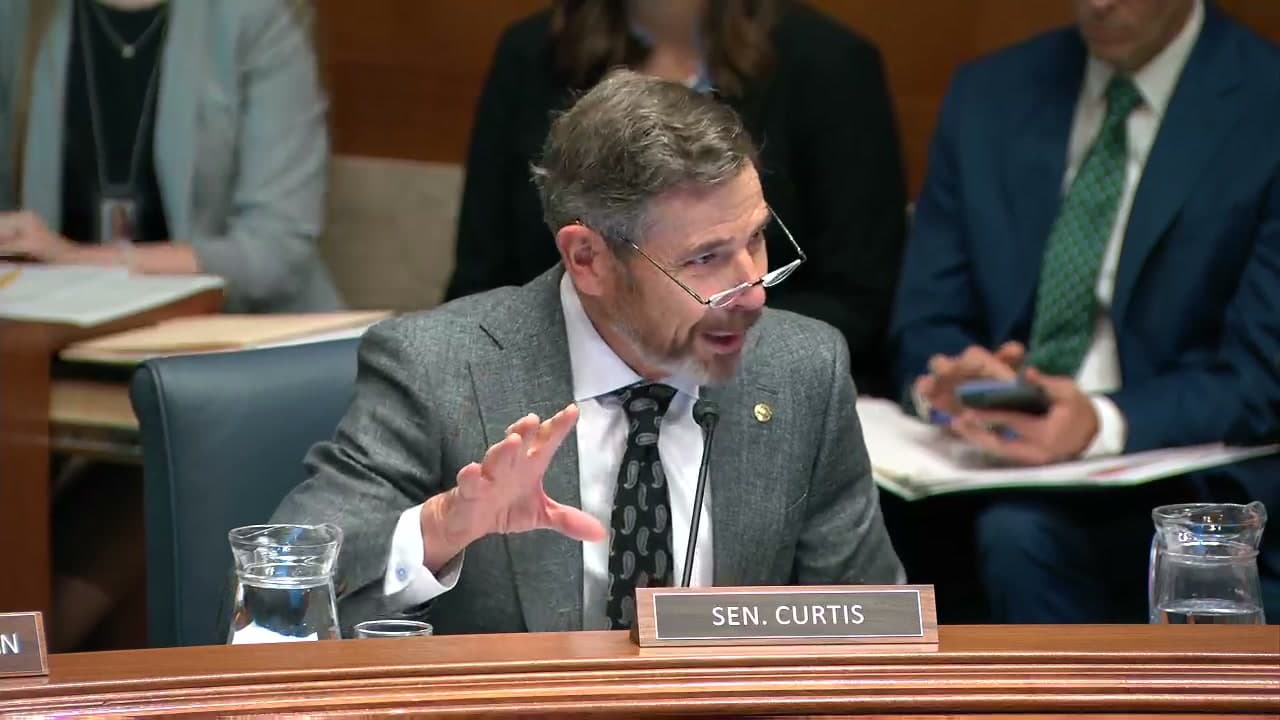
Frame from "Senate Environment and Public Works (Sullivan): Business meeting to consider S.5045, to amend the Clean Air Act to modify the handling of air quality monitoring with respect to prescribed fires, S.3135, to require the Administrator of the Environmental Protection Agency to authorize manufacturers of certain vehicles to suspend engine derate or shutdown functions in prolonged cold weather conditions, and S.5249, to amend the Atomic Energy Act of 1954 to align the licensing of uranium enrichment facilities with other fuel cycle facilities under that Act, and 21 Committee resolutions to approve prospectuses from the General Services Administration." · Source
Senate committee advances Sullivan cold-weather diesel bill on 10-9 vote
Truckers, plow operators and state fleet mechanics in Alaska moved a step closer to relief from a federal rule that shuts diesel engines down in deep cold. The Senate Environment and Public Works Committee voted 10-9 on Wednesday, Sept. 16, 2026, to report out Sen. Dan Sullivan's Cold Weather Diesel Reliability Act. The bill would direct the Environmental Protection Agency to end automatic engine shutdowns during extreme cold.
The committee first adopted a substitute amendment by voice vote. Chairman Shelley Capito said the substitute was offered as the base text in response to feedback received after the bill's introduction. The measure now awaits floor scheduling. The full Senate has not voted on it.
Sullivan tied the vote to equipment Alaskans depend on through winter. Diesel exhaust fluid, or DEF, freezes at 12 degrees Fahrenheit. Emissions systems can cut engine power when the fluid fails or a sensor reads a fault. "Even with onboard heaters, these systems can't compete with -40°F weather, which we often see in Alaska," Sullivan said. He said the failures strand drivers on remote highways without cell service, and that the problem reaches fire trucks, school buses and airport plow equipment.
At the committee's March hearing on the bill, Alaska Transportation Commissioner Ryan Anderson testified that "DEF-related failures cause up to 80% of the state of Alaska's fleet maintenance issues," Sullivan said. Wyoming Farm Bureau Federation's Todd Fornstrom also testified at that hearing. So did the Natural Resources Defense Council's John Walke. The group has said the existing shutdown framework serves emissions-control and safety goals together, and that changing the requirements could weaken compliance and increase pollution from the affected engines.
Ranking Member Sheldon Whitehouse voted no. He said the bill skipped the negotiation the committee's other two measures went through. "With real regret, because I think there may have been a way to cure the over-breadth problem, I will oppose it," Whitehouse said. He added, "Perhaps we can keep working towards a bipartisan solution."
Sullivan and Sen. Cynthia Lummis introduced the bill in November 2025. Sullivan said he wants a bipartisan path before it reaches the floor.
This article is based on a public meeting of Senate Environment and Public Works (Sullivan) — Senate Environment and Public Works (Sullivan): Business meeting to consider S.5045, to amend the Clean Air Act to modify the handling of air quality monitoring with respect to prescribed fires, S.3135, to require the Administrator of the Environmental Protection Agency to authorize manufacturers of certain vehicles to suspend engine derate or shutdown functions in prolonged cold weather conditions, and S.5249, to amend the Atomic Energy Act of 1954 to align the licensing of uranium enrichment facilities with other fuel cycle facilities under that Act, and 21 Committee resolutions to approve prospectuses from the General Services Administration. ().
AI-assisted. No editor review is on record for this article. Who is accountable. Transcript byWalter AlaskaNews
Watch key moments from the source meeting. Click to expand.
Stay informed. Support what matters.
Free, permanent access to local news you can verify. Subscribe to support Walter AlaskaNews and go ad-free.
Related Coverage
EPA moves to stop Alaska's cold from shutting down diesel engines
Alaska News · 2mo ago
Alaska wants out of a diesel rule that shuts trucks down in the cold
Alaska News · 6mo ago
Sullivan files resolution to overturn EPA decision on California at-berth ship emissions
Alaska News · 1mo ago
Senate committee advances hydropower bill backed by Murkowski
Alaska News · 3mo ago
Senate panel advances water bill with Alaska Native village sanitation, Nome port, and Juneau flood provisions
Alaska News · 2mo ago
Comments
Sign in to leave a comment.
No comments yet. Be the first to share your thoughts.