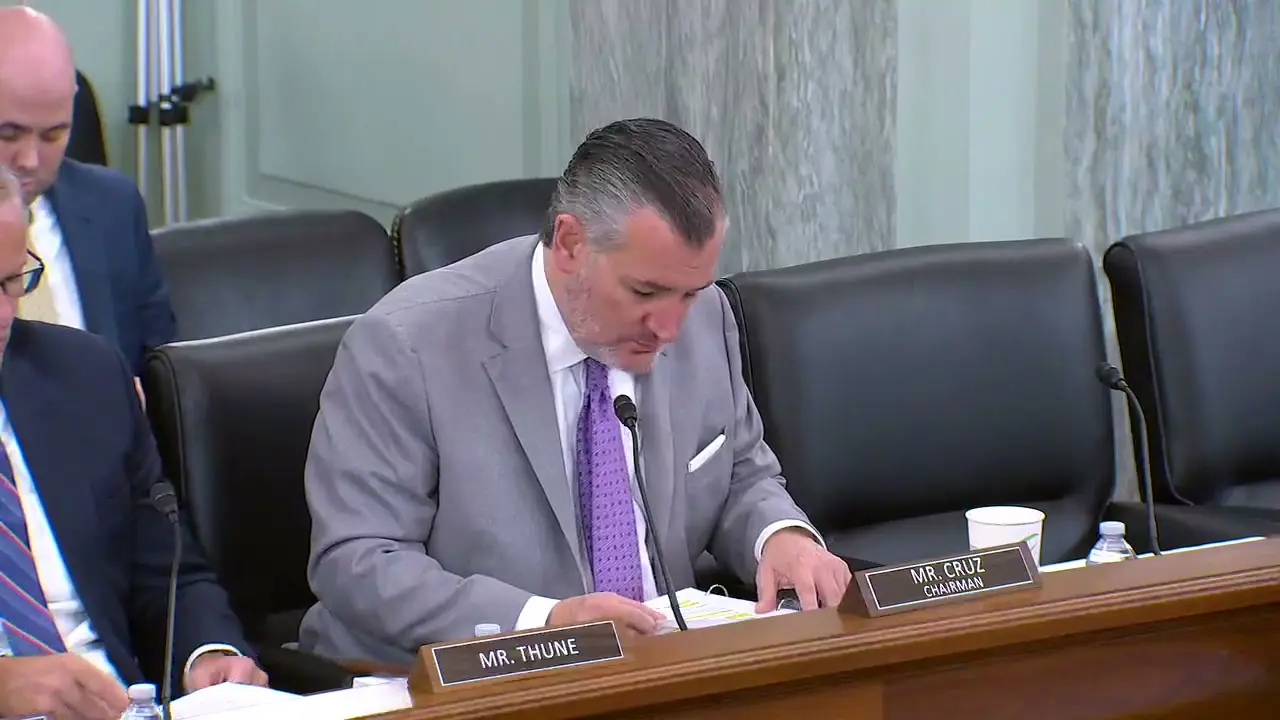
Frame from "Senate Commerce, Science, and Transportation: Business meeting (November 18, 2026)" · Photo source
Senate committee advances bill to let users sue platforms that censor at federal request
The Senate Commerce, Science, and Transportation Committee voted Wednesday to send the full Senate Sen. Eric Schmitt's bill letting speakers sue social media platforms that censor them at the federal government's request. The bill would also bar platforms from invoking Section 230, the federal law that generally shields them from lawsuits over user content, against qualifying claims.
Schmitt, a Missouri Republican, carried the measure, known as the COLLUDE Act. The committee advanced it as amended. Schmitt said it would also give speakers a way to seek evidence of government pressure. "Platforms will remain free to enforce their own rules independently," he said, adding that the same protections would apply no matter who occupies the White House.
The committee approved the bill by voice vote as part of a package moved by Chairman Ted Cruz. No committee Democrats attended. Cruz said they had boycotted the meeting over a Federal Communications Commission nomination, the second boycott of a markup this Congress.
The committee's Democrats, led by Ranking Member Maria Cantwell of Washington, had sent Cruz a Nov. 16 letter asking him to remove that FCC nominee from the agenda. They asked that the nomination wait until the next Congress and be paired with two Democratic nominations. "There is no mandate for the outgoing majority to rush through a partisan FCC nomination in its final weeks," they wrote. Democrats will control the Senate in January.
Schmitt traced the bill to his time as Missouri attorney general, when Missouri and Louisiana brought Missouri v. Biden in 2022. He said evidence gathered in the case showed Biden administration officials pressed social media companies to remove posts and change their moderation policies. In June 2024, the Supreme Court reversed an appeals court ruling in the case after concluding the plaintiffs lacked standing to seek an injunction, according to the court's opinion. A 2026 consent decree, a court-enforceable settlement, barred the Surgeon General, CDC and CISA for 10 years from threatening major platforms to remove the plaintiffs' protected speech, according to a Schmitt press release.
"As Attorney General, I had the resources of a state to investigate and fight back," Schmitt said. "Most Americans do not, but they should not need an Attorney General to take up their cause to defend their freedom of speech."
At a Sept. 16 committee meeting, Schmitt had thanked Cruz for committing to bring the bill up at the next markup. The committee advanced Cruz's own bill on government pressure on platforms at that meeting. Cruz said then that it would let people sue over the coercive government threat itself when it is made against a broadcaster, social media or similar tech company. On Wednesday he said it provides "a very direct remedy if and when government agencies of either party violate free speech."
The bill next goes to the full Senate.
What did you make of this story? (no account needed)
Made by our human newsroom with AI. How humans and AI work here · Grow with our newsroom · Transcript byLucas Brown
Keep Alaska News free for everyone.
No paywall, ever. Members pay so everyone can read the meetings and records Alaska News covers.
Get Alaska News in your inbox
Create your free account and get the day’s top stories around 6 each morning, in a few minutes’ read.
Top stories, around 6 each morning.
Stories on what you follow, on Sundays.
This article is based on a public meeting of Senate Commerce, Science, and Transportation — Senate Commerce, Science, and Transportation: Business meeting (November 18, 2026) ().
Watch key moments from the source meeting. Click to expand.






Comments
Sign in to leave a comment.
No comments yet. Be the first to share your thoughts.