Senate Commerce, Science, and Transportation: Business meeting (November 18, 2026)
Alaska News • • 53 min
Articles from this transcript
Senate committee advances bill to let users sue platforms that censor at federal request
Senate Commerce Committee advanced Sen. Eric Schmitt's bill letting users sue platforms that censor them at federal request. It heads to the full Senate next.

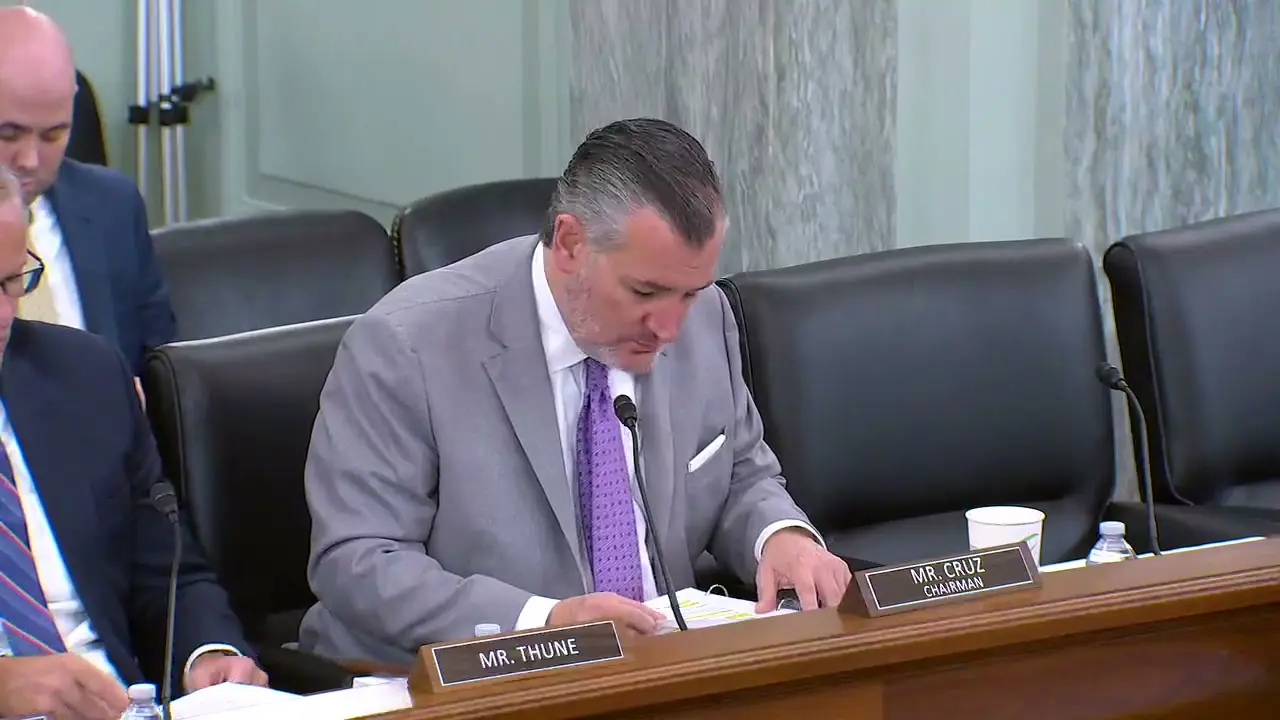
No audio detected at 0:00
No audio detected at 2:00
No audio detected at 3:30
No audio detected at 5:30
No audio detected at 7:30
No audio detected at 9:30
No audio detected at 10:30
No audio detected at 12:30
No audio detected at 14:30
No audio detected at 15:10
No audio detected at 16:30
No audio detected at 18:30
No audio detected at 20:30
No audio detected at 21:30
Good morning. The Senate Committee on Commerce, Science, and Transportation will come to order.
Yesterday, I received a letter from members of the minority urging me to postpone a vote on Daniel Thuman, who has been nominated to the Federal Communications Commission. The opening sentence of the letter explained that, quote, the recent elections returned control of both chambers of Congress to the Democrats.
Apparently, that means the Democrats don't need to show up for work anymore. Look, Democrats will control the Senate, unfortunately, in January. But today is November 18th.
The American people elected each of us to fulfill our duties, including advice and consent, for our full terms. As Senator Cantwell put it a few years ago, quote, "Advice and consent isn't an option. It's an obligation." So we're going to be doing our job today. Even if the Democrats refuse to show up to do theirs. It's a shame, really, because this is now the second time that the Democrats have boycotted a markup this Congress.
We never saw that at this committee last Congress when the Democrats had the majority. When Senator Cantwell was chairman, not once did Republicans do what Democrats have done twice now, which is boycott the meeting and throw a temper tantrum because they did not like the choice of the American voters at the previous election. And candidly, it's a terrible harbinger heading into next year. What it should tell all of us is the Democrats have zero intention of processing any of the president's nominees. We are heading into 2 years of total obstruction, Total war, partisan warfare is what the Democrats are promising us.
By the way, on the campaign trail, they talked about affordability. Affordability is now gone. This is just open Democrat war.
Ms. Thuman's nomination followed a typical process. President Trump nominated her way back in August. She was scheduled to testify before this committee in September. But she went into labor just before the hearing, leading us to have to postpone it to last week. So the Democrats, who love to boast about their support of working mothers, are now punishing a woman for having a baby and taking a few days of maternity leave.
We've had plenty of time to vet Ms. Thuman, and all throughout that time, my colleagues never suggested that moving this nomination was a red line. We didn't learn about this boycott until last night, after staff on both sides has spent countless hours preparing for the markup. So what's the issue? Some Democrats oppose Ms. Thuman because President Trump did not pair her with a Democrat FCC nominee. But there's no evidence that Democrats actually worked with the Trump administration to have a Democrat nominated to the FCC.
The administration has shown it's willing to move Democrats. Just this week, Senate committees are voting on bipartisan pairs for the CFTC and the SEC. Of course, there's nothing that requires the president to nominate in pairs, and this committee has moved FCC nominees separately in the past. The law merely says that no more than 3 of the commissioners may be from the same party. If confirmed, Ms. Thuman would be the third Republican FCC commissioner consistent with that requirement.
I'll also note that while the Supreme Court decided in Trump v. Slaughter that President Trump has the authority to dismiss commissioners of independent regulatory agencies, he has not fired any FCC commissioners. Commissioners Nathan Symington and Jeffrey Starks voluntarily resigned in June of 2025. Ms. Thuman is nominated to fill the vacancy left by former Commissioner Symington, a Republican. This is an ordinary nomination to fill a vacancy previously held by someone of the same party. There's ample precedent for advancing nominations during a lame duck session.
In fact, in December 2024, I want us to remember back to what we did in December 2024. This committee, under Democratic leadership, and despite the Democrats getting trounced in an election the month earlier, November of 2024, this committee advanced 8 of President Biden's nominees before the new Congress was sworn in. Republicans didn't boycott that markup. We could have.
I even praised the committee chair for her leadership at the time. I made the motion to advance the nominees. So let's evaluate our nominees on their own records. Let's actually do our jobs. Ms. Thuman, for her part, has substantial experience at the FCC and in communications law.
This committee, on the merits, should advance her nomination today. By the end of this markup, the committee will have advanced more than 120 pieces of legislation in the last 2 years. It's a record we should all be proud of, Republicans and Democrats alike. I had intended to commend both the Republicans and Democrats on this committee for a remarkable record of success. Unfortunately, half the members of this committee decided not to be here.
Although I can't tell her in person this morning, I look forward to working hand in hand with Ranking Member Cantwell when she takes over the, the gavel in January. And this committee will continue to be productive. But having half the committee refused to show up for work is not helpful to getting our work done.
With that, I recognize Senator Sullivan for a motion. Mr. Chairman, I move that PN1355, PN1356, PN1357, PN1438, PN1470, and PN1471 Coast Guard promotions be favorably reported. Is there a second? Second. All those in favor say aye.
No audio detected at 30:40
Aye. All those opposed say no. The motion is agreed to and the nominations are ordered to be reported favorably. I move that S. 69, the Kahloud Act, as amended by the Schmidt Substitute and Cantwell 5, S. 2586, the MARA Act of 2025, as amended by the Wicker Substitute, as modified, and Sullivan 1. S.2883, Quantifying Uncertainty and Action to Help Optimize Growth of Shellfish Act of 2025, as amended by the Blunt-Rochester substitute.
No audio detected at 31:00
S.3301, the CHIP Equip Act, as amended by the Blackburn substitute. S.3741, the Biosecurity Modernization and Innovation Act of 2026, as amended by the Klobuchar substitute, as modified. S.3954, No Lifeline for Dead People Act, as amended by the Cruz substitute, as modified. Marquee 1, as modified, and Marquee 5. S.4256, the Airmen's Certi— uh, Certificate Accessibility Act, as amended by the Shihee Kim substitute.
S.5251, the ACPAC Modernization Act. S.5332, the Cooperative Institute Act of 2026, as amended by the Cantwell substitute, as modified. S.5508, the Telecommunications Cybersecurity and Resilience Act, as amended by the Cruz substitute, as modified. S.5663, the Proof Act, as amended by the Lummis substitute, as modified, and S.5718, the Trucker Bathroom Access Act, as amended by the Blunt-Rochester substitute, as modified, be favorably reported. Is there a second?
Second. All those in favor say aye. Aye. All those opposed say no. The motion is agreed to.
And the bills are ordered to be reported favorably. Mr. Chairman, Senator Sullivan, I'd like to be recorded as a no on S2586. The record will so reflect. I ask for unanimous consent that staff are authorized to make technical and conforming changes. Without objection, so ordered.
No audio detected at 33:10
I recognize Senator Thune for a motion. Thank you, Mr. Chairman. And Mr. Chairman, just by the way, I observe on that list of bills just prove that half of those were Democrat bills. Indeed. They're not here to vote for their own legislation.
No audio detected at 33:30
Mr. Moran. Aye. Mr. Sullivan. Aye. Mrs. Blackburn.
Mr. Young. Mr. Budd. Mr. Schmidt. Mr. Curtis. Mr. Marino.
Mr. Sheehy. Mrs. Caputo. Miss Lomas. Miss Cantwell. Miss Klobuchar.
Mr. Schatz. Mr. Markey. Mr. Peters. Miss Baldwin. Miss Duckworth.
Ms. Rosen, Mr. Lujan, Mr. Hickenlooper, Mr. Federman, Mr. Kim, Ms. Blunt-Rochester, Mr. Cruz. Aye. The yeses are 15. The motion is agreed to and the nomination is ordered to be reported favorably. I recognize Senator Fischer for a motion.
Thank you, Mr. Chairman. I move that PMN 1255-18 Nomination of Danielle Thuman-Seavers to be a member of the Federal Communications Commission be favorably reported. Is there a second? Second. Clerk will call the roll.
No audio detected at 34:50
Mr. Thune. Aye. Mr. Wicker. Aye. Mrs. Fisher.
Aye. Mr. Moran. Aye. Mr. Sullivan. Aye.
Mrs. Blackburn. Aye. Mr. Young. Aye. Mr. Budd.
Aye. Mr. Schmidt. Mr. Curtis, Mr. Marino, Mr. Sheehy, Mrs. Caputo, Miss Lummis, Miss Cantwell, Miss Klobuchar, Mr. Schatz, Mr. Markey, Mr. Peters, Miss Baldwin, Miss Duckworth, Miss Rosen, Mr. Lujan, Mr. Hickenlooper, Mr. Fetterman, Mr. Kim, Ms. Blunt Rochester. Mr. Cruz. Aye.
Yeses are 15. The motion is agreed to and the nomination is ordered to be reported favorably. I recognize Senator Wicker for a motion. Mr. Chairman, I move that PN— excuse me, let me turn— I move that PN1273-20, nomination of Joshua Shoemaker to be Chief Financial Officer of the National Aeronautics and Space Administration be favorably reported. Is there a second?
No audio detected at 36:00
Clerk will call the roll. Mr. Thune. Aye. Mr. Wicker. Aye.
Aye. Mr. Schmidt. Aye. Mr. Curtis. Mr. Marino.
Aye. Mr. Sheehy. Mrs. Capito. Ms. Lummis, Ms. Cantwell, Ms. Klobuchar, Mr. Schatz, Mr. Markey, Mr. Peters, Ms. Baldwin, Ms. Duckworth, Ms. Rosen, Mr. Lujan, Mr. Hickenlooper, Mr. Fetterman, Mr. Kim, Ms. Blunt-Rochester, Mr. Cruz. Aye.
The yeses are 15. Motion is agreed to and the nomination is ordered to be reported favorably. I recognize Senator Moran for a motion. Mr. Chairman, thank you. I move the PN1367-7 nomination of Robert Snell to be the Inspector General of National Aeronautics and Space Administration be favorably reported.
No audio detected at 37:10
Aye. Mr. Sullivan? Aye. Mrs. Blackburn? Aye.
Mr. Young? Aye. Mr. Budd? Aye. Mr. Schmidt?
Aye. Mr. Curtis? Aye. Mr. Marino? Aye.
Mr. Sheehy? Aye. Mrs. Capito? Aye. Ms. Lummis?
Aye. Miss Cantwell? Aye. Miss Klobuchar? Aye.
Mr. Schatz? Aye. Mr. Markey? Aye. Mr. Peters?
Aye. Miss Baldwin? Aye. Miss Duckworth? Aye.
Ms. Rosen, Mr. Lujan, Mr. Hickenlooper, Mr. Fetterman, Mr. Kim, Ms. Blunt-Rochester, Mr. Cruz. Aye. Yeses are 15. The motion is agreed to and the nomination is ordered to be reported favorably. That concludes our votes for the morning.
Are there members wishing to make remarks on any of the agenda items? Senator Moran. Mr. Chairman, thank you.
Mr. Chairman, thank you. On the nomination of Ms. Seavers to the FCC. I was interested in her confirmation hearing and the testimony that she gave. It was comforting to me because I have concerns with FCC action in regard to political speech, broadcasters, and she indicated in her answers that, in a way, that provided me with a level of comfort about her nomination in regard to that issue. Mr. Chairman, I think you expressed those kind of concerns as well publicly.
I also visited with her on the phone this morning to convey again my serious interest in how the FCC protects and promotes free speech, including free speech on broadcast, and she was able to satisfy me once again in her answers, including an explanation for her role at the FCC and her lack of engagement on this type of issue as the FCC made decisions. So, Mr. Chairman, I'm only here to report that my level of comfort to exist continues to exist. I've asked her to come visit with me before her nomination is considered by the full Senate, and I felt— and she agreed to do that. And, uh, the point I would make is I want to be on the record as continuing to try to make certain that our nominees understand the value of, uh, political free speech, uh, and the role, the proper role that the FCC has in regulation of broadcasting. Mr. Chairman, thank you.
Thank you, Senator Moran. I emphatically agree, and I'm happy to work with you to ensure that we hold the FCC and all the agencies to that standard. And I will say I am glad that this committee advanced my Jawbone legislation, which is designed to provide a very direct remedy if and when government agencies of either party violate free speech. And we need to continue to be vigilant in protecting First Amendment rights of all Americans. I appreciate your position and I value your leadership in this regard.
Thank you, Senator Moran. Senator Schmidt. Thank you, Mr. Chairman. I want to thank you for bringing the CULLUD Act up, and really proud that it passed today and advanced out of committee. America's founders understood a principle on which self-government depends: a free people must be able to criticize those in power.
They wrote the First Amendment into the Constitution to protect the freedom of speech from government suppression. The federal official cannot evade this constitutional limit by coercing a private company to do what the government cannot do itself. I've been fighting this battle since I served as Missouri's Attorney General. In 2022, I brought the Missouri v. Biden case and exposed federal officials' role in suppressing American speech online. Through discovery, we uncovered communications revealing how Biden administration officials pressed social media companies to remove posts and change their moderation policies.
We uncovered how the social media companies participated in that censorship because they thought it would help their bottom line. Some have tried to suggest that these social media companies have somehow been the victims of the scenario. That couldn't be further from the truth. The true victims were the American people whose speech was suppressed, and the tech companies didn't stand up for them. Instead, the companies sold out the American people's free speech rights to protect their bottom lines.
As Attorney General, I had the resources of a state to investigate and fight back. Most Americans do not, but they should not need an Attorney General to take up their cause to defend their freedom of speech. The CLOUT Act would give everyday Americans a direct way to fight back against social media platforms censoring them at the behest of the federal government. Today, Americans use social media to debate public policy, expose government misconduct, and organize with their neighbors. When a federal official threatens a platform with regulatory action unless it takes down protected speech, the platform can resist or give in.
But if it gives in, Americans exercising their right to free speech are the ones who pay the price. The Kahloud Act fixes that. The bill gives the social media platforms a strong legal and financial incentive to resist government censorship. I want to thank Chairman Cruz and the Commerce Committee staff for working with us on the revised bill. It would give effective speakers an express right to sue social media platforms that censor them at the behest of the federal government and prevent those platforms from invoking Section 230 to shield themselves from qualifying claims.
It would also give speakers a way to seek evidence of government pressure to ensure the deterrent effect of a lawsuit is credible. Platforms will remain free to enforce their own rules independently, but the CLOUD Act would make sure Section 230 no longer confers categorical immunity to social media platforms to participate in unconstitutional government censorship. As Justice Thomas has explained, Section 230 immunity eliminates the biggest deterrent, a private lawsuit against the social media companies caving to an unconstitutional government threat. The Kahloud Act restores that deterrent and gives the American people the tools they need to protect their rights and hold Big Tech accountable. And the same protections would apply no matter who occupies the White House.
In a republic, the people have the right to answer back, and those in power have no right to silence them. I thank my colleagues for advancing this bill and look forward to working together to get it signed into law. Thank you. Thank you, Senator Schmidt. And I congratulate Senator Schmidt on the passage from this committee of his important legislation.
Senator Moreno. Just a quick message to the American people who pay taxes at home and you wonder what is your government doing. You're struggling. You can't afford groceries. You can't afford gas.
You can't afford rent. You just saw an election 2 weeks ago and you're wondering, you know, have the— have my elected officials heard my message? We're here in the Committee on Commerce, Science and Transportation to advance nominees and get bills done. And the Democrat members of this committee are total and complete Childish temper tantrum for the second time, decide not to show up for work. Ask yourself at home, if you're at home, are you able just to not show up for work because you want to take your toys home and be upset?
What were we doing today? We were advancing 12 bills, 4 of them to protect this nation, all of them with bipartisan support. We're advancing nominees, not nominees that they hadn't heard of. We had hearings in this committee. For those nominees.
The one that they're upset about, the FTC, the Democrats didn't even show up to that hearing to ask that nominee the questions that would help them decide whether to vote or not. So for those of you who voted for Democrats, what did you vote for? Did you vote for people who didn't show up to work? Did you vote for people who aren't willing to defend this country? Did you vote for Democrats that want to shut down this government while they still get paid?
For people who have every meal taken care of for them. They get people to drive them around, treat them like kings. You are at work doing your job and these guys can't even show up for work. That's the modern Democrat Party. Unfortunately, we have a media that will cover for them.
There isn't a single reporter out there in these hallways that will ask any of these sons of bitches why they didn't show up for work today. And yet you have to do that. This is a total and complete disgrace. Washington, D.C. shouldn't be this hard. It is grotesque and disgusting that we have colleagues that will burn this country down, not fight for the American people to score cheap political points.
But to my Democrat colleagues, be careful what you ask for. Just like you think you can weaponize the Senate rules against Republicans, you too will soon feel the pain of those types of antics. I hope and pray that maybe somewhere in the freshman class of Democrats, there's people who actually want to work for the American people And if you're out there, I'll be there with you. And to those of you lazy people who decided that it was better to be a middle schooler with a suit on than be actually a constructive member of the United States Senate, the shame that you're bringing on this institution, the deterioration of norms that you're bringing to this United States Senate is a total and complete disgrace.
Thank you, Senator Moreno. Notably, we reported out multiple Democrat-led bills from this markup, from Senators Cantwell, Rosen, Blunt Rochester, Whitehouse, Kelly, and Warner. Three of those Democrats sit on this committee, but they refuse to come here and advance their own bills today. One of those bills is the Telecommunications Cybersecurity and Resilience Act. That is a bill that I am advancing along with Senator Warner, a Democrat.
Americans have good reason to be concerned about the security and reliability of the technologies they depend upon every day. Just this past week, we've seen widespread technology disruptions affecting communications, financial services, air travel, and even government systems. While we do not presently have evidence that these incidents were part of a coordinated cyberattack, they are a stark reminder of how vulnerable the systems we depend on every day can be, and how far-reaching the consequences are when they fail. Also this week, Google cybersecurity researchers warned that adversaries, including Chinese-linked actors, are increasingly using artificial intelligence to automate sophisticated cyberattacks. And just last week, the FBI issued a warning about AI-powered hacking tools being used to target critical infrastructure including telecommunications networks.
And we are still confronting the consequences of Salt Typhoon, one of the most serious foreign intrusions into our telecommunications infrastructure in American history. These developments expose a fundamental reality: our adversaries are relentless, our networks are vulnerable, and Americans deserve greater confidence that the systems they rely on are secure. Our defenses must be equally capable of adapting. A cybersecurity framework that focuses more on satisfying regulatory requirements than addressing actual vulnerabilities can leave Americans with the appearance of security rather than the real thing. That is why Senator Warner and I took a different approach.
Our legislation brings together the federal government and the telecommunications industry to develop cybersecurity best practices that are informed by real-world threats, grounded in technical expertise, and capable of evolving as those threats change. It establishes independent certification to encourage companies to adopt and maintain stronger cybersecurity practices. And it recognizes the companies responsible for operating these networks must be active partners in securing them, not simply the recipients of instructions from Washington, D.C. This is not about giving industry a free pass. It's about creating a framework that rewards better security rather than simply demanding more compliance.
I appreciate Senator Warner's willingness to work across the aisle on this legislation. We have had substantive disagreements and we've worked through difficult questions because we share a common objective: protecting America's communications infrastructure. I also appreciate Ranking Member Cantwell's commitment to improving cybersecurity, but I fundamentally disagree with the approach that is reflected in her filed amendments, which were not offered this morning. Those amendments would move us away from a genuine public-private partnership and towards a more government-directed process, while stripping away important incentives for companies to participate and improve their cybersecurity practices. I do not believe that this is the right direction.
The government has an indispensable role in protecting national security. Sharing threat intelligence, and helping industry respond to sophisticated foreign adversaries. But federal agencies do not have a monopoly on cybersecurity expertise, and government-directed compliance is not a substitute for operational security. We should measure success by whether American networks are becoming more secure, not by how many new requirements Washington has imposed. As Congress continues this work, I hope that we can build on the bipartisan foundation that Senator Warner and I have established together.
Because cybersecurity should not be a contest over who can impose the most regulations. It should be a commitment to developing the most effective cyber defenses. And ultimately, that is what the American people expect from us. That concludes our executive session for today. The committee is adjourned.
No audio detected at 52:30
Speakers in this transcript
Bernie Moreno
U.S. Senator for Ohio; member of the Senate Committee on Commerce, Science, and Transportation · U.S. Senate Committee on Commerce, Science, and Transportation
Deb Fischer
Eric Schmitt
United States Senate
Jerry Moran
United States Senator · United States Senate
Ted Cruz
Chairman · U.S. Senate