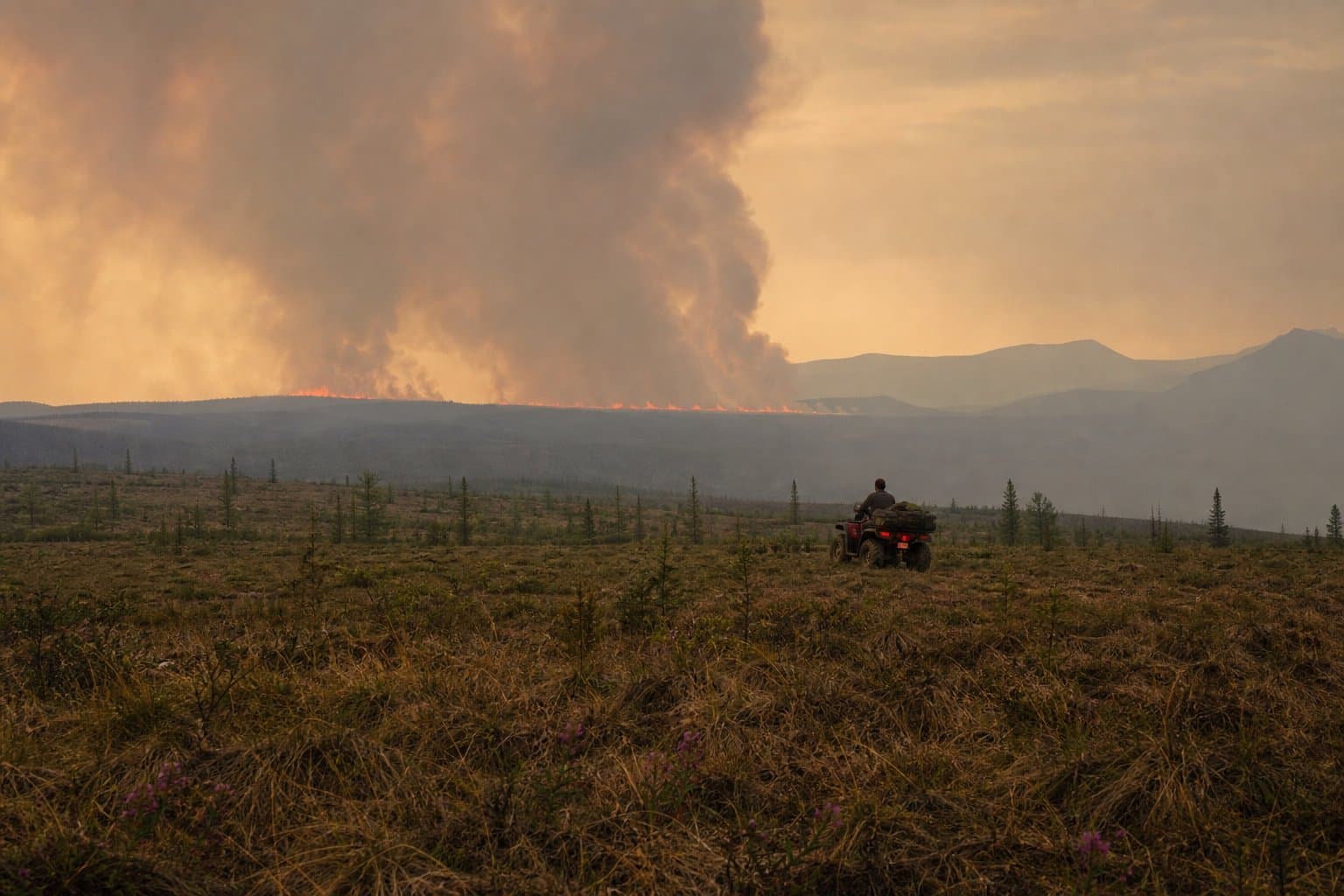
AI image
Red Flag Warnings cover five western Alaska regions Tuesday as lightning threat may push to North Slope
Five regions of western and interior Alaska face critical wildfire conditions Tuesday as the National Weather Service in Fairbanks issued Red Flag Warnings, with thunderstorms potentially extending as far north as the North Slope on Wednesday.
The warnings run from 10 a.m. Tuesday through midnight Tuesday night for the Northern Seward Peninsula, Upper Kobuk Valleys, Lower Koyukuk Valley, Interior Seward Peninsula, and Middle Yukon Valley. Humidity across the warning zones is forecast in the low 30 percent range, with highs in the upper 70s and lows in the mid 40s. Winds will be northeast at 5 to 10 mph for the Interior Seward Peninsula and Middle Yukon Valley zones.
The driver is lightning. NWS Fairbanks warned that scattered thunderstorms will bring frequent lightning and outflow boundaries, and that "any lightning can cause new ignitions since the fuels are dry and burnable." Under Red Flag conditions, residents in warned areas should avoid burning, use caution with spark-producing equipment, dispose of cigarettes properly, and fully extinguish campfires.
Fire Weather Watches extend the window into Wednesday for four of those regions plus the Lower Kobuk Valley, where temperatures are expected near 80 degrees and gusts could hit 20 mph. NWS Fairbanks flagged an open question: "There is a question of how far north scattered thunderstorms will travel Wednesday, potentially as far north as the North Slope. Stay tuned."
The same weather cluster also brought heat advisories for the Yukon Flats, where temperatures could reach 85 degrees through Wednesday evening, and for the Western and Central Arctic Plains, where highs near 80 degrees are expected through Tuesday night.
This stretch follows a run of late-June Red Flag Warnings across interior and western Alaska, including warnings issued June 26 for McGrath, the Middle and Lower Yukon Valleys, Innoko Valley, and Fortymile Country due to abundant lightning and dry fuels. NWS defines a Red Flag Warning as a call to take action because critical fire weather conditions are occurring or imminent, directed toward fire agencies and, through them, to the public. A Fire Weather Watch means conditions could soon reach that threshold.
Source: National Weather Service.
AI-assisted. How we use AI
Stay informed. Support what matters.
Free, permanent access to local news you can verify. Subscribe to support Maggie AlaskaNews and go ad-free.
Related Coverage
NWS issues overlapping fire-weather alerts across northern Alaska through July 9
Alaska News · 2mo ago
Fire Weather Watch issued for Lower Kobuk Valley through Wednesday
Alaska News · 2mo ago
Heat and fire risk converge across Interior Alaska for solstice weekend
Alaska News · 3mo ago
Red Flag Warnings span Interior Alaska as fire season intensifies
Alaska News · 3mo ago
Red Flag Warning covers Southwest Alaska through Wednesday
Alaska News · 4mo ago
Comments
Sign in to leave a comment.
No comments yet. Be the first to share your thoughts.