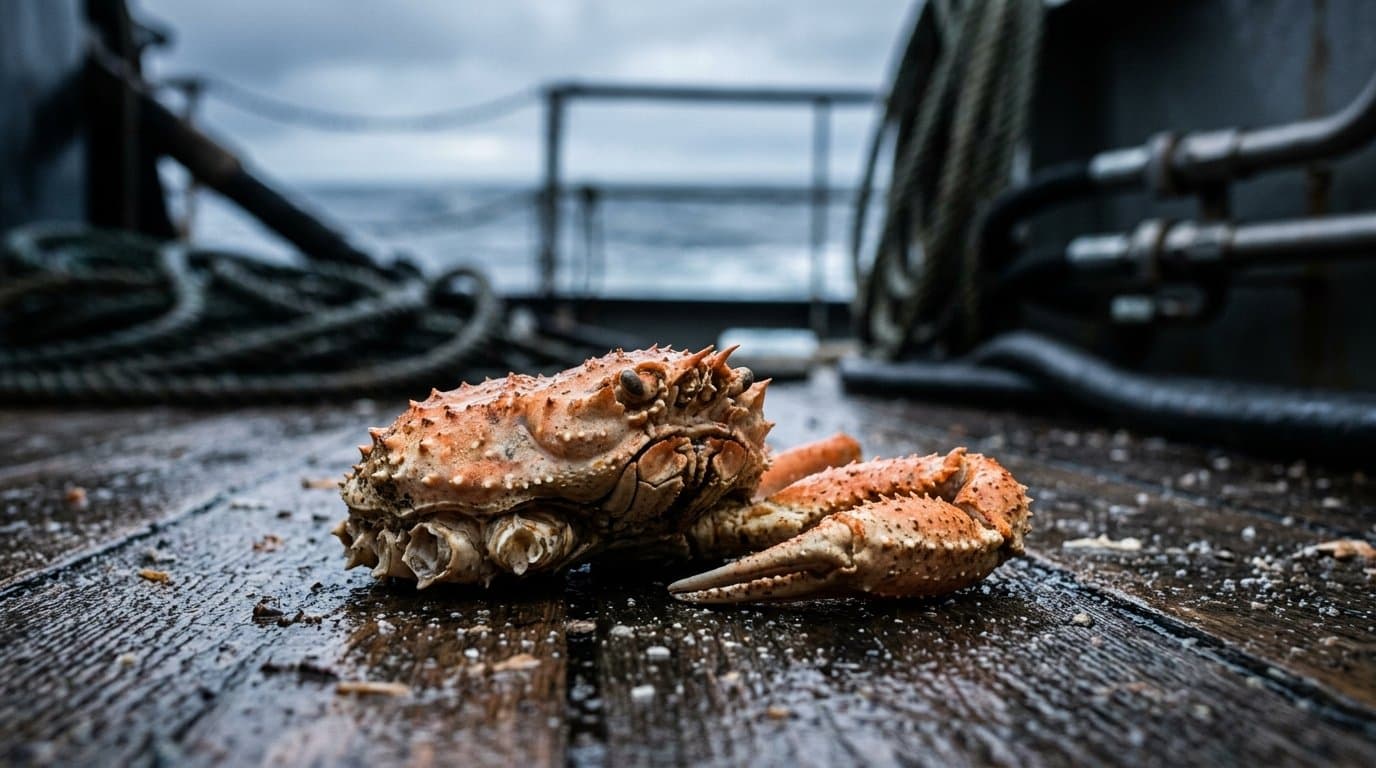
AI image
Once-rare hybrid crab were nearly half of big Bering Sea males after snow crab collapsed
A crab that was once a rarity in the Bering Sea, a cross between snow crab and Tanner crab, made up nearly half of the commercial-sized males in last year's federal survey, NOAA Fisheries scientists reported Monday.
The hybrids surged after the 2018-19 marine heatwave. More than 10 billion snow crab disappeared from the eastern Bering Sea between 2018 and 2021, and the state shut down the snow crab fishery for the 2022-23 season, the first closure in its history. The fishery had averaged $150 million a year from 2012 to 2021.
Now the people who set catch limits have a problem the rules weren't written for. Fishermen can legally land male hybrids as snow crab. But hybrids were so rare that they were never included in the federal plan that sets yearly Bering Sea crab quotas, and existing regulations have no formal way to set a separate limit for them, the agency said.
"These results are unprecedented," said Erin Fedewa, the study's lead author, whose team works at the Alaska Fisheries Science Center's Kodiak Laboratory. She said it was the first time an increase in hybridization had been attributed to a single marine heatwave.
The hybrids' overall numbers rose more than 13 times. Commercial-sized male hybrids went from less than 10 percent of harvestable males to 41.7 percent in 2025, and this year's survey found even more commercial-sized male hybrids, said Emily Ryznar, a co-author.
"It's clear this will continue to be a pressing management challenge for decision makers," Ryznar said.
The study, in the Proceedings of the National Academy of Sciences, found that indirect effects of the snow crab collapse accounted for 76 percent of the surge in hybrid and Tanner crab. With billions fewer snow crab on the seafloor, hybrids were likely released from competition and predation, the agency said. Tanner crab hit their highest recorded numbers in 2025.
State managers responded to the first wave of hybrids last year. The 2025 snow crab limit of 9.3 million pounds included 1 million pounds added so boats could target hybrids. This season's limit of 5.1 million pounds, a 45 percent cut, has no such allowance, Alaska News reported Oct. 6. The season opened Oct. 15.
A 2023 study by NOAA Fisheries scientists tied the snow crab die-off to starvation. They found that lab-tested snow crab needed nearly twice as many calories as the water warmed, while the area where the crab were found in 2018 was the smallest, relative to their historical range, in the survey's history. The scientists found no strong link to Pacific cod predation or to bycatch, crab caught by boats fishing for other species.
"During the marine heatwave, snow crabs faced a triple threat," Cody Szuwalski, that study's lead author, said at the time.
The closure hit hard. In 2021, 59 boats fished snow crab and brought $219 million into fishing communities. After the fishery shut down, St. Paul, which depends heavily on it, declared a cultural, economic and social emergency, and the Secretary of Commerce issued disaster declarations for 2022-23, according to NOAA Fisheries.
Based on a press release.
Made by our human newsroom with AI. Reviewed by Cale Green. How humans and AI work here · Grow with our newsroom
Stay informed. Support what matters.
Free, permanent access to local news you can verify. Subscribe to support Maggie AlaskaNews and go ad-free.
Related Coverage
North Pacific council raises Tanner and Bristol Bay red king crab limits, keeps snow crab in rebuilding
Alaska News · 1w ago
North Pacific council's SSC keeps snow crab buffer at 40%, not 50%
Alaska News · 1w ago
The snow crab limit is going up. There aren't more crab.
Alaska News · 1mo ago
Bering Sea Tanner crab limit nearly triples as snow crab falls 45 percent
Alaska News · 1w ago
State reviews Bering Sea crab catch calculations Wednesday
Alaska News · 2w ago
Comments
Sign in to leave a comment.
No comments yet. Be the first to share your thoughts.