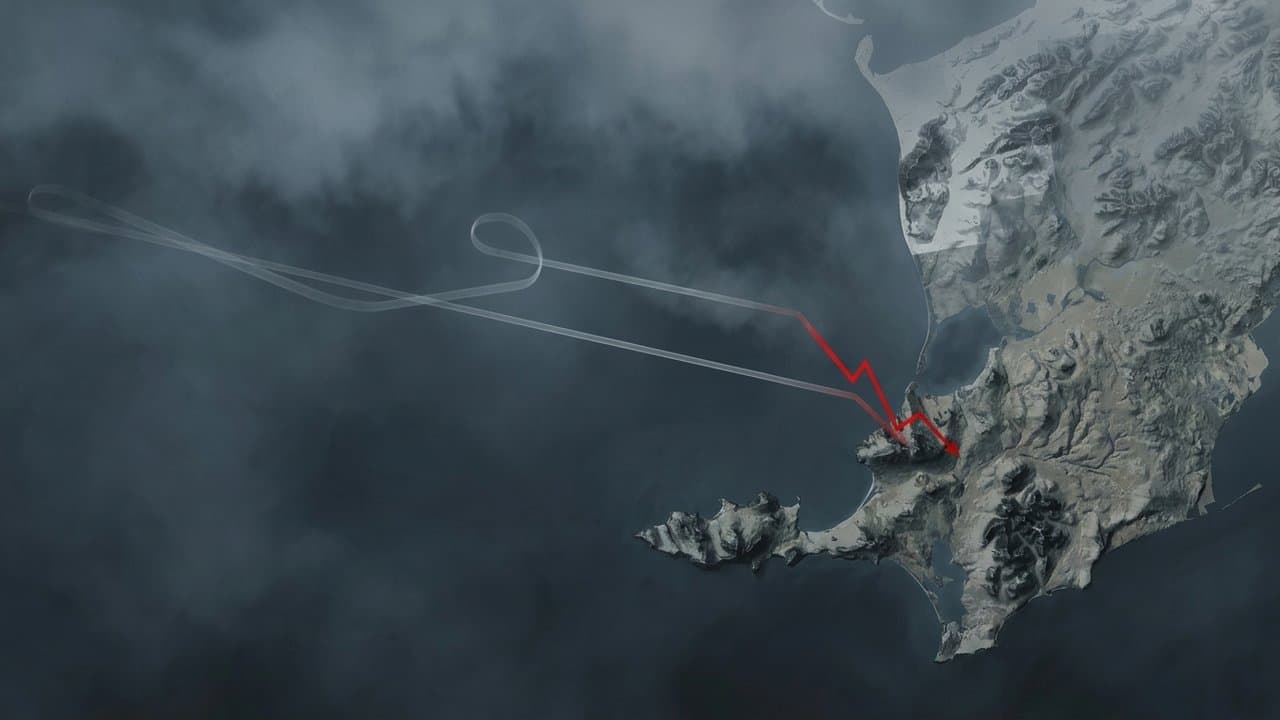
Editorial map (Gemini + Google Maps)
NTSB report details fog, aborted landing and second attempt before fatal Cape Newenham crash
A charter flight to the Cape Newenham radar site aborted its first landing attempt in fog, abandoned a plan to divert to another airport, and crashed on its second try Aug. 20, killing both pilots and all six passengers, the National Transportation Safety Board says.
The board's preliminary report, posted in early September and subject to change, does not say why. The investigation remains open.
The Cessna 441 crashed at about 11:45 am near the Cape Newenham Long Range Radar Site airport on a charter flight from Anchorage. The U.S. Army Corps of Engineers Alaska District says it chartered the flight with Security Aviation to inspect and maintain a new fire suppression system at the site.
When the flight left, the site reported 10 miles of visibility and clouds at 800 feet. Cleared to approach the runway at 10:27, the crew chose to hold. At 10:43 the site reported a quarter mile of visibility, patchy fog and clouds at 300 feet.
The crew began the approach at 11:02, with 3 miles of visibility in mist and clouds at 300 feet. At 11:14 they reported aborting the landing, said they were in visual conditions and canceled their instrument flight plan.
A site technician told investigators the crew then said they would try Platinum Airport, about 23 miles north. Minutes later, the crew said they could not reach Platinum by radio and wanted a second approach at Cape Newenham. The report does not explain why.
At 11:24 the crew told air traffic controllers in Anchorage the weather had improved and asked for an instrument clearance. When it came, the site reported a quarter mile of visibility, fog and clouds at 300 feet. No further radio calls followed.
The approach chart sets a minimum altitude of 1,320 feet and requires 3 miles of visibility. Federal rules require pilots to climb away at a point 2.2 miles north of the runway if they don't have the required visibility and can't see the runway. The chart warns that the runway sits on the slope of a 2,306-foot mountain and that a successful go-around is improbable if started past that point.
Flight-tracking data, which dropped out several times, last showed the first approach at about 425 feet, 2.3 miles short of that point. On the second approach, the airplane crossed the point at about 1,000 feet, descended to about 600 feet, and then the data ended at 11:43, 1.3 miles north of the runway.
Thick fog kept one technician from his usual pre-arrival runway check. Another technician, talking to the crew by radio, lost sight of his visibility references and the runway. He then heard "normal motor sounds," the engines "throttle up," a "backfire," and silence. The report does not explain the sound.
Site staff found the wreckage in rising terrain about half a mile west of the runway's approach end. The plane first hit the ground at about 610 feet, leaving a 160-foot debris path, and there was a ground fire. The wreckage awaited recovery for examination.
The Air Force identified 2nd Lt. Leah R. Borsich, 23, a project programmer with the 611th Civil Engineer Squadron at Joint Base Elmendorf-Richardson. The Corps named fire protection engineer Sabrina Hansen and mechanical engineer Hayden Scalis, both of Anchorage.
The other five victims, two pilots and three passengers, remain unnamed in records reviewed. Military releases said the Alaska State Troopers would name them, but the Troopers' daily dispatch from Aug. 20 through Oct. 4 has no entry for the crash.
The plane, a 1979 Cessna 441, is registered to N128EZ LLC of Anchorage, according to the FAA registry. The NTSB lists that company as the holder of the charter operating certificate. Security Aviation is a party to the investigation. Neither company has commented in the records reviewed.
The NTSB has not set a date for its final report.
Source: NTSB: Cape Newenham charter crew missed one approach in fog, set out for Platinum, then turned back for a second approach that ended short of the runway.
AI-assisted. Reviewed by Cale Green. How we use AI
Stay informed. Support what matters.
Free, permanent access to local news you can verify. Subscribe to support Walter AlaskaNews and go ad-free.
Related Coverage
Charter plane crash at Cape Newenham radar site kills eight
Alaska News · 1mo ago
Three of 20 Alaska aviation accidents since July 19 were fatal
Alaska News · 2w ago
Air Force names 2nd Lt. Leah Borsich as airman killed in Cape Newenham crash
Alaska News · 1mo ago
Four killed in Piper crash in Seldovia Slough; NTSB investigating
Alaska News · 1mo ago
NTSB: Bering Air crash that killed 10 was a chain of preventable failures
Alaska News · 2mo ago
Comments
Sign in to leave a comment.
No comments yet. Be the first to share your thoughts.