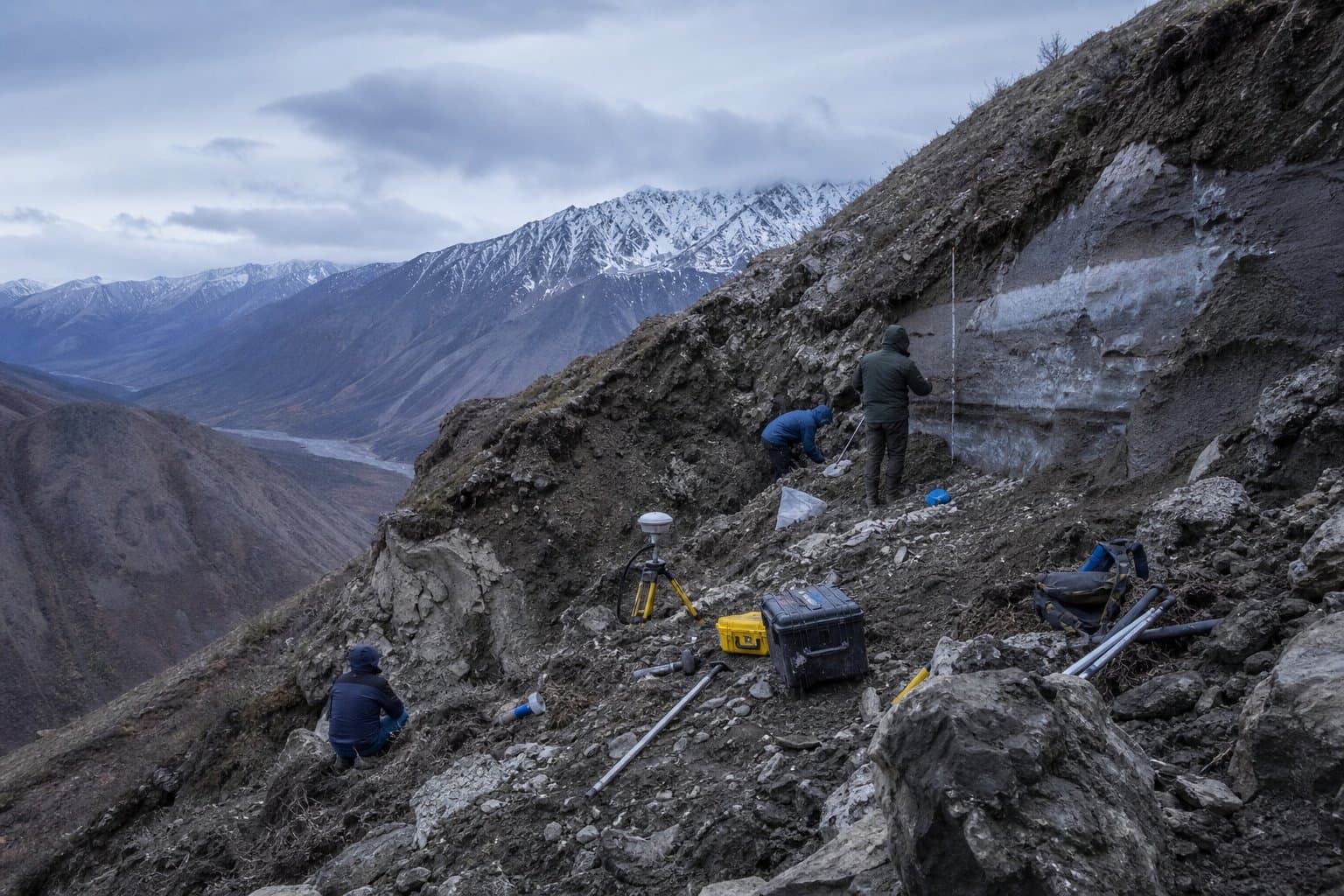
NSF awards UAF $294,141 to study deep permafrost landslides in the Alaska Range
The National Science Foundation has awarded the University of Alaska Fairbanks $294,141 for research aimed at predictive tools to protect the Trans-Alaska Pipeline System and regional highways from landslides in thawing permafrost. The award was dated Aug. 14; the project runs from Jan. 15, 2027, through Dec. 31, 2028.
Louise M. Farquharson, a research assistant professor at the UAF Geophysical Institute, is principal investigator, and the grant provides her a fellowship under the program. The project targets failure initiation at depths of 20 to 120 meters in the central Alaska Range, combining thermal modeling and field coring of active landslide headwalls with laboratory work conducted alongside Professor Demian Saffer at the University of Texas at Austin. Two techniques anchor the testing: pressurized nuclear magnetic resonance, which quantifies how much water in frozen ground remains liquid, and X-ray-transparent triaxial testing, which allows fractures to be watched as they propagate. The award describes both as currently unavailable in Alaska.
The hazard along the corridor is already documented. The 2002 federal environmental impact statement for renewal of the TAPS right-of-way identified roughly 50 slopes with mass-movement potential, including three pipeline sections totaling about four miles near Gulkana buried in thaw-unstable permafrost. It concluded that earthquake-triggered landslides and liquefaction are credible threats whose risk can increase with Alaska's warming trend, while describing such events as very unlikely. Separately, technical work has mapped 43 frozen debris lobes, slow-moving landslides in permafrost, within the Dalton Highway and pipeline corridor.
The exposure runs wider than transportation infrastructure. Farquharson, who has presented a preliminary permafrost hazard map for the Fairbanks North Star Borough, has said permafrost thaw, ground-ice melt and associated ground settlement "pose significant hazards to northern communities and industry."
The grant, issued under the EPSCoR Research Fellows program, also funds training for one graduate student.
AI-assisted, reviewed by editors. Spot an error?
Stay informed. Support what matters.
Free, permanent access to local news you can verify. Subscribe to support Melinda Communities.News and go ad-free.
Related Coverage
NSF awards UAF $1.77 million to build AI geohazard forecasting tools
Alaska News · 1mo ago · 86% match
As Alaska's glaciers retreat, new carbon-storing bogs are forming behind them
Alaska News · 1w ago · 84% match
UAF scientist gets $300K to unlock permafrost's carbon time bomb
Alaska News · 2mo ago · 82% match
NSF awards UAF $877,501 for mass spectrometer to support fisheries and minerals research
Alaska News · 4w ago · 81% match
A $1.6 million grant to help Alaska burn on purpose, before wildfire does
Alaska News · 2w ago · 79% match
Comments
Sign in to leave a comment.
No comments yet. Be the first to share your thoughts.