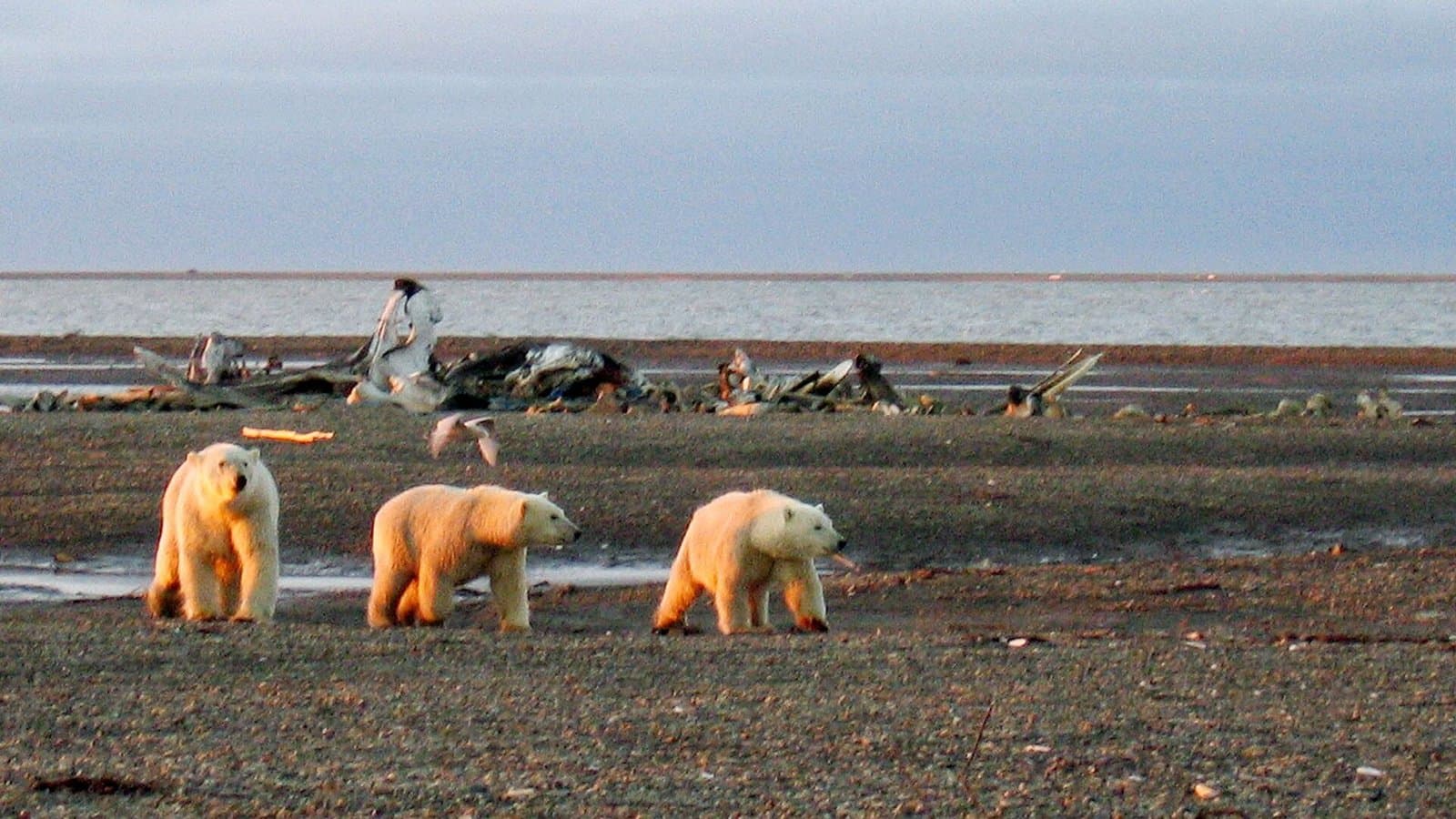
Photo: USFWS via Wikimedia Commons · Photo source · Public domain
North Slope oil rule now covers accidental polar bear deaths the agency doesn't expect
The U.S. Fish and Wildlife Service filed final rules Friday that let North Slope oil and gas companies seek permission, for the next five years, to unintentionally take small numbers of polar bears and Pacific walruses. Unlike the rules they replace, the new ones cover an accidental death, though the agency says it expects none.
Under the Marine Mammal Protection Act, "take" includes harassing, capturing or killing an animal. The previous rules, as revised last year, said "no lethal take is authorized." The final rule covers any incidental take from work done in full compliance with its conditions.
The agency said the change concerns who is legally liable, not what happens to an animal. Companies that follow the rules "remain insulated from legal liability where FWS's predictive estimates prove inaccurate," it wrote. It said limits tied to its estimates are hard to enforce, because darkness, snow, fog and wind can make harm to a bear hard to detect. Intentional take remains prohibited, as does take from work that breaks the rules.
The rules take effect Monday and run through Oct. 19, 2031. They cover year-round exploration, development, production and transportation across about 19.8 million acres of the Beaufort Sea and coast from Point Barrow east to the Arctic National Wildlife Refuge. The refuge is not included. The previous rules expired Aug. 5. Companies must still apply for letters of authorization for specific work, and the rule itself does not permit drilling.
The agency's model puts the chance of at least one bear death at 12% in the riskiest year and 43% over five years, with a median of zero. The main scenario is a mother abandoning her den early, before her cubs can survive. In its request for the rules, the Alaska Oil and Gas Association said an incidental polar bear death from oil and gas work in the area "has never been documented."
The model projects that about 46 polar bears a year would be harassed, mostly through short-term changes in behavior. AOGA estimated about 24. In the worst year, up to 49 bears could be taken, 5.4% of the Southern Beaufort Sea stock of 907, the agency said. Up to 20 walruses could be harassed a year. The agency said its model's estimates "significantly exceed historical data and AOGA take estimates" and, citing the "Restoring Gold Standard Science" executive order, said it did not weigh the model above other information.
At AOGA's request, the final rules drop a third aerial infrared den survey the agency had proposed in March, which it concluded "is not practicable." AOGA said a single survey takes a crew of three or four flying a small plane at night, in cold that can reach minus 55 degrees. The agency said third surveys under the prior rules found no additional dens.
Companies doing winter work on land must still survey denning habitat within a mile of their activities, at least twice in high- and medium-density denning areas and once elsewhere. During denning season, they must stay a mile from any known or suspected den. Also at AOGA's request, vessels must keep the "maximum distance practicable," at least half a mile, from groups of bears or walruses.
The proposal drew 85,589 comments, 77,468 of them through mass mailing campaigns led by conservation groups opposing the rule. Nearly all of the 8,104 individual comments were opposed too, the agency said. Opponents argued that a better-than-40% chance of a death is substantial, that covering unanticipated deaths goes beyond what the law allows, and that dens are hard to find in Arctic darkness, snow and fog, which some said called for the third survey.
One commenter said earlier work with subsistence hunters, the North Slope Borough's wildlife department and the Alaska Nannut Co-Management Council would have produced a more realistic forecast than the agency's "overly conservative" estimates. The agency said it has a strong working relationship with the council.
The agency found the rules would have a negligible impact on both species and no unmitigable adverse impact on subsistence hunting in Kaktovik, Nuiqsut and Utqiaġvik. It said none of those communities' walrus harvests from 2014 through 2024 happened in the covered area. AOGA has committed to notifying Kaktovik and Nuiqsut of planned work, and companies must draw up a plan with communities if hunting concerns are raised.
Source: Fish and Wildlife Service renews five-year polar bear and walrus take rules for Beaufort Sea oil and gas work, dropping a third den survey at industry's request.
Made by our human newsroom with AI. Reviewed by Cale Green. How humans and AI work here · Grow with our newsroom
Stay informed. Support what matters.
Free, permanent access to local news you can verify. Subscribe to support Walter AlaskaNews and go ad-free.
Related Coverage
Interior proposes dropping the Arctic relief rig rule and a whaling check
Alaska News · 3w ago
Interior proposes easing Arctic offshore drilling safety rules
Alaska News · 2mo ago
Federal rule changes loosen protections for Alaska's listed species
Alaska News · 2mo ago
BLM Rule Would Cut NPR-A Pad Approvals to 60 Days, Limit Hunting
Alaska News · 1mo ago
Justice Department concedes Biden-era Arctic Refuge leasing program violated the law
Alaska News · 3mo ago
Comments
Sign in to leave a comment.
No comments yet. Be the first to share your thoughts.