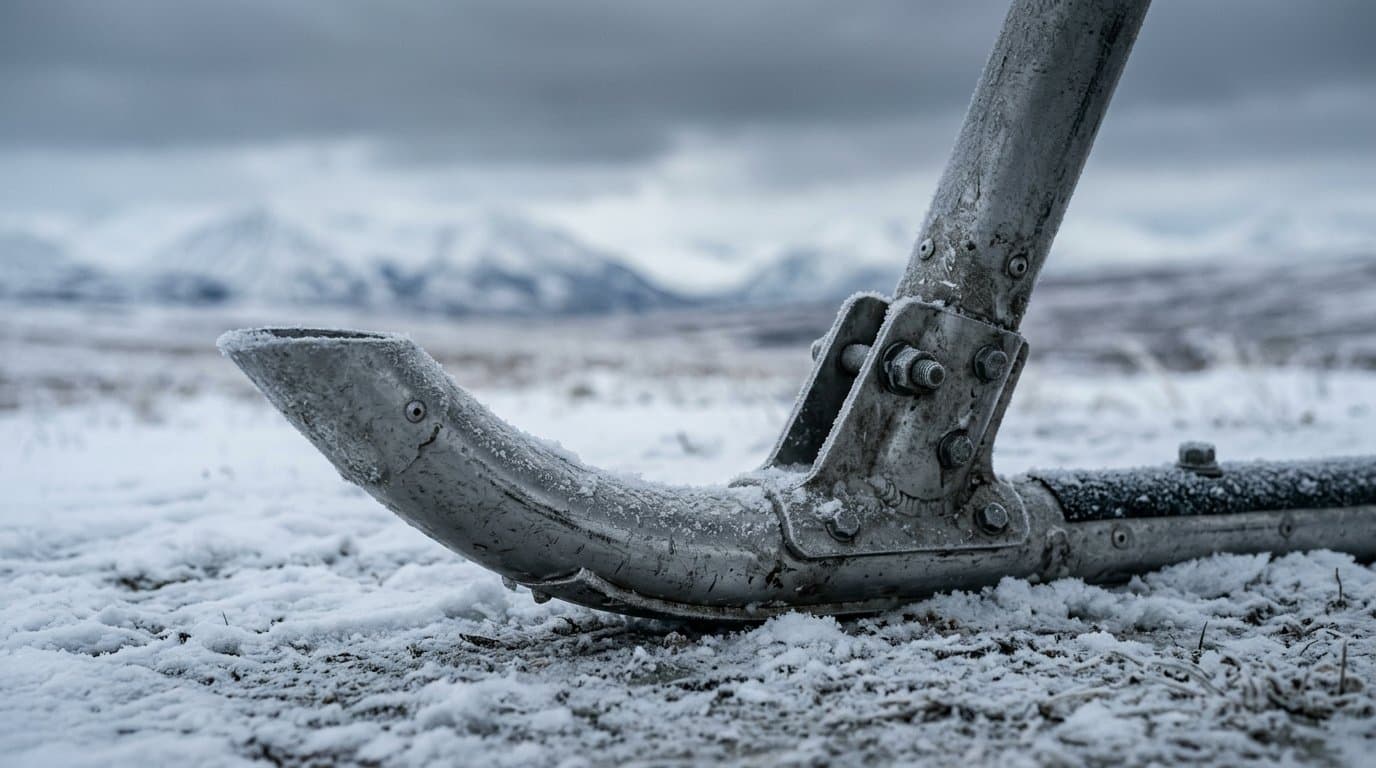
AI image
Helicopters will service the Seward Peninsula's snow stations as the first snow arrives
The Interior Department on Oct. 14 hired Bering Air of Nome for on-call helicopter support to the automated snow stations the federal government runs on the Seward Peninsula, as the first snow of the season begins to show up on their sensors.
The order runs through Nov. 30, with $4,650 committed so far, according to federal award records. The flights support the Natural Resources Conservation Service, the U.S. Department of Agriculture agency that runs a network of remote snow stations known as SNOTEL, short for snow telemetry.
Each station sits in a remote spot and works on its own. A "snow pillow" on the ground weighs the snow piled on top of it, and the station converts that weight into snow water equivalent, the amount of liquid water the snowpack holds. Stations also measure snow depth, precipitation and air temperature, and send readings several times a day by radio or satellite, according to the conservation service. The data are public and used to forecast water supplies.
Alaska has 90 automated stations after the agency added seven in fiscal 2024, according to its annual report. One of them is at Pilgrim Hot Springs on the Seward Peninsula. The others went in near Yukon Crossing, at Joint Base Elmendorf-Richardson, on the Kenai Peninsula and in the Talkeetna Mountains. Surveyors also took 581 readings by hand and from aircraft at snow courses and aerial markers that year.
Four of the stations are on or near the Seward Peninsula. Rocky Point and Pargon Creek have reported since 1999 and Johnsons Camp since 2000, and Pilgrim Hot Springs came online in July 2024, according to the agency's station records.
Winter is just starting to register. Rocky Point showed no snow early in the week and 9 inches by Saturday, and Pilgrim Hot Springs still showed bare ground, according to provisional station data.
The conservation service lists the National Weather Service's Alaska-Pacific River Forecast Center among its snow survey partners. Its monthly snow reports track whether each region's snowpack is running above or below normal. In February 2020, for example, it reported Seward Peninsula snowpack lower than in four or five years, even with normal to above-normal precipitation.
Bering Air holds an earlier order for the same Seward Peninsula station work, now at $6,750.
Source: Department of the Interior, Department of the Interior: [DELIVERY ORDER] Department of the Interior: BERING AIR, INC. for ALASKA HELICOPTER ON CALL - NATURAL RESOURCE CONSERVATION SERVICE (NRCS) SEWARD PENINSULA SNOTEL ($4,650).
Made by our human newsroom with AI. Reviewed by Cale Green. How humans and AI work here · Grow with our newsroom
Stay informed. Support what matters.
Free, permanent access to local news you can verify. Subscribe to support Maggie AlaskaNews and go ad-free.
Related Coverage
Interior awards $8,360 for helicopter service to Tincan and Indian Pass snow sensors
Alaska News · 1mo ago
Tok's 40-Mile Air gets $45,000 contract for helicopter flights to track Yukon-Charley wolves
Alaska News · 2w ago
Helicopters will keep a remote Unuk River gage running below British Columbia mines
Alaska News · 1d ago
Snow covers just under a quarter of Alaska as September ends
Alaska News · 1w ago
Why the Coast Guard is paying a Homer helicopter company to reach roadless villages
Alaska News · 1mo ago
Comments
Sign in to leave a comment.
No comments yet. Be the first to share your thoughts.