AI image
Sitkana's new patent covers how its tidal generator looks, not how it works
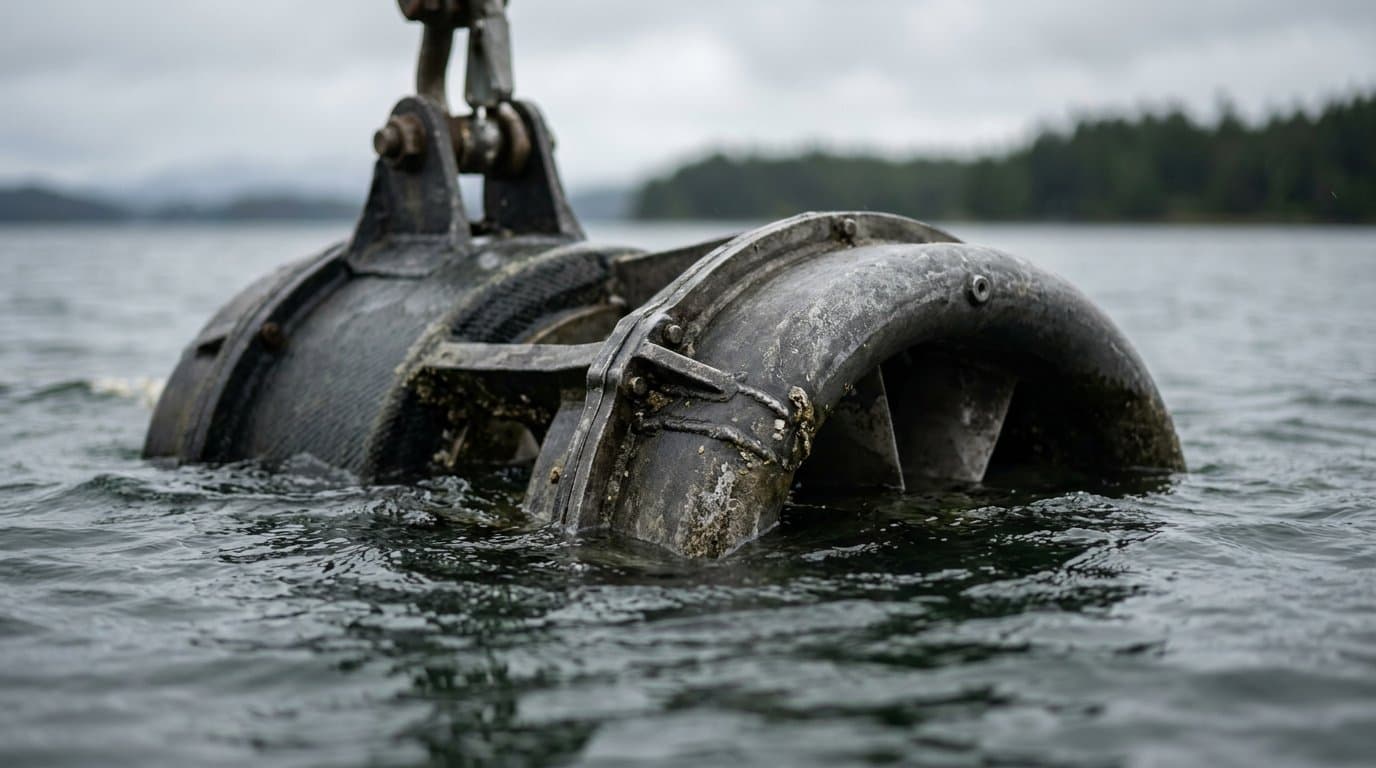
Sitkana, Inc. of Juneau now holds 15 years of protection on the shape of a floating tidal generator. The U.S. Patent and Trademark Office issued the design patent Tuesday, naming company founder and chief executive Lance D. McMullan as inventor. A design patent covers what something looks like rather than how it works, and the application had been pending since March 2024.
What it looks like is an anchor. Sitkana's device is a turbine on a shaft inside a submerged housing, tethered by cable to a float on the surface, and the company's pitch is that a boat crew can drop it over the stern and start making power. The housings are 3D printed, which is how a startup gets to iterate on hull shapes without a foundry.
The physics favor the water. Sitkana puts the density of seawater at about 840 times that of air, so a rotor small enough to lift by hand pulls energy from a current that a wind turbine of the same size could never match. Tides also run on a schedule. The company claims its devices operate 30 to 50 percent of the time, a figure that would put them well ahead of solar in Southeast Alaska and roughly even with good wind.
The market is out the front door. Coastal communities across Alaska burn diesel barged in at cost while some of the strongest tidal currents in the world move past them twice a day. McMullan has taken the idea to Kake Tribal Corporation, whose board approved a proposal to study tidal energy at nearby Point Macartney.
The design patent is the second this summer. In July the office granted Sitkana a utility patent on the buoy-mounted anchoring system that keeps power flowing to shore as the current reverses, which is the hard problem in tidal generation — the water stops, turns around, and comes back the other way twice a day. The company built its fourth-generation prototype, Chinook V4, with a power control system developed alongside Sandia National Laboratories, and it has a Department of Energy grant to test whether fishing vessels sitting idle through the winter could be turned into floating power plants.
Source: United States Patent and Trademark Office, United States Patent and Trademark Office: FLOATING HYDROKINETIC GENERATOR.
Made by our human newsroom with AI. How humans and AI work here · Grow with our newsroom
Stay informed. Support what matters.
Free, permanent access to local news you can verify. Subscribe to support Melinda Communities.News and go ad-free.
Related Coverage
A Juneau company turning idle fishing boats into tidal power just cracked a deep-fjord problem
Alaska News · 1mo ago
Wasilla man wins a federal design patent for his fish bonker after a 3½-year wait
Alaska News · 2d ago
The University of Alaska owns the look of a Fairbanks man's pliers
Alaska News · 1mo ago
Tidal energy permit application opens in Isanotski Strait near False Pass
Alaska News · 3mo ago
Anchorage company wins patent for adjustable pipeline support
Alaska News · 1mo ago
Comments
Sign in to leave a comment.
No comments yet. Be the first to share your thoughts.