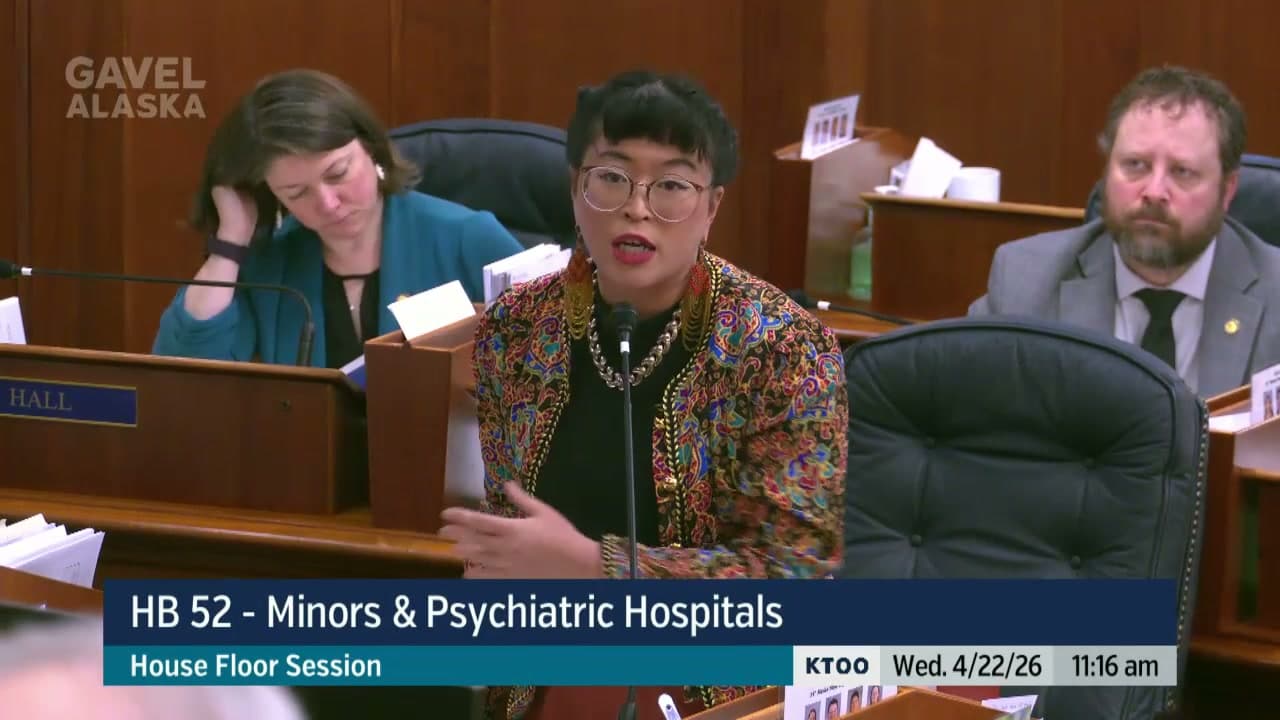
House passes bill requiring transparency at psychiatric hospitals for minors
The Alaska House voted 37-0 Tuesday to pass legislation requiring psychiatric hospitals to strengthen protections for minors after years of documented abuse and federal investigation.
House Bill 52 responds to a 2022 Department of Justice investigation and reports of sexual abuse at facilities treating Alaska children. The bill requires psychiatric hospitals to allow minors at least two hours weekly of confidential communication with parents or guardians, mandates unannounced inspections at least twice yearly, and requires 72-hour notification to parents and the Department of Health when seclusion or restraint is used on minors.
The House Finance Committee advanced HB 52 on March 24, 2025, after sponsor Rep. Maxine Dibert presented it. The bill addresses longstanding concerns about treatment of minors in psychiatric facilities. A 2022 Department of Justice investigation found problems in Alaska's behavioral health system for children. The Alaska Disability Law Center documented issues dating back to 2004. News articles documented cases of sexual abuse at facilities, including North Star psychiatric hospital.
The legislation drew broad bipartisan support, with cosponsors including Fields, Foster, Burke, Jimmie, Galvin, Hannan, Josephson, Story, Schrage, Mina, and Costello. Fiscal notes from relevant departments indicated zero financial impact.
"In the documents along with this bill were some news articles about some separate cases of two young boys who were sexually abused while in the facilities," said Rep. Sarah Vance, a Homer Republican. "And I tell you what, that hit me right in the heart, Mr. Speaker, because they were the same ages as my boys."
Vance estimated that approximately 800 Alaska minors annually are placed in psychiatric hospitals. Many Alaska Native children are sent hundreds of miles from their communities for treatment.
The bill establishes three core requirements. First, it guarantees minors access to confidential communication with a parent or guardian for at least two cumulative hours per week. Second, it requires the Department of Health to publish an annual report to the legislature including data on the use of seclusion and restraints, whether mechanical, physical, or chemical, as well as findings from facility inspections. Third, it strengthens oversight by requiring unannounced inspections at least twice a year, including interviews with at least half of the minor patients without staff present unless necessary for safety.
When seclusion or restraint is used on a minor, both the department and the minor's parent or legal guardian must be notified within 72 hours.
"I would like to highlight the requirement of unannounced visits," said Rep. Andrew Gray, an Anchorage Democrat. "I think that having unannounced visits is maybe the most important part of the bill."
Gray said legislators often receive advance notice before facility tours, giving staff time to prepare. "I think allowing these unannounced visits is going to make a real difference in terms of the quality of care that the facility is providing," he said.
The House adopted an amendment by Vance requiring inspectors to conduct standardized, age-appropriate wellness checks designed to identify signs of abuse, including physical injury, neglect, mental injury, sexual abuse, or exploitation. If indicators are found, inspectors must notify Child Protection, potentially law enforcement, and parents.
Rep. Ben Prax noted that problems at facilities had escalated in part because the Department of Health was not authorized to exercise oversight. The bill aims to prevent the system from sliding backward after recent improvements.
Rep. Alyse Galvin pointed out that while HB 52 addresses abuses at the end of the behavioral health continuum, many children end up in institutionalized settings because Alaska has underinvested in home and community-based services. The 2022 Department of Justice report found that Alaska's administration of its behavioral health service system results in many children experiencing needless institutionalization. The report also found that Alaska can reasonably modify its service system to serve children with behavioral health disabilities in integrated settings.
"House Bill 52 is an important step in making sure that youth who are ending up in these institutionalized settings are being taken care of and that they can talk to their family members and that family members are aware of what is happening to them," Galvin said. "But there are so many steps that we can do to invest in our upstream to make sure that we can prevent youth from being in these places in the first place."
The bill now moves to the Senate, which referred it to the Senate Finance Committee on April 24. The effective date is July 1, 2026.
This article is based on a public meeting — Alaska Legislature: House Floor Session, 4/22/26, 10:30am ().
AI-assisted. How we use AI Transcript byLucas Brown
Stay informed. Support what matters.
Free, permanent access to local news you can verify. Subscribe to support Alaska News and go ad-free.
Related Coverage
House advances complex care homes for behavioral health patients
Alaska News · 4mo ago
House Passes Barbers Board Reform, Honors NICU Lifesaving Work
Alaska News · 6mo ago
Alaska Senate passes bill for deaf and hard of hearing students
Alaska News · 4mo ago
Alaska Senate panel hears bill requiring 7-day review for foster youth in psychiatric hospitals
Alaska News · 4mo ago
House panel fast-tracks insurance coverage for PANDAS treatment
Alaska News · 5mo ago
Comments
Sign in to leave a comment.
No comments yet. Be the first to share your thoughts.