Alaska Senate panel hears bill requiring 7-day review for foster youth in psychiatric hospitals
The Alaska Senate Finance Committee heard legislation May 10 that would require judicial review within seven calendar days when foster children are placed in psychiatric hospitals, a change supporters say is needed to prevent lengthy stays that have cost the state hundreds of thousands of dollars.
House Bill 36 responds to a February 2024 Alaska Supreme Court ruling in Quinnahawk v. Office of Children's Services that found children in state custody face substantial risk of being hospitalized longer than necessary. The bill would cut the current 30-day review window to seven days, with a possible seven-day extension in cases where a hearing cannot be scheduled.
According to previously reported court records, the Alaska Supreme Court ruled in 2021 in the case of April S. that children in state custody cannot be held under voluntary admission frameworks when the Office of Children's Services is not a statutory parent or guardian. That decision reversed a lower court order that had treated an initial 30-day commitment as voluntary, establishing that involuntary commitments require full hearings or jury trials. A 2022 U.S. Department of Justice report documented that lengths of stay in psychiatric hospitals for children involved with the Office of Children's Services exceed 80 days on average, with out-of-state stays increasing from 17 days in fiscal year 2021 to over 42 days in the first half of fiscal year 2022.
Representative Andrew Gray told the committee that current law allows foster children admitted to short-term psychiatric facilities to remain there for extended periods without review of whether they need to be there. He cited one case from 2012 to 2013 where a facility billed Medicaid $330,000 to keep a child hospitalized for her 13th and 14th birthdays when she did not need to be there.
"The facility is able to bill Medicaid about $1,000 per night for the child," Gray said. "And one particularly egregious case, Katrina Edwards from 2012 to 2013, the facility was able to bill $330,000 to Medicaid to keep her there for her 13th and 14th birthdays when she did not need to be there."
Gray said the Supreme Court ruled in the February 2024 Quinnahawk v. Office of Children's Services case that 30 days is too long to wait for review. "In February 2024, in the case of Quinnahawk versus OCS, the Supreme Court said that there is no doubt the children in OCS custody are at substantial risk of being hospitalized for longer than they need, or when they do not need to be hospitalized at all," Gray said. "The Supreme Court has said we must close this loophole. In that Supreme Court case and that decision, they said that 30 days is too long. What House Bill 36 does is says that these children's cases need to be reviewed within seven calendar days."
The bill represents a compromise from Gray's original proposal for a 72-hour requirement. "I introduced this bill in a previous legislative cycle with a 72-hour requirement. We have compromised on seven calendar days," Gray said. "There are many entities involved in a child in need of aid case, and so this allows for that extra time. There is a provision in the bill that says they can have a seven-day extension. I want to say it on the record as a sponsor of the bill, it is my intent that that seven-day extension is rarely used."
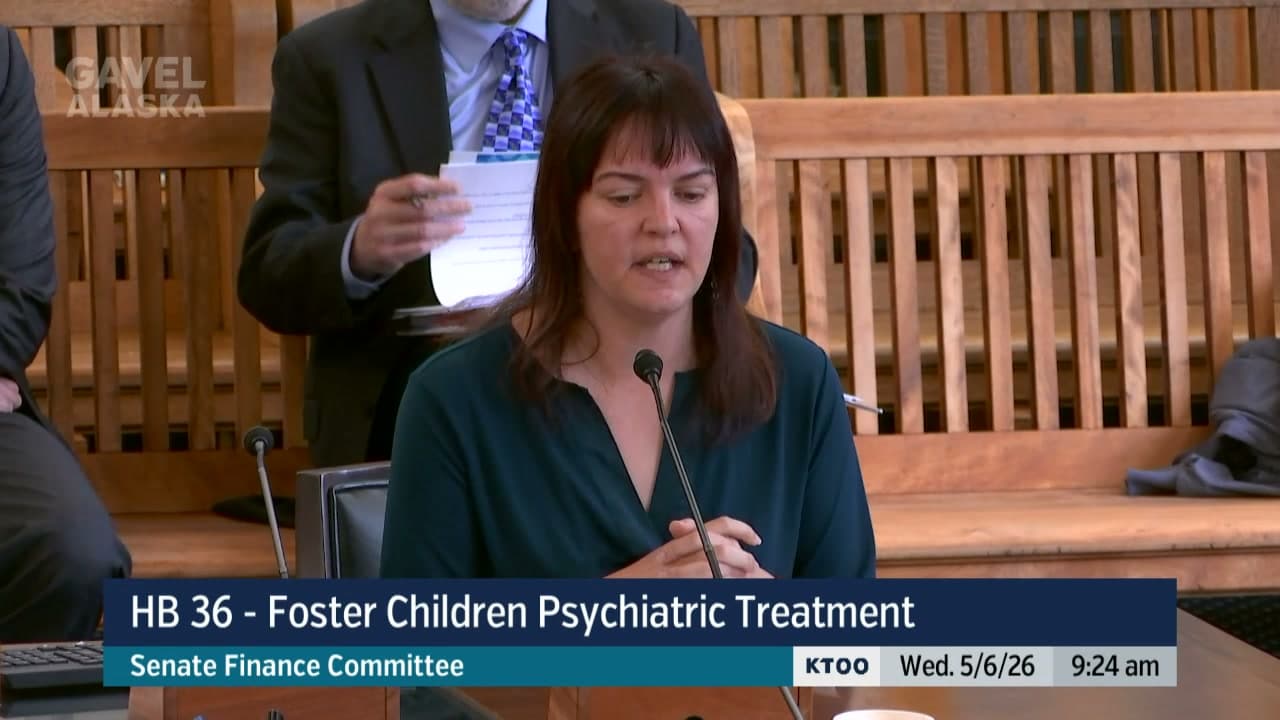
Amanda Metivier, director of Facing Foster Care in Alaska, testified that the bill came at the request of foster youth themselves. She said foster youth placed in psychiatric hospitals report being subjected to unnecessary mental health diagnoses, physical restraint, chemical restraint, and seclusion.
"House Bill 36 would require that foster youth get a hearing within seven calendar days of placement so a judge can hear the facts and determine if youth need to remain in an acute setting to stabilize or if they need to be released for a lower or higher level of care," Metivier said.
Metivier noted in her testimony that the state's fiscal note indicated the bill would lead to cost savings by reducing lengthy hospital stays. When young people remain in psychiatric facilities beyond what Medicaid will cover, the state pays from general funds at rates up to $1,000 per day. The fiscal note estimates 90 admissions of young people per year could be affected.
The formal fiscal notes filed with the committee showed zero additional costs. The Department of Family and Community Services assigned a zero fiscal note with no additional costs or revenues. The courts estimated about 110 additional hearings per year but said they could absorb that workload with existing resources and also assigned a zero fiscal note.
The bill also requires that children be appointed an attorney. "The bill also requires the child be appointed an attorney. That is the practice, but it is not the requirement," Gray said. The bill requires OCS to report how many children in state custody are held in out-of-state residential facilities.
The bill creates a new treatment foster home license category to provide community-based alternatives to psychiatric hospitalization. "The bill creates a new type of foster care license, treatment foster homes. This part of the bill was added in a previous committee by the administration," Gray said.
Chrissy Vogeli, senior policy advisor for the Department of Family and Community Services, explained that Alaska is the only state without a defined treatment foster care program, though services are already being provided under traditional foster care licenses. The treatment foster home license would align state requirements with Medicaid standards and would be available to all children, not just those in state custody. Vogeli said the homes would typically be limited to a small number of children due to their level of need, with a maximum of four children with specialized needs.
Kelly Richardson with the Citizens Commission on Human Rights testified that the treatment foster care provisions lack needed safeguards and oversight. Richardson said the current draft creates a new treatment foster care model but leaves youth vulnerable because it contains no statutory guardrails on diagnosis, medication, treatment planning, oversight, or family involvement. Richardson provided amendment language addressing non-drug interventions, trauma screening, diagnostic guardrails, psychotropic medication oversight, youth rights, family involvement standards, and independent clinical review.
Barbara Malschick, a board member of Facing Foster Care in Alaska who spent over 25 years as a guardian ad litem representing foster youth, testified in support of the bill. She said it strikes a balance between keeping youth safe during crisis situations while protecting their constitutional rights. Malschick noted the bill requires immediate notification within 24 hours of placement to all parties in the child's need of aid case so they know what is going on and can come together to find a less restrictive setting for the youth.
Senator Lyman Hoffman, who chairs the Finance Committee, set the bill aside for further consideration at a later time. The committee did not take action on the legislation.
This article is based on a public meeting — SFIN-260506-0900 ().
AI-assisted. How we use AI Transcript byLucas Brown
Stay informed. Support what matters.
Free, permanent access to local news you can verify. Subscribe to support Alaska News and go ad-free.
Related Coverage
House passes bill requiring transparency at psychiatric hospitals for minors
Alaska News · 5mo ago
Alaska Senate Panel Advances Youth Suicide Prevention Bill
Alaska News · 5mo ago
House Finance Advances Mental Health Education Guidelines for Schools
Alaska News · 5mo ago
House panel fast-tracks insurance coverage for PANDAS treatment
Alaska News · 5mo ago
Alaska sends kids Outside for care. A Wasilla project targets that.
Alaska News · 2mo ago
Comments
Sign in to leave a comment.
No comments yet. Be the first to share your thoughts.