House panel ties Alaska gas line tax breaks to Fairbanks spur line
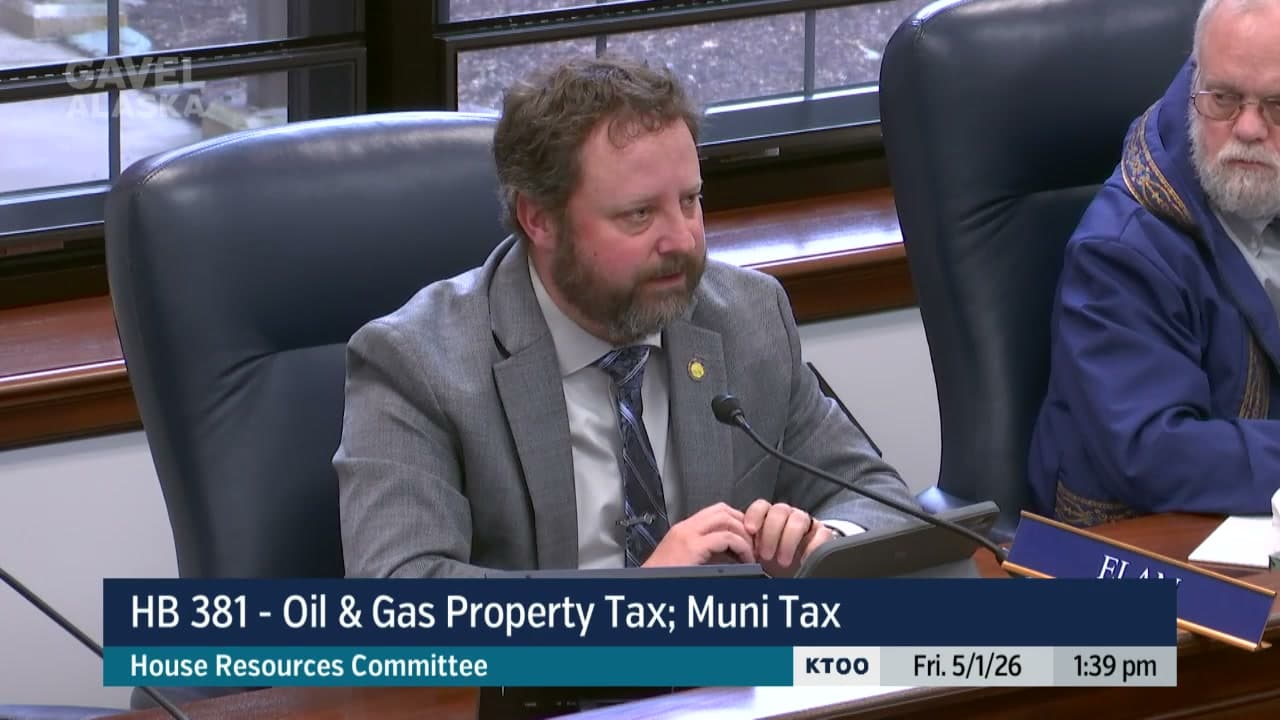
The House Resources Committee advanced a major change Friday to the governor's Alaska LNG tax bill. The new version makes tax incentives contingent on building a spur line to deliver affordable gas to Interior Alaska residents and military bases.
The committee substitute for House Bill 381 requires the project to construct a spur line to the Fairbanks North Star Borough as a condition for receiving tax benefits. The spur line would serve residential customers, Golden Valley Electric Association, Eielson Air Force Base, Fort Wainwright, and potential AI data centers.
Governor Dunleavy's original bill proposed replacing the existing property tax with a 6-cent per 1,000 cubic feet volumetric tax. Borough mayors and local governments raised concerns about projected local revenue losses over 36 years. The House committee version imposes a 20-cent total tax per 1,000 cubic feet split across facilities.
"This new committee substitute corrects that by conditioning those tax benefits on delivering real statewide value through getting Alaska gas to Alaska, Alaska gas to Alaskans at the Alaska price," Fairbanks North Star Borough Mayor Grier Hopkins said.
The spur line is estimated to cost roughly $150 million to $200 million. Included in the cost of the overall project, it would add only about 2 cents to the cost of gas once exports start, a House Resources Committee co-chair said.
Crucial to the Interior's support is language ensuring residents pay the same tariff as Southcentral customers by rolling spur line costs into the full system. Without that provision, Hopkins said, the cost of constructing the spur line would fall on some 3,500 Interior Gas Utility customers, making conversion uneconomical.
"If that language on lines 29 through 31 is not there, then we are not going to be looking at affordable gas here in the interior," Hopkins said. "That would be borne on the backs, that means the cost of constructing the spur line to just get gas to our infrastructure, distribution infrastructure here locally, would be borne on some 3,500 Natives, and that would make it unaffordable."
Without the spur line inclusion, gas rates for Interior residents could exceed $30 per thousand cubic feet, Hopkins said, compared to the current $24 to $25 per MCF residents pay. That would make conversion uneconomical for residential customers, Golden Valley Electric Association, or military installations.
Hopkins and project developer Glenfarne are negotiating an amendment to remove a hard construction deadline while ensuring permitting moves forward. The current language requires construction to begin within two years of the main line becoming operational. Hopkins said separating the spur timeline from the main line would prevent project delays from permitting obstacles outside Glenfarne's control.
"The language that we are working with and discussed with Glenfarne yesterday would, that removes the two-year hard start for the spur line, would allow for the permitting to be going in place for the spur line while the taps have already been turned on and are operating for the major line," Hopkins said.
The committee substitute puts oversight of spur line requirements under the Regulatory Commission of Alaska to ensure fair and non-discriminatory rates.
Hopkins emphasized the national defense implications. Fort Wainwright operates the oldest coal plant in the country, which has experienced outages that could affect war readiness. Eielson Air Force Base could also benefit from affordable gas access.
The House approach differs from the Senate Resources Committee's version, which approved a preliminary 5-2 vote in April on a substitute requiring Alaska Gasline Development Corp. to pursue a Fairbanks spur line as a priority. The Senate version also includes a 55-cent export tax, a $1 million per mile construction fee, and in-state gas price caps.
Kenai Peninsula Borough Mayor Peter Machicki emphasized the need for fair compensation and expressed concern about local residents subsidizing the project. "A fair outcome does not have us rubbing our hands together on profits," Machicki said. "A fair outcome is where I can look at the 62,000 people I represent and say, I am comfortable that you will not be subsidizing this project."
Machicki noted that 43 percent of the project's value will be in the Kenai Peninsula Borough, with the community living with construction impacts for four years and operational impacts for decades. He estimated construction impacts on solid waste, roads, fire, EMS, recreation, and education at around $10 million per year based on project worksheets.
The House Resources Committee will meet Monday to consider amendments and updated modeling from the Department of Revenue on House Bill 381.
This article is based on a public meeting — Alaska Legislature: House Resources, 5/1/26, 1pm ().
AI-assisted. How we use AI Transcript byLucas Brown
Stay informed. Support what matters.
Free, permanent access to local news you can verify. Subscribe to support Alaska News and go ad-free.
Related Coverage
Fairbanks spur line language added to Alaska LNG tax bill
Alaska News · 3mo ago
Alaska's LNG tax break now hinges on a gas line to Fairbanks
Alaska News · 3mo ago
Alaska House examines $4 billion LNG equity option, Fairbanks spur-line tax break
Alaska News · 4mo ago
House Finance advances Alaska LNG tax bill, curtailing North Slope's power to negotiate
Alaska News · 3mo ago
Alaska House Rewrites LNG Tax Bill, Raising Rate While Empowering Boroughs
Alaska News · 4mo ago
Comments
Sign in to leave a comment.
No comments yet. Be the first to share your thoughts.