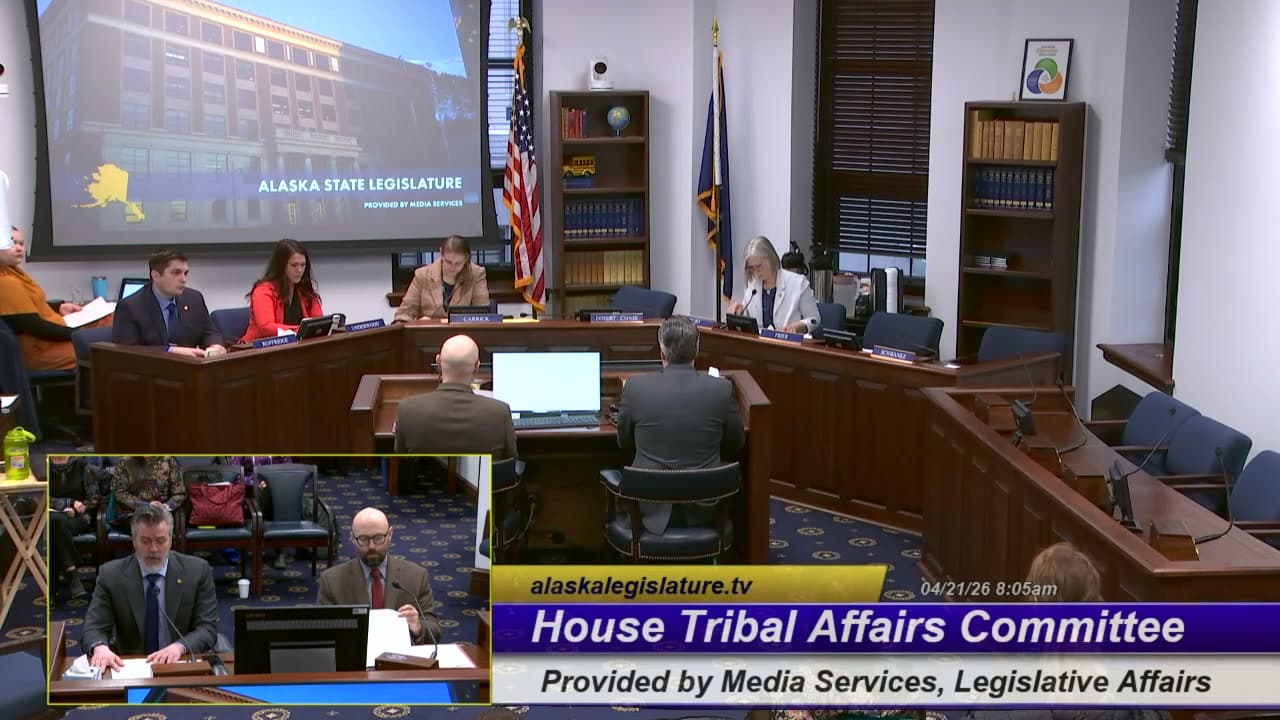
House panel hears bill to extend confidentiality to tribal victim advocates
The Alaska House Tribal Affairs Committee heard a bill Tuesday that would close a legal gap leaving Alaska Native domestic violence and sexual assault survivors without confidentiality protections when they seek help from tribal organizations.
House Bill 384 would add two words to state statute defining victim counseling centers: "or tribal." The change would extend the same confidentiality protections already given to survivors served by nonprofits, local governments, and military organizations.
"Tribal governments are not included in the current definition of victim counseling center, meaning victims who receive care from a tribal counseling center lack the same confidentiality protection afforded those served by a nonprofit, a local government, or a military-affiliated organization," said Representative Andrew Gray, the bill's sponsor. "HB 384 remedies this failure with the addition of two words: or tribal."
Under current law, victims who receive care from tribal counseling centers lack the confidentiality protection that shields communications between survivors and advocates from being disclosed in court proceedings. Without statutory protection, advocates' notes and confidential communications can be subpoenaed by opposing counsel and included in discovery. Those records may contain safety plans, confidential information about survivors, and safe locations.
Rick Haskins Garcia, director of law and policy for the Alaska Native Women's Resource Center, told the committee that tribal governments have become essential frontline providers of victim services across Alaska. Each of the state's 229 federally recognized tribes has the authority to create victim services programs. Many are doing that work on an as-needed basis or through established programs.
Garcia described a recent example where a tribal Sexual Assault Response Team in the Interior could not enter into a memorandum of understanding with the Department of Public Safety specifically because tribal advocates lack statutory confidentiality protections. The Department of Law and Alaska Department of Safety concluded last summer that the statutory void prevented the collaboration.
"The reality of the situation is for survivors that are experiencing domestic violence and sexual assault until we are able in Alaska to build up our tribal justice systems, many of those cases are being prosecuted either in our state criminal system or our state civil system," Garcia said. "And with the lack of confidentiality for our advocates, it is going to create a chilling effect."
Dylan Hitchcock Lopez, staff to Representative Gray and in-house counsel, explained that Alaska's constitutional right to privacy does not provide the same protections as the confidentiality statutes governing criminal and civil proceedings. Those statutes are narrowly tailored to balance victims' privacy interests against defendants' Sixth Amendment rights to discovery.
Representative Alyse Galvin asked why the constitutional right to privacy would not cover everyone with blanket protection. Hitchcock Lopez said confidentiality for court proceedings is governed by statute, not the broader constitutional provision, because constitutional rights must be balanced. Victims' privacy must be weighed against defendants' rights to put on a case and seek discovery.
"If somebody right now goes to a victim counseling center that is run by a tribal organization, or by a tribal government, they would potentially have their statements made pursuant to seeking treatment discoverable in a later criminal case, whereas if that same person was to go to an organization providing that same service but is a nonprofit, that would be confidential," Hitchcock Lopez said. "So you have an anomaly."
The victim counseling center definition was drafted in 1992 to include organizations providing services at that time. The legislature last updated it in 2013 to include military organizations. Gray said that with expanded federal support, tribal governments now offer counseling and advocacy services, but current statutes do not reflect that work.
The bill includes an applicability section. A fiscal note from the Department of Public Safety indicates zero fiscal impact.
The committee set an amendment deadline of Friday, April 25, at 5 p.m. The bill returned for further testimony Thursday, when subject matter experts and service providers spoke to the need for the change.
On April 24, the Tribal Affairs Committee reported a "Do Pass" recommendation for HB 384, with six members supporting it: Schwanke, Frier, Ruffridge, Underwood, Carrick, and Story. The bill was then referred to the House Judiciary Committee, which heard and moved it out of committee on April 27. Letters of support for HB 384 were submitted by the Rasmuson Foundation's Rural Community Partnership Center, the Council on Domestic Violence and Sexual Assault, the Alaska Network on Domestic Violence and Sexual Assault, and the Alaska Native Women's Resource Center.
This article is based on a public meeting — Alaska Legislature: House Tribal Affairs, 4/21/26, 8am ().
AI-assisted. How we use AI Transcript byLucas Brown
Stay informed. Support what matters.
Free, permanent access to local news you can verify. Subscribe to support Alaska News and go ad-free.
Related Coverage
House panel advances tribal victim advocate confidentiality bill
Alaska News · 5mo ago
House Judiciary advances bill extending confidentiality to tribal advocates
Alaska News · 5mo ago
House panel advances domestic violence protective order extensions
Alaska News · 4mo ago
Senate Judiciary hears testimony on crime omnibus combining five bills
Alaska News · 5mo ago
Senate Finance advances public safety bill with parole board overhaul
Alaska News · 4mo ago
Comments
Sign in to leave a comment.
No comments yet. Be the first to share your thoughts.