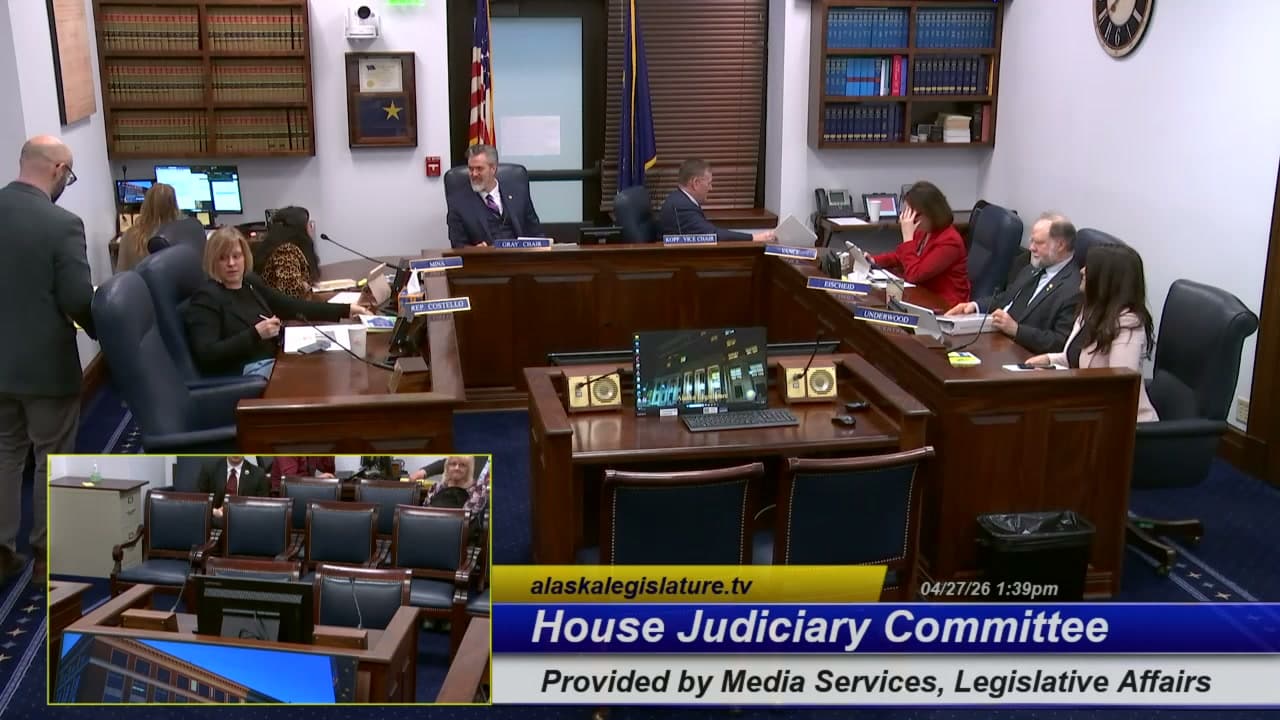
House Judiciary advances bill extending confidentiality to tribal advocates
The House Judiciary Committee advanced legislation Monday that would extend confidentiality protections to tribal domestic violence and sexual assault advocates by adding two words to Alaska statute.
House Bill 384 adds "or tribal" to the definition of a victim counseling center under AS 18.66.250. The change ensures that survivors who seek help from tribal advocates receive the same confidentiality protections as those served by nonprofit, government, or military organizations. The bill passed out of committee without objection after a hearing that drew testimony from tribal leaders and victim service providers across Alaska.
The House Tribal Affairs Committee voted to report the bill out on April 23. Representative Andrew Gray, who chairs the Judiciary Committee and sponsors the bill, said the change addresses a legal gap that has existed since the statute was drafted in 1992.
"Currently, a victim of domestic violence or sexual assault who seeks help from a victim counseling center run by a tribal government does not receive the same confidentiality protections that they would get from a victim counseling center run by any other entity," Gray said.
Alaska has 229 federally recognized tribes that now serve as frontline providers of victim services across the state, particularly in rural communities. Without statutory confidentiality protections, communications between tribal advocates and survivors can be subpoenaed and used in court proceedings.
Brenda Stanfield, executive director of the Alaska Network on Domestic Violence and Sexual Assault, said the lack of confidentiality creates a barrier to survivors seeking help. Her organization operates 24 established programs statewide but has increasingly partnered with tribal advocates who understand the specific safety planning needs of rural villages.
"One of the challenges though is that if someone knows that their information is not going to be held privileged, they're going to have a very hard time talking about a safety plan," Stanfield said.
She explained that survivors often hesitate to disclose details about sexual violence or other sensitive aspects of abuse if they fear those communications could later surface in protective order proceedings or criminal cases.
Rick Haskins Garcia, director of law, policy, and tribal justice with the Alaska Native Women's Resource Center, told the committee that tribal governments employ advocates doing identical work with identical survivors but are excluded from the statutory definition that covers private organizations, military programs, and local government agencies.
The bill requires no new appropriations, according to a fiscal note from the Department of Public Safety. It simply recognizes tribal governments as sovereign entities deserving equal legal standing under Alaska law.
Public testimony came from tribal leaders and advocates across the state. Tracy Charles Smith, president of Dot Lake Village, said her community operates a tribal sexual assault response team and victim advocacy program that in many cases provides the first and only place survivors can turn.
The committee heard that tribal advocates are often embedded in the communities they serve, making confidentiality essential. Survivors may know advocates personally or be related to them, and the fear that communications could be disclosed in court proceedings discourages many from seeking help.
The legislature last updated the confidentiality statute in 2013, when it extended protections to military organizations. Gray said tribal governments have since become essential frontline providers of victim services with expanded federal support, but current statutes do not reflect that role.
The bill now moves to the House floor. Gray authorized Legislative Legal Services to make any necessary technical and conforming changes to the legislation.
This article is based on a public meeting — Alaska Legislature: House Judiciary, 4/27/26, 1pm ().
AI-assisted. How we use AI Transcript byLucas Brown
Stay informed. Support what matters.
Free, permanent access to local news you can verify. Subscribe to support Alaska News and go ad-free.
Related Coverage
House panel advances tribal victim advocate confidentiality bill
Alaska News · 5mo ago
House panel hears bill to extend confidentiality to tribal victim advocates
Alaska News · 5mo ago
House panel advances domestic violence protective order extensions
Alaska News · 4mo ago
Senate Judiciary hears testimony on crime omnibus combining five bills
Alaska News · 5mo ago
Senate Finance advances public safety bill with parole board overhaul
Alaska News · 4mo ago
Comments
Sign in to leave a comment.
No comments yet. Be the first to share your thoughts.